 NexAIX-官方博客
In the second half of 2026, technical teams maintaining production GPT API calls are going through a period of intensive interface refactoring. According to OpenAI's official deprecation announcements, the platform will not only remove a batch of early GPT-5 and o3 snapshots on December 11, 2026, but also announced in October that it will officially shut down API access for gpt-4o, gpt-4o-mini, gpt-4.1, and gpt-4.1-mini on January 14, 2027 (leaving only about a 3-month migration window), and plans to retire gpt-5.1, gpt-5.3-codex, and other versions on April 1, 2027.
Meanwhile, the domestic AI API relay market is also undergoing a shakeout. Many gray-market relay stations that rely on personal account pools, reverse-engineered client protocols, or low-price adulteration have recently experienced frequent disconnections, account bans, and compliance shutdown risks. For teams migrating existing applications, teams building Agents, and technical leads responsible for production stability, the core issue is no longer just "changing the model name in the code," but how to use this migration to build a calling foundation that is channel-compliant, does not downgrade specifications, and can switch between closed-source flagship and open-source weight models at low cost.
This article combines the latest model lifecycle changes to outline a practical path for refactoring GPT API in production environments.
1. Three Real Pain Points of GPT API Migration in the Second Half of 2026
In the process of actually assisting development teams with migration, we found that projects that rely solely on a single legacy model or non-standard relay channels usually get stuck in the following three areas:
1. Cascading Failure of Hardcoded Legacy Snapshots and Fine-tuned Models
According to official rules, fine-tuned versions trained on deprecated base models will be shut down on the same day as the base model. If the business code couples the request URL, authentication logic, and specific legacy model snapshots across multiple microservices, every time a deprecation window of only 90 days comes around, the team has to repeatedly go through the passive firefighting cycle of "searching the entire repository for model names → changing parameters → re-integrating tool calling."
2. Cross-generation Differences in Context Windows and Billing Structures Between Old and New Models
When switching from legacy models with 128K windows to new-generation flagship models, context capacity, maximum output limits, chain-of-thought parameters, and latency characteristics for long prompts all change. If the access layer cannot transparently pass parameters such as max_tokens, temperature, top_p, or if the relay link secretly truncates context, long document parsing and complex JSON output in Agent workflows will frequently fail (see "What to Do When Large Model API Output Is Truncated: Check finish_reason First, Then Fix by Cause").
3. "Hidden Downgrades" and Audit Blind Spots of Account Pool Relays
Many teams, to solve overseas payment and network issues early on, connected to civilian relay stations with prices far below common sense. Such sites often operate by piecing together personal subscription account pools or reverse-engineering web protocols. They not only face upstream risk control bans at any time but also frequently secretly switch requests to low-cost small models during peak hours or inject hidden system prompts to compress output length. In enterprise compliance audits or data security investigations, such channels with no contracts, no invoices, and unclear data flows have become high-incidence areas for production incidents.
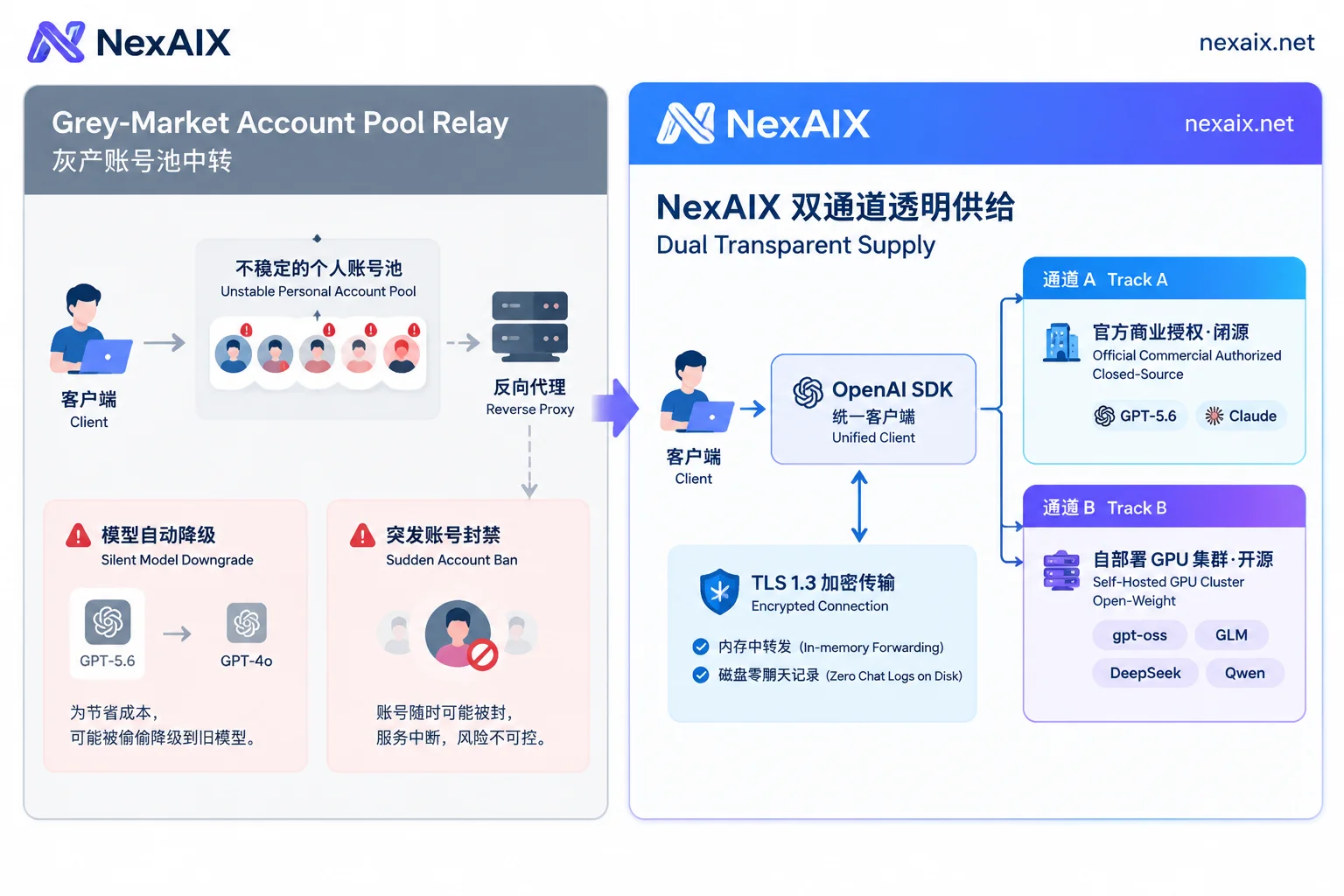
2. Refactoring Approach: Use a Unified OpenAI-Compatible Endpoint to Connect "Closed-Source Official Authorization + Open-Source Self-Owned Compute"
To avoid rewriting business code every time a model is retired or a channel fluctuates, a more robust approach is to connect applications to a standardized OpenAI-compatible endpoint and, under the same Key, split closed-source and open-source models by task complexity.
In the architecture design of NexAIX, we provide only two clear and verifiable supply methods (see "Transparent Supply and Self-Check Instructions" and the blog "What's the Difference Between Open-Source Weight Model APIs and Official Authorized Channels"):
- Official Authorized Channels (Closed-Source Models): For closed-source series such as GPT-5.6, Claude, Grok, and Gemini, all go through the vendor's official commercial authorization channels, with a legal entity, contracts, invoices, and auditability. We never use personal account pools, nor reverse-engineer client protocols. Suitable for core reasoning, complex multi-step tool calling, or online links highly dependent on the behavior of the original GPT models.
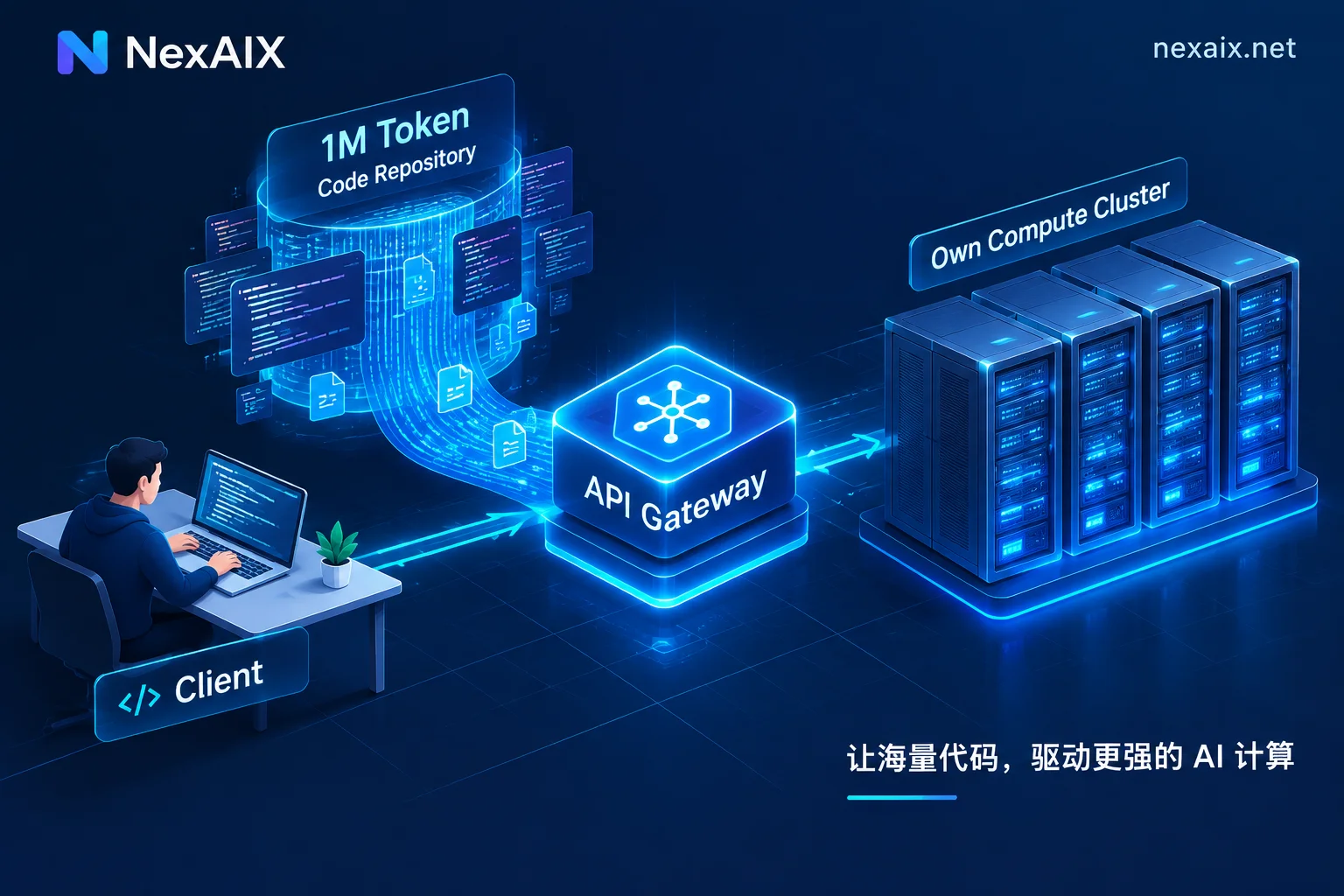
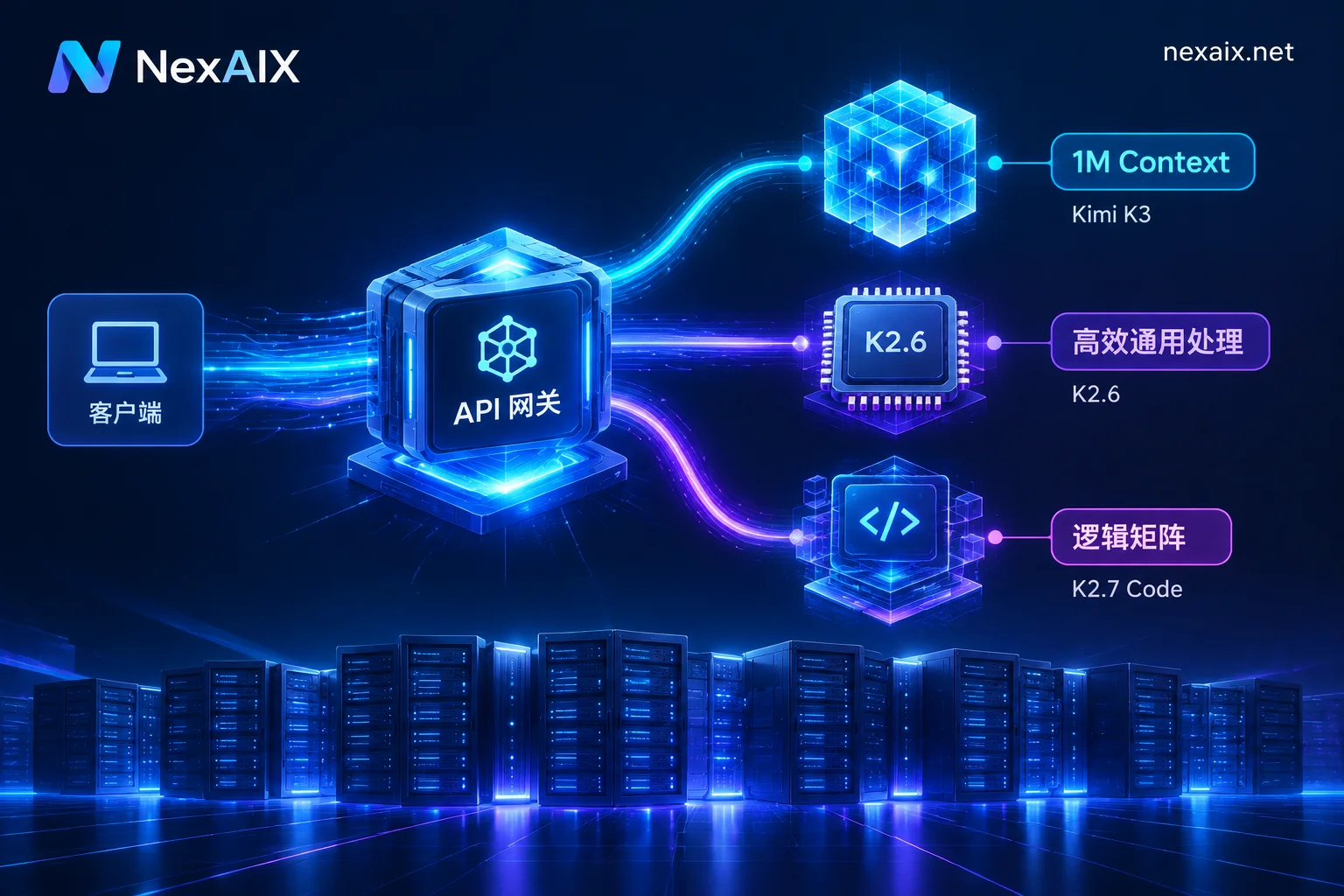
- Self-Owned Compute Deployment (Open-Source Weight Models): For officially released open-source weight models such as gpt-oss, GLM, DeepSeek, Kimi, MiniMax, and Qwen, we deploy directly on NexAIX's self-built and leased GPU clusters in our own data centers, with self-managed operations, and do not resell third-party quotas. Each model page clearly indicates the context window, maximum output, inference precision (e.g., BF16, FP8, MXFP4), and open-source license. Very suitable for replacing original
gpt-4o-minior for high-frequency batch processing, classification extraction, code pre-screening, and other tasks sensitive to cost and controllability (for tuninggpt-oss, see "gpt-oss-120b API Integration Guide: Selection Judgment, reasoning_effort Adjustment, and Downgrade Verification").
Selection Tip: For specific specifications, prices, context, and input modalities of models on sale, please refer to the real-time page of the NexAIX Model Marketplace. When viewing a single model's detail page, theslugin the URL requires replacing the dot (.) in the model ID with a hyphen (-), for example visitinghttps://nexaix.net/models/glm-5-2/, but in the API request body'smodelfield, still fill in the original model ID (e.g.,glm-5.2). If you need open-source weight models not in the list, you can send the model and estimated usage to [email protected], and we will reply with scheduling after evaluating compute.
3. Three Steps to Smoothly Migrate GPT API in Production
For teams already using the OpenAI SDK or mainstream orchestration frameworks in their projects, migrating to NexAIX does not require changing the conversation assembly logic; just follow these three steps to replace and refactor (for more language details, see "What Code Changes Are Needed When Switching Large Model APIs: Three Must-Change Configurations Plus Four Types of Parameter Compatibility Checks").
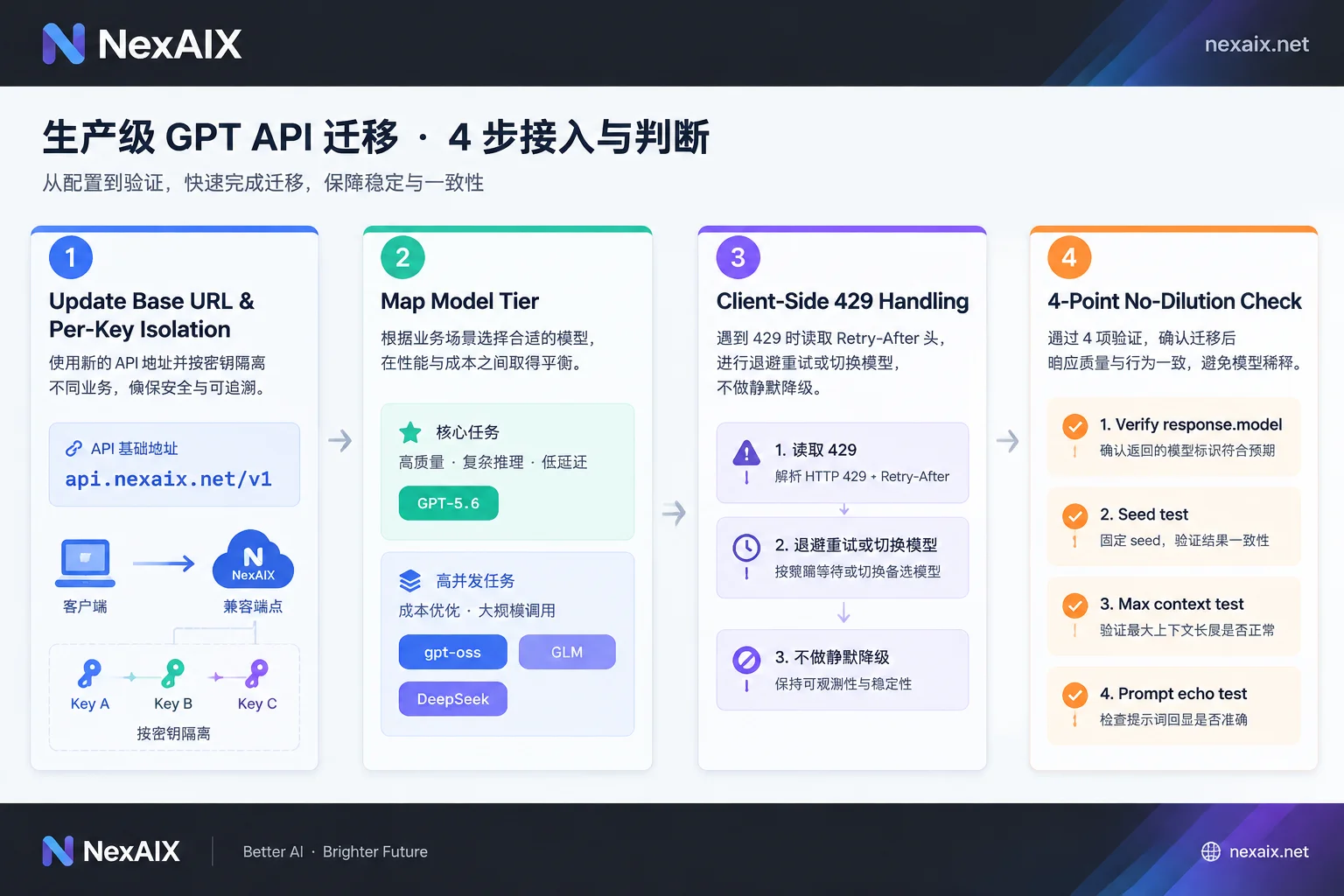
Step 1: Replace base_url and Isolate API Keys by Environment
Log in to the NexAIX Console (supports direct registration with email, free test quota upon registration, no enterprise qualification required) to obtain an API Key. Point the client's base_url uniformly to https://api.nexaix.net/v1.
In production environments, it is recommended to create multiple Keys by business line or environment (development, staging, production). NexAIX supports Key-based isolation: each Key has independent quota, independent permissions, and independent usage billing by model; if a Key is leaked, it can be revoked separately without affecting other services (see "How to Obtain, Store, and Distribute AI API Keys").
The following is a Python OpenAI SDK integration example; you only need to modify the model field to switch between closed-source GPT-5.6 and open-source weight models:
import os
from openai import OpenAI, RateLimitError
import time

client = OpenAI(
    api_key=os.environ.get("NEXAIX_API_KEY"),
    base_url="https://api.nexaix.net/v1"
)

def call_chat_model(messages, model_id="gpt-5.6"):
    response = client.chat.completions.create(
        model=model_id,  # 切模型只改此字段,具体可用 ID 以 https://nexaix.net/models/ 为准
        messages=messages,
        temperature=0.2,
        max_tokens=2048,
        stream=False
    )
    # 每次调用均可记录 id 以便排障,并核对实际执行的 model 字段
    print(f"Request ID: {response.id} | Executed Model: {response.model}")
    return response.choices[0].message.content
In addition to the official SDK, any framework and client that supports custom OpenAI base_url—including LangChain, LlamaIndex, Vercel AI SDK, Dify, Cherry Studio, NextChat, Cline, and OneAPI—can be directly integrated.
Step 2: Verify Multimodal and Tool Calling Formats
NexAIX strictly implements the OpenAI Chat Completions specification, supporting streaming, function/tool calling, and multi-turn conversations. If the original GPT-4o pipeline included visual input:
- First check on the corresponding model page whether "input modalities" support images or video;
- Images are passed in
image_urlorbase64in the OpenAI multimodal standard format; - Video input is passed as a sequence of frames after frame extraction.
Note: For support of interface formats other than Chat Completions (such as Responses, Anthropic Messages, etc.), please refer to the latest official documentation; for a side-by-side evaluation between GPT and Claude, see "Claude vs GPT API Comparison: Protocol Differences, Caching Mechanisms, and Migration Costs".
Step 3: Explicitly Handle 429 Rate Limiting and Fallback Strategies on the Client Side
This is the most easily overlooked point in production-grade migration. To ensure determinism of calls, NexAIX does not perform implicit automatic routing or silent failover—when the self-owned cluster hosting open-source models is saturated, or closed-source models hit upstream quota limits, or the RPM/TPM/concurrency limit of a single Key is reached, the server will directly return a standard HTTP 429 status code with a Retry-After response header, and will never hang the connection indefinitely, nor arbitrarily downgrade the request to a cheaper model (see "High Throughput and Rate Limiting Mechanisms").
Therefore, when migrating legacy GPT APIs, you should read Retry-After in your business code and let the application layer decide whether to back off and retry, enter a queue, or explicitly switch to an alternative model (for example, switching non-core requests from closed-source models to gpt-oss or glm-5.2 on self-owned compute). For troubleshooting, simply contact the support team with the request ID returned by each call for quick localization (for error code handling, see "How to Read AI API Error Codes: Causes, Retries, and Fallbacks for 400, 401, 404, 429, 5xx, and 529"). If your business requires higher RPM, TPM, or concurrency quotas, you can also submit a request directly, and we will respond based on actual capacity.
4. Must-Do Before Launch: Four-Step Self-Check Against Downgrades and Data Compliance Confirmation
After switching traffic, how do you confirm that the new endpoint returns the full, original model rather than a truncated or shell-swapped interface? We recommend that technical leads run through the NexAIX No-Downgrade Self-Check List in the staging environment (for practical details, read "How to Confirm Whether the API Returns the Original Model: Four Verifiable Inspection Methods"):
- Check the
modelfield in the response body: NexAIX guarantees that themodelfield in the response body is the model that actually performed inference, without swapping to a smaller model or downgrading precision. - Retest with fixed Prompt and random seed: Compare output distributions under the same
temperatureandtop_pto verify whether sampling parameters are passed through as-is. - Length stress test near the limit: Construct input and
max_tokensrequests close to the context limit stated on the model page, and confirm there is no implicit truncation (also note: the first-token latency and cost for very long inputs will naturally increase with input length). - System prompt integrity self-check: Ask the model to repeat the entire message structure it received to verify that no hidden system prompts are injected in the intermediate layer.
Boundary Clarification on Conversation Privacy and Upstream Data Retention
At the data compliance level, we fully disclose the boundary between our site's side and the closed-source upstream vendor's side (see "Zero Logging and Privacy Protection"):
- NexAIX Gateway Side: TLS 1.3 encryption is used throughout from client to inference node;
promptandcompletionare forwarded only in memory and released after the request ends, not written to disk, not logged as conversation content, not used for training, nor shared with third parties that do training; the system only retains metadata for billing and troubleshooting (request ID, model name, token count, timestamp, status code). - Closed-Source Model Upstream Side: After requests for closed-source models reach the vendor, data retention is governed by each vendor's commercial terms. Policies vary, and our site cannot make commitments on their behalf (currently, the official website only separately notes upstream retention on two Claude model pages: Opus 5 supports zero data retention, Fable 5 currently has 30-day retention; for other models, please refer to vendor terms and official website annotations).
- Enterprise Compliance Requirements: If your team has strict compliance audit requirements in finance, healthcare, or government/enterprise scenarios, NexAIX has a formal legal entity, supports contract signing, invoicing, and can sign service agreements and data processing agreements; for scenarios requiring zero external retention, we recommend prioritizing open-source weight models deployed on self-owned GPU clusters, or emailing [email protected] to discuss dedicated resource pools and private deployment solutions.
Conclusion
The phased retirement of legacy GPT models is essentially forcing development teams to upgrade from the fragile calling approach of "hardcoding a single model" to a production-grade architecture with standardized protocols, multi-model layering, and auditable channels. You can now go to the NexAIX Console to register and receive test quota, switch base_url to https://api.nexaix.net/v1, and complete benchmark testing and smooth migration of GPT-5.6 officially authorized models and open-source weight models such as gpt-oss within the same codebase.


Comments(0)