 NexAIX-官方博客
Recently, the iteration density in the open-source LLM community has peaked again: from DeepSeek, Qwen, GLM, Kimi, MiniMax to the gpt-oss series, and to the newly released overseas 800B-level ultra-large-scale MoE (Mixture of Experts) open-weight models, open-source solutions' scores on SWE-bench code repair, long document parsing, and complex Agent tool calling have compressed the gap with top closed-source models to within a few percentage points.
Performance parity combined with a significant drop in cost per million tokens has led more engineering teams to change strategy: instead of throwing all requests to expensive closed-source flagships, they shift high-concurrency daily tasks, code generation, and internal knowledge base workflows to open-source LLM APIs, calling closed-source models only for extremely difficult edge cases.
But when actually integrating open-source models into production, technical leads often face a dilemma: since model weights are public, should they pull the weights and build their own inference cluster, or directly purchase ready-made open-source LLM APIs? API providers' quotes vary by several times, and what exactly differs in compute supply, inference precision, and data privacy behind them?
This article does not discuss benchmark rankings; instead, it helps you calculate the costs of self-hosting vs. API calls from an engineering implementation perspective and provides an actionable checklist for production selection and verification of open-source LLM APIs.
1. Free weights do not mean cheap self-hosted inference
Many teams first consider "deploying open-source models themselves" because they see model weights publicly downloadable under permissive open-source licenses and think that with a few GPUs they can run unlimited free tokens.
This is entirely true for local validation with small-parameter models; but once put into production to run flagship open-source models, the hidden bills of hardware and operations quickly surface:
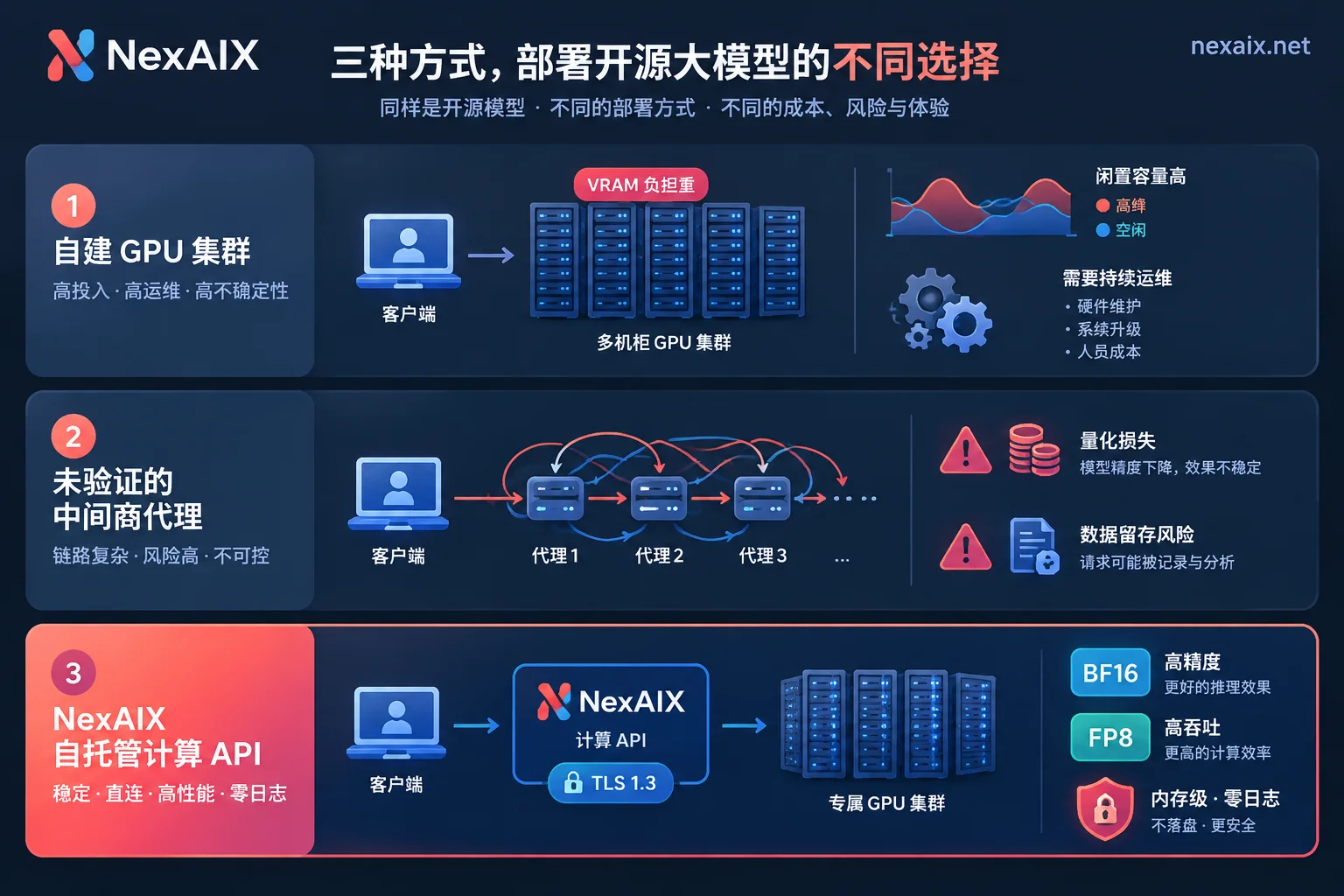
- VRAM wall and hardware infrastructure threshold: The main open-source models capable of replacing closed-source flagships today generally have total parameters in the tens to hundreds of billions (e.g., large MoE architectures). Even with quantized versions, loading a single instance often requires hundreds of GB or even TBs of high-bandwidth VRAM, necessitating multi-machine, multi-GPU high-speed interconnect clusters.
- Idle compute during peaks and valleys: Business traffic naturally has diurnal and weekday peaks and valleys. Self-built clusters must be sized for peak concurrency plus safety redundancy, meaning expensive GPU compute sits idle during off-peak hours.
- Ongoing engineering manpower for tuning: Getting vLLM or SGLang running is just the first step. KV Cache memory management for long contexts, multimodal frame extraction and concurrent scheduling, hot-standby replacement during node failures, and model version iterations almost weekly in the open-source community all require dedicated inference system engineers for long-term monitoring.
Therefore, except for organizations with extremely large stable daily active users or strict physical isolation requirements mandating local deployment, most R&D teams and enterprises directly access high-spec open-source LLM APIs in production, with a total cost of ownership (TCO) far lower than self-hosting and maintenance.
2. Four hidden pitfalls when choosing open-source LLM APIs
Since you decide to call APIs, why do the same open-source models on different platforms have vastly different call experiences and generation quality? When helping migration teams troubleshoot online failures, we found problems usually concentrate in the following four areas:
1. Multi-layer resale of "second-hand quotas" and fragile links
Many lightweight aggregation platforms do not have their own GPU clusters; instead, they purchase cheap quotas from upstream platforms or piece together free trial packages from various providers for secondary resale. This model not only adds a layer of network forwarding latency but also, when upstream risk controls tighten or promotions end, downstream businesses suddenly encounter large-scale errors or forced interruptions.
2. Secretly reducing inference precision (over-quantization)
The same model ID (e.g., also called glm-5.2 or deepseek series) may run in VRAM as BF16, FP8, or aggressive low-bit quantization, with hardware costs differing by several times. Some low-price channels, to pack more concurrency onto a single GPU, use over-quantized weights without informing users, directly causing "dumbing down" and skyrocketing hallucination rates when writing complex code or following multi-step JSON format instructions.
(Further reading: What's the difference between BF16 and FP8 inference precision: VRAM, speed, quality, and selection)
3. Implicit context truncation and swapping in smaller models
When you pass hundreds of thousands of tokens of codebase or long documents to the model, the Prefill stage consumes significant compute. Some opaque gateways silently truncate the middle context in the background, or during peak hours secretly route requests to lightweight Flash/Lite models of the same series; the frontend sees a successful call, but the actual output quality is greatly reduced.
4. Trading low price for conversation data retention
Why can some channels offer open-source LLM APIs at prices far below hardware electricity costs? Public industry analysis has long pointed out that some low-price endpoints retain user Prompt and Completion data by default for subsequent model training or business analysis. For teams handling core enterprise code, internal documents, or customer privacy data, this "trading business data for cheap tokens" approach harbors serious compliance risks.
3. Five selection criteria for production-grade open-source LLM APIs
To safely put open-source LLMs into core workflows, when selecting, do not just compare fractions of a cent per million tokens; verify providers against the following five hard indicators (these are also the standards by which NexAIX builds open-source model infrastructure):
Criterion 1: Supply method—must be "proprietary compute deployment"
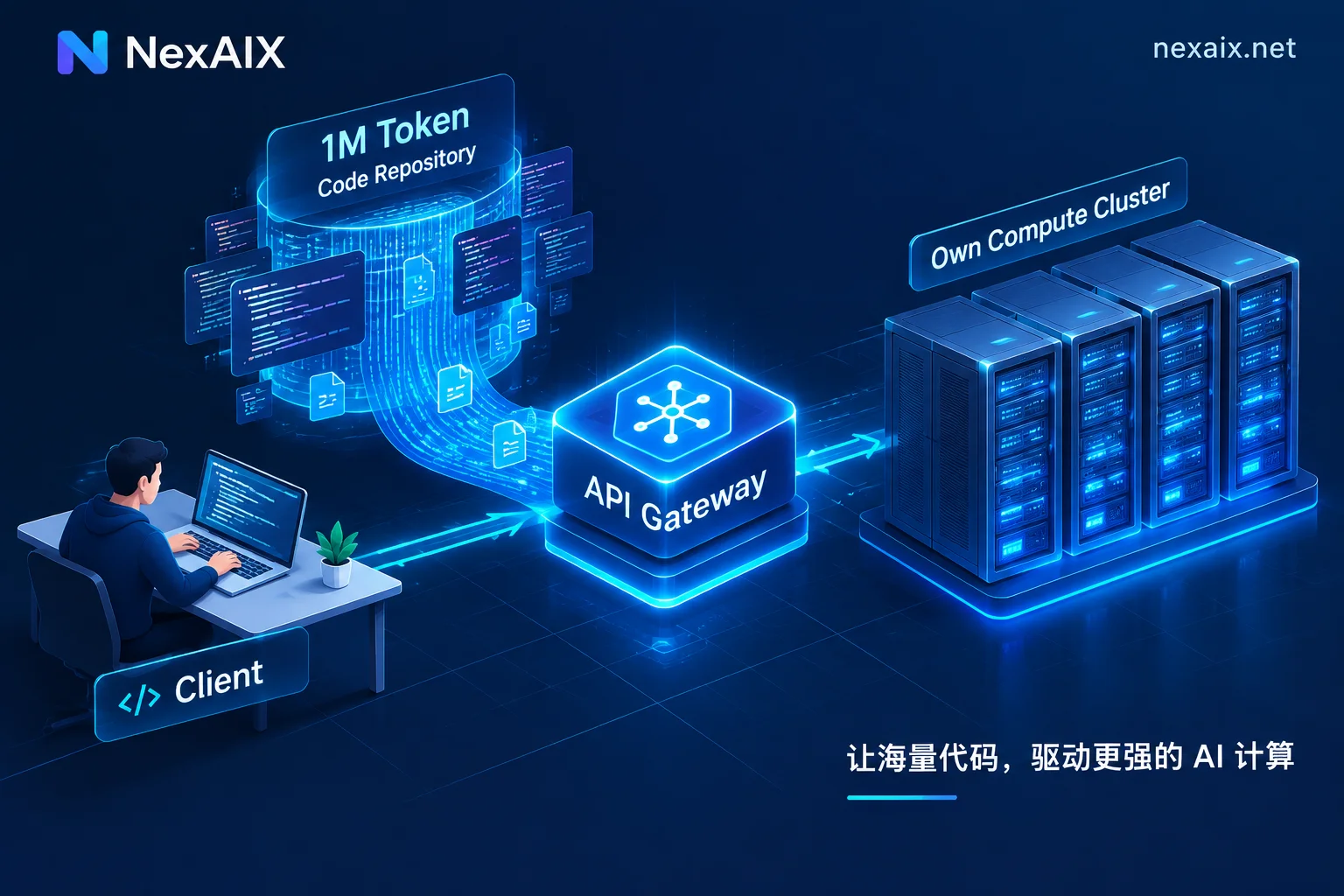
A reliable open-source LLM API should directly connect to hardware controlled by the provider. At NexAIX, all open-weight models (currently covering major series such as Kimi, GLM, DeepSeek, MiniMax, Qwen, gpt-oss) use proprietary compute deployment: we deploy officially released open weights directly on our own GPU clusters in self-built and leased data centers, operated directly by our own engineering team, never reselling third-party quotas.
Because compute is in our hands, capacity planning, node scaling, and inference engine parameters are all controllable. If you need to compare the underlying differences between open-source and closed-source supply, refer to our previous analysis: What's the difference between open-weight model APIs and official licensed channels: precision, context, retention, and rate limiting.
Criterion 2: Specification transparency—precision, window, and license clearly stated
Do not accept "black box" specifications. On each individual model page in the NexAIX model list, we mandatorily label the required supply method tag and publicly disclose the model's inference precision (e.g., BF16, FP8, MXFP4, etc., truthfully labeled according to actual deployment), maximum context window, maximum output length, input modalities, and open-source license agreement.
At the same time, we adhere to the no-downgrade principle: the model field in the response is the model that actually performed inference; no swapping to smaller models, no precision reduction, no truncation of context and max output, no injection of hidden system prompts; your temperature, top_p, max_tokens are passed through to the inference engine as-is. You can always use our compiled four reviewable verification methods to stress-test and verify the online interface.
Criterion 3: Data boundary—in-memory forwarding and zero log persistence
A major reason for using open-source models is to control data security. NexAIX enforces a strict no conversation logging policy on the gateway and proprietary inference nodes:
- Your Prompt and model-generated Completion are forwarded only in memory and released immediately after the request ends, never written to disk;
- The system retains only metadata for reconciliation and troubleshooting (request ID, model name, token count, timestamp, status code);
- User data is never used for any model training, nor handed over to third parties for training;
- End-to-end TLS 1.3 encrypted transmission from client to inference node.
(For how to cooperate on the client side for privacy protection, see: How to verify whether an AI API logs conversations: what can be checked, what cannot, and how to prevent)
Criterion 4: Concurrency and rate-limiting behavior—explicit 429 when full, no hanging or tampering
In production, the biggest fear is requests hanging indefinitely during peak hours (exhausting the caller's connection pool) or being arbitrarily downgraded by the platform to cheaper models. Under NexAIX's high-throughput architecture:
- All models natively support streaming output (Streaming);
- Each API Key has explicit RPM, TPM, and concurrency limits (if business growth requires higher quotas, you can directly contact us to evaluate an increase based on actual cluster capacity);
- When sudden traffic triggers rate limiting or cluster saturation, the gateway immediately returns standard HTTP
429 Too Many RequestswithRetry-Afterresponse headers, fully returning the decision to back off, retry, or switch to an alternative model to your business code.
Criterion 5: Long-tail expansion and enterprise compliance support
The open-source community is diverse; if your business eyes a vertical open-weight model outside the list, at NexAIX you don't need to buy GPUs and build it yourself—you can directly email [email protected] with the model name and estimated usage requirements, and we will reply with an onboarding schedule after evaluating cluster compute.
Additionally, for teams and enterprise customers, we have complete legal entity qualifications, can sign contracts, issue invoices, and support signing Service Level Agreements (SLA) and Data Processing Agreements (DPA); for scenarios with strong regulatory compliance requirements, we can also discuss dedicated resource pools or private deployment solutions.
4. Architecture in practice: one endpoint for "open-source primary + closed-source fallback"
In actual engineering, the truly efficient architecture is often not "all open-source" or "all closed-source" but hybrid calls:
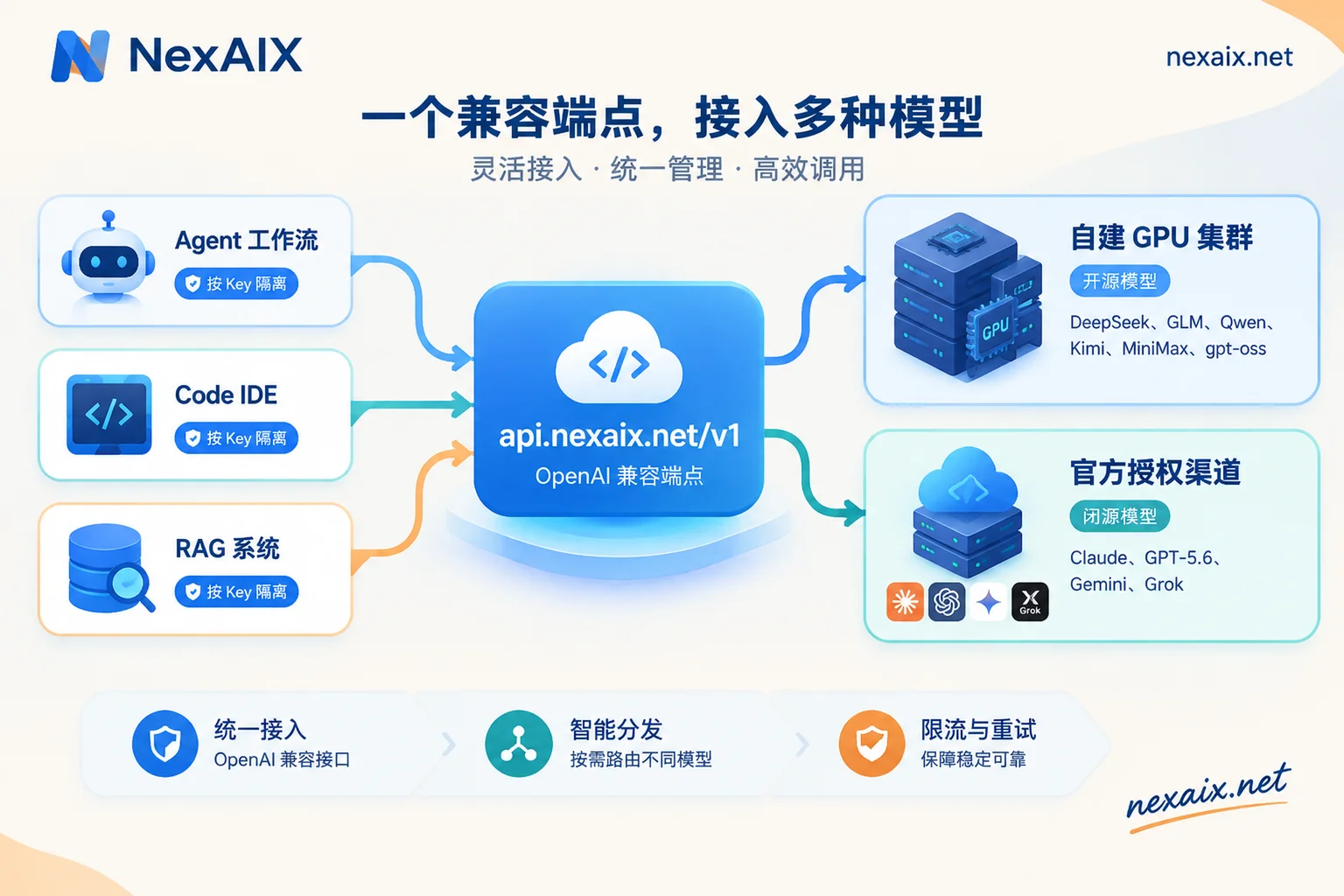
- Use open-weight models like DeepSeek, GLM, Qwen, Kimi deployed on proprietary compute to handle 80% of code generation, long-text summarization, multi-turn customer service, and routine Agent planning;
- Use closed-source models like Claude, GPT-5.6, Gemini, Grok via vendors' official licensed channels (with contracts, invoices, no account pools, no reverse-engineered protocols) to handle 20% of extremely complex reasoning or cross-modal review tasks.
If you integrate seven or eight vendors' native SDKs separately, maintaining different authentication logic, error codes, and scattered bills would be a nightmare for engineering teams. At NexAIX, you only need to connect to one standard OpenAI-compatible endpoint (https://api.nexaix.net/v1) and use a single Key to access all the above open-source and closed-source models.
Integration and model switching example
Existing OpenAI SDK, LangChain, LlamaIndex, Vercel AI SDK, or tools like Dify, Cherry Studio, Cline, NextChat, OneAPI only need to change base_url and api_key for seamless integration:
from openai import OpenAI

client = OpenAI(
    base_url="https://api.nexaix.net/v1",
    api_key=" NEXAIX_API_KEY "  # 在 api.nexaix.net 控制台获取
)

# 场景 A:日常高并发长文本与代码任务,调用自有算力部署的开源权重模型
# 切换不同开源模型(如 glm-5.2、kimi、deepseek、qwen 等)只需改 model 字段
response_open = client.chat.completions.create(
    model="glm-5.2",
    messages=[
        {"role": "system", "content": "你是一个资深后端架构师,请审查以下代码片段的并发隐患。"},
        {"role": "user", "content": "...代码内容..."}
    ],
    temperature=0.2,
    stream=True
)

for chunk in response_open:
    if chunk.choices[0].delta.content:
        print(chunk.choices[0].delta.content, end="")
💡 Tip for viewing model documentation:
When visiting a single model detail page to check context specifications and three-step integration code, theslugin the URL requires replacing the English dot (.) in the model ID with a hyphen (-). For example, to view the specification page forglm-5.2, visithttps://nexaix.net/models/glm-5-2/(directly concatenating/models/glm-5.2/returns 404); but in the JSON body of actual API requests, themodelfield is still filled with"glm-5.2"as-is.
Per-Key isolation and fine-grained reconciliation
When a team runs multiple open-source and closed-source models simultaneously, cost attribution is especially critical. NexAIX supports creating multiple API Keys, each with independent quotas, permissions, and usage bills. You can issue different Keys for "R&D test environment," "online Agent service A," and "internal knowledge base B":
- If a Key is compromised, it can be revoked separately at any time without affecting other business lines;
- The console automatically itemizes bills by Key and by model, supporting one-click export of usage details;
- Each API call returns a unique request ID; if an online anomaly occurs, contact technical support with the request ID to quickly locate the link status.
(For best practices on key separation and environment isolation, see: How to get, store, and distribute AI API Keys: integration and isolation from local development to production)
5. Summary and quick start
The rise of open-weight models gives developers the confidence to break single-vendor lock-in and significantly reduce token costs. But to truly enjoy the benefits of open-source models in production, the underlying infrastructure must achieve controllable compute, transparent precision, zero log retention, and standard interfaces.
If you are evaluating open-source LLM APIs or planning to migrate existing hybrid model calls to a more transparent and stable production-grade gateway, you can now spend two minutes to verify:
- Browse the NexAIX model marketplace to view detailed precision and window specifications of currently available proprietary compute open-source models such as Kimi, GLM, DeepSeek, MiniMax, Qwen, gpt-oss, and officially licensed closed-source models;
- Learn about our technical implementation and self-check methods for channel transparency and the no-downgrade commitment;
- Go to the NexAIX console to register directly with your email (no cumbersome enterprise qualification review, test credits upon registration), replace one line of
base_url, and personally test the original precision and streaming throughput experience with real business Prompts.


Comments(0)