 NexAIX-官方博客
With the successive release and open-sourcing of GLM-5.2 and GLM-5.3 by Zhipu AI, the positioning of the GLM series in the open-source large model camp has fully shifted from the early "cost-effective general conversation" to Long-Horizon Agent and Complex Software Engineering (Agentic Coding). In particular, after the implementation of the 744B-level MoE architecture combined with the IndexShare sparse attention mechanism, the truly engineering-usable 1M (1 million) Token context and 128K maximum output have made it common to directly stuff entire code repositories into the context and continuously execute dozens of tool calls.
However, when integrating GLM models into production environments, Cline, or self-developed Agent pipelines, many development teams encounter a series of engineering-level frictions: subscription-based Coding Plans have limitations such as binding to specified clients, 5-hour dynamic credit caps, peak-hour multiplier increases, and automatic redirection of historical models; while if you plan to use open-source weights to build your own vLLM or SGLang, the hardware threshold of often needing 8 H100/H200 GPUs (over 640GB VRAM) under FP8 precision discourages small and medium teams.
This article outlines the technical generations and applicable scenarios of current GLM core models, dismantles four common engineering pitfalls in calling GLM API in production environments, and provides a standard OpenAI-compatible integration and verification solution based on NexAIX's self-owned compute cluster.
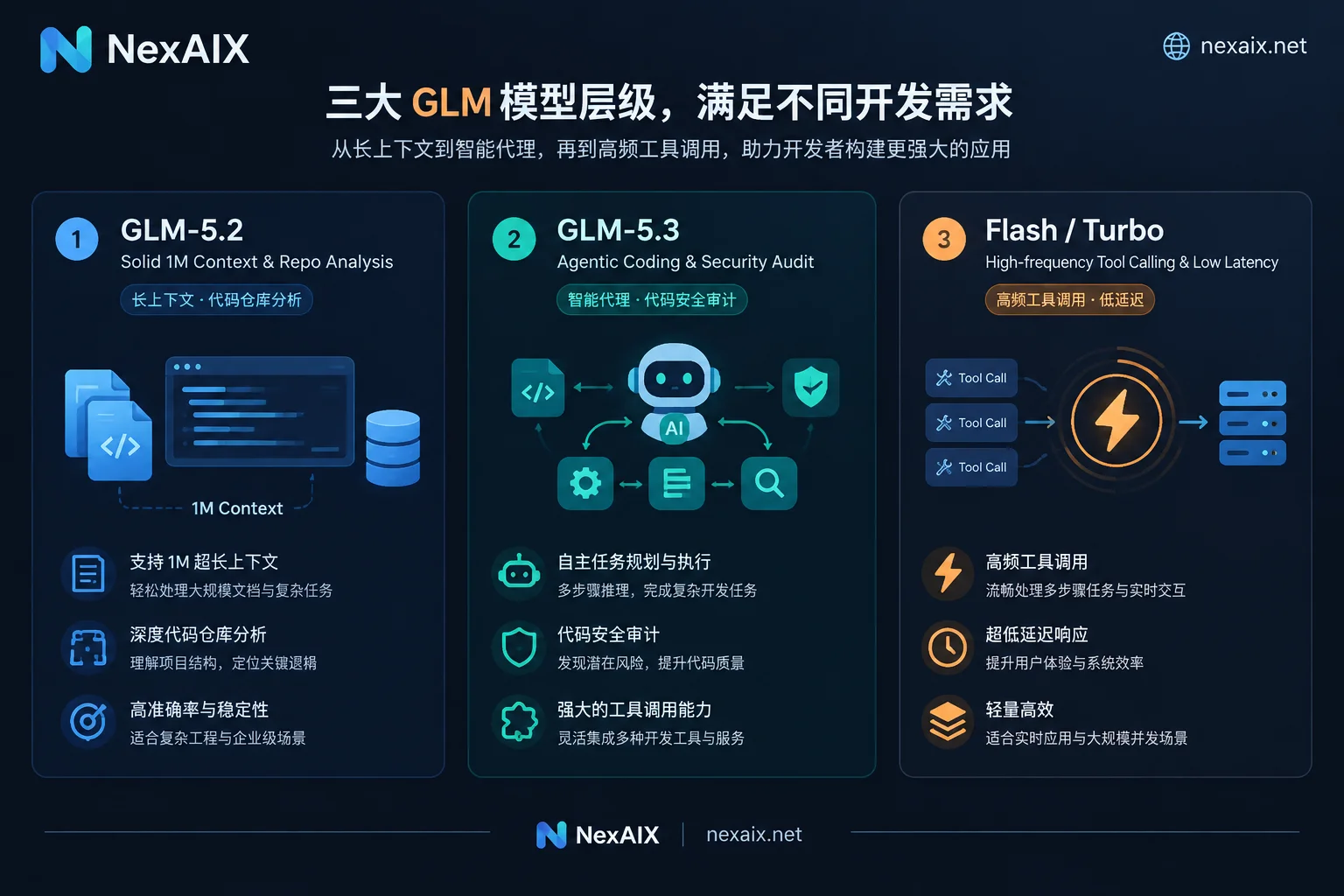
I. How to Choose Among GLM-5.2, GLM-5.3, and Flash/Turbo?
After multiple rounds of iteration in the GLM-5 family, different sub-models have shown significant gaps in post-training weights, context depth, and tool-calling tendencies. Before integrating the API, it is recommended to first determine the base model according to business load:
| Model Series | Core Architecture and Specification Reference | Capability Focus | Typical Production Scenarios |
|---|---|---|---|
| GLM-5.2 | 744B-level MoE (approx. 40B activated), 1M context, MIT open-source license | The first version to achieve Solid 1M lossless context and long-horizon software engineering environments, with stable cross-file refactoring and long document recall | Full repository code analysis, automated research report generation, production-grade Agent with fixed version baseline |
| GLM-5.3 | Same base as 5.2, strengthened asynchronous agent RL post-training, 1M context | Significant leap in complex Coding and Terminal Bench, with outstanding white-box code audit and vulnerability discovery capabilities | Multi-step autonomous debugging (SWE tasks), DevSecOps automated code security review, complex system architecture generation |
| Flash / Turbo Branch | Lightweight activation or optimization for specific long-chain scheduling | Sacrifices some extreme deep reasoning for higher throughput and lower first-token latency (TTFT), strengthens high-frequency MCP/tool calls | GUI Agent real-time interaction, high-frequency multi-agent collaborative division of labor, structured data cleaning and high-concurrency customer service |
Version Verification Tip: For specific model versions, inference precision (e.g., BF16, FP8), context limits, and pricing that go online at different times, please visit the NexAIX Model Plaza for real-time annotations. For example, forglm-5.2, you can check the complete publisher, license agreement, input modalities, and parameter specifications on the GLM-5.2 Model Detail Page (Note: When browsing a single model webpage, the URL slug requires replacing dots in the model ID with hyphens, i.e.,/models/glm-5-2/; while when making API requests in code, themodelfield still usesglm-5.2). If the specific open-source weight version your team needs is not yet listed, you can email the model and estimated usage to [email protected], and we will reply with scheduling after evaluating compute.
II. Four Common Pain Points in Engineering Implementation of GLM API
During research or initial trial, many developers first encounter various "monthly programming packages" or low-price aggregation channels. However, once the business is pushed to automated pipelines or shared by multiple team members, the following four problems often erupt intensively:
1. Tool Lock-in and Peak-Hour Soft Rate Limiting of Subscription Packages
Some subscription packages for individual developers (e.g., Coding Plan) are only effective within whitelisted clients and cannot be used as a general backend API for self-developed services; meanwhile, there are dual credit pool caps every 5 hours and every week, and different deduction coefficients or secondary scheduling queues are triggered during peak hours 14:00–18:00 on weekdays. For online businesses requiring predictable latency, such non-standard rate limiting is extremely difficult to handle fault-tolerantly at the code level.
2. Historical Models Being "Silently Upgraded" Causing Prompt Drift
Under some package rules, when the client requests glm-5.2 or glm-5.1, the gateway will forcefully redirect it to a newer model in the background (or forcibly switch the old Turbo to the new Flash). Although the new model scores higher on public benchmarks, in strict production environments, silent replacement of the underlying model can easily break existing regex parsing, JSON structured extraction, or adherence to specific System Prompts.
3. "Quantization Shrinkage" and Context Truncation in Low-Price Resale Channels
Because loading the full 744B-level MoE model requires enormous VRAM overhead, some relay services on the market that rely on carpooling or secondary resale privately use over-quantized versions or hard-truncate the 1M context window to 64K/128K on the server side to pack more concurrency on limited GPUs. This is reflected on the business side as the Agent suddenly "forgetting" after the 10th round, losing the architectural constraints at the beginning, or frequent unexpected truncations (refer to our previous article on troubleshooting methods for large model API output truncation).
4. SDK and Billing Fragmentation in Multi-Model Hybrid Orchestration
In real Agent architectures, few teams use only a single model: typically GLM-5.2/5.3 is used for heavy code repository understanding and long-text analysis, while Claude Opus 5 or GPT-5.6 is used for cross-validation, or Qwen and DeepSeek for classification routing. If each model requires maintaining a separate SDK, authentication logic, and recharge invoices, the maintenance cost of the infrastructure will rise exponentially.
III. NexAIX's Supply Solution: Self-Owned Compute Deployment and Transparent Boundaries
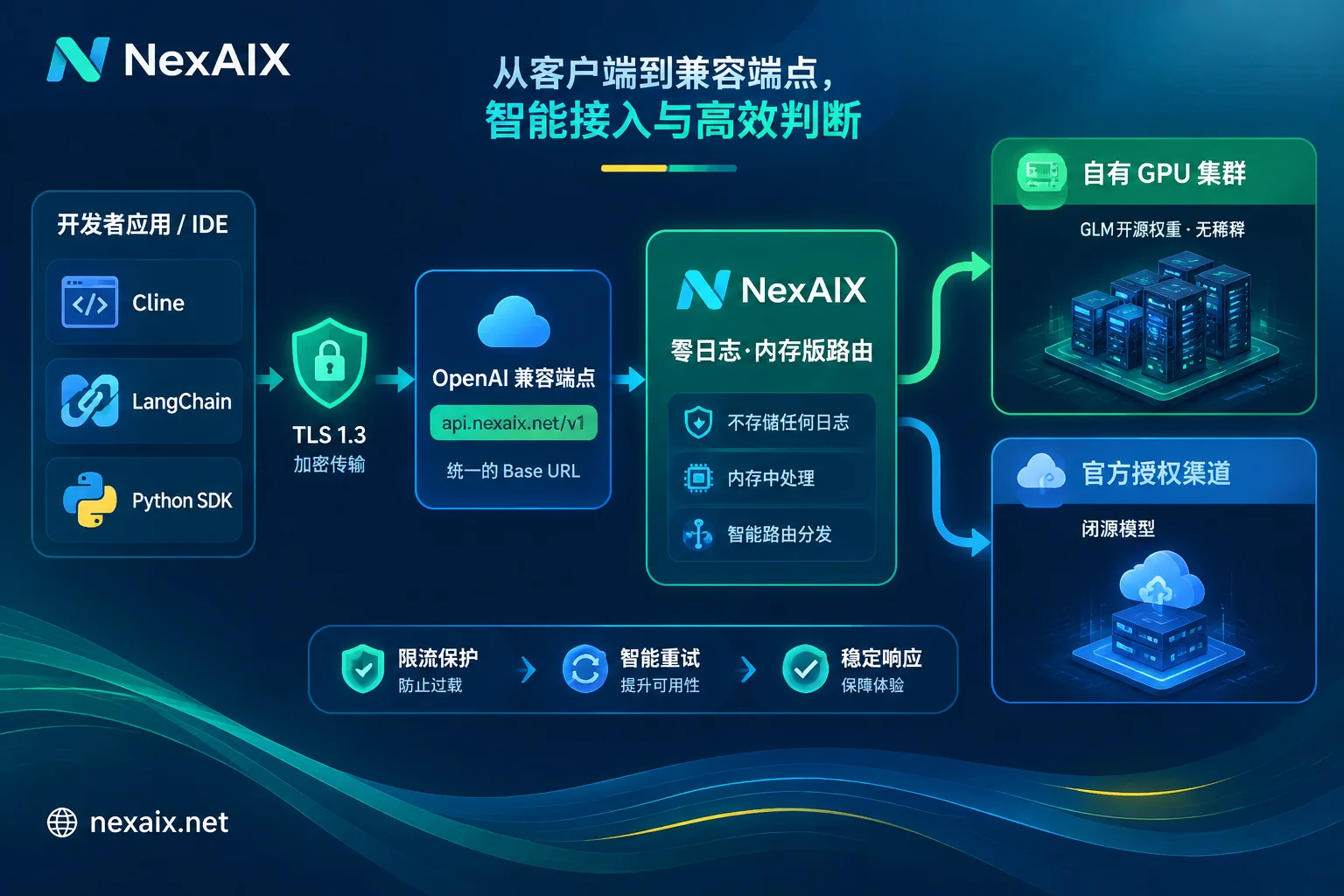
In response to the above engineering pain points, NexAIX's design logic is very straightforward: only provide clear compute supply and a standardized OpenAI-compatible gateway (for a detailed comparison of open-source and closed-source supply models, you can read What is the difference between open-source weight model API and official authorized channels).
- Self-Owned Compute Deployment (for open-source weight models like GLM)
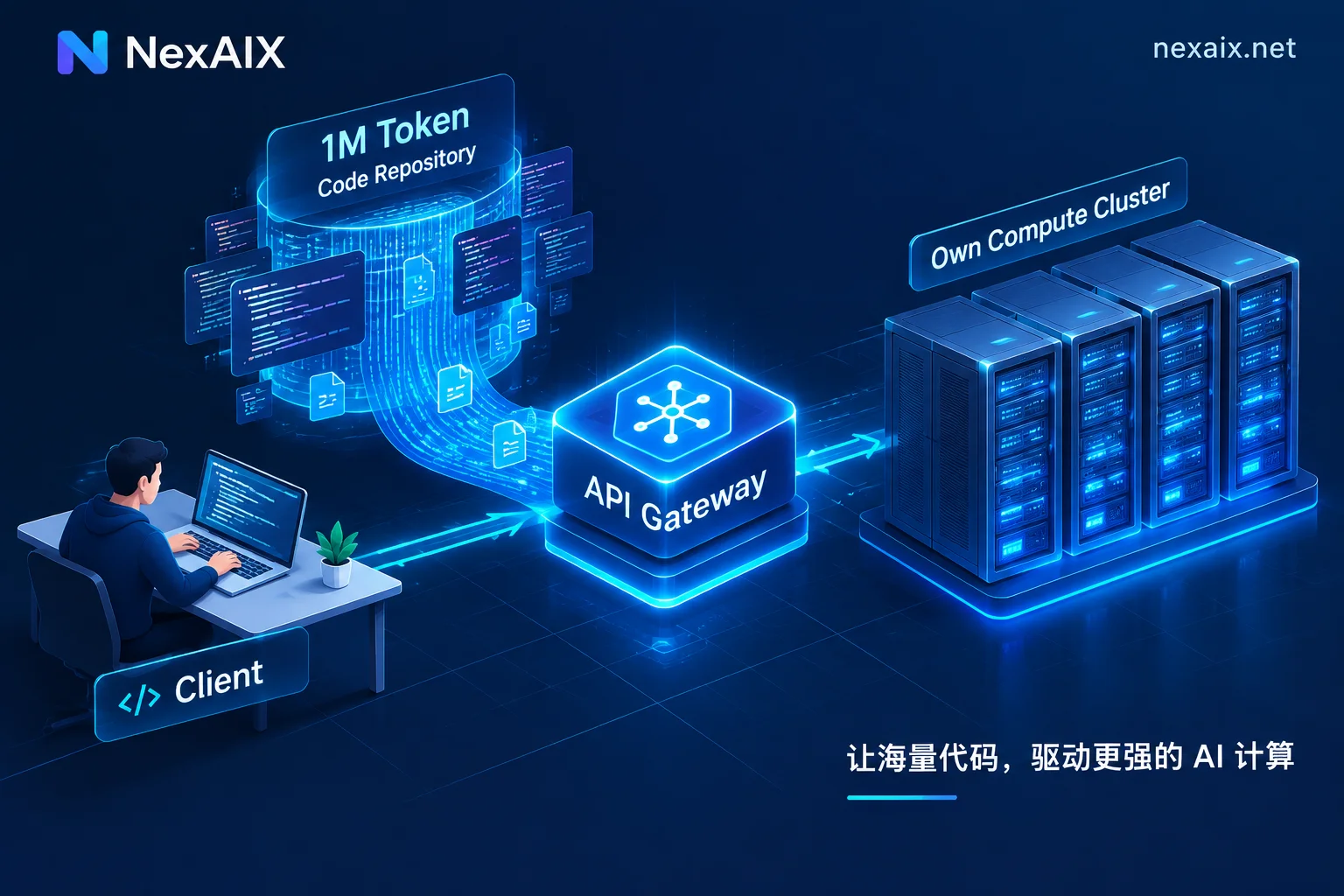
The GLM series on NexAIX are officially released open-source weight models, directly deployed on our self-owned GPU clusters in self-built and self-leased data centers, independently operated and maintained by our own engineering team, and never resell uncontrollable third-party carpool quotas. Each model detail page clearly marks the "Self-Owned Compute Deployment" label and discloses the context window, maximum output, and actual inference precision (e.g., BF16, FP8; for the impact of precision on quality, see What is the difference between model inference precision BF16 and FP8). - No Dilution, No Silent Model Switching
We promise No Dilution: themodelfield in the API response body strictly corresponds to the model that actually performed inference. A request forglm-5.2is executed byglm-5.2, never silently replaced with a smaller Flash model in the background, never secretly reduces inference precision, never truncates the nominal context and maximum output, and never injects any hidden system prompts. Parameters such astemperature,top_p, andmax_tokensare passed through as-is throughout. - Clear Rate Limiting Semantics (429 + Retry-After)
The capacity of open-source models comes directly from self-owned GPU clusters. Each API Key has clear RPM, TPM, and concurrency limits (contact us to apply for higher quotas, with responses based on actual cluster capacity). When a sudden flood triggers full load, the gateway immediately returns the standard HTTP429 Too Many Requestsstatus code with aRetry-Afterresponse header, never hangs the connection indefinitely, and never arbitrarily routes the request to a cheaper model as a substitute, fully returning control of backoff, queuing, or model switching to your business code. - Zero Conversation Logs and Compliant Auditability
Code repositories and business data often involve core intellectual property. On the NexAIX side, allpromptandcompletionare only streamed and forwarded in memory, released immediately after the request ends, not persisted to disk, not used for model training, and not handed over to any third party; the system only retains request ID, model name, token count, timestamp, and status code for billing and troubleshooting, and the entire process from client to inference node is encrypted with TLS 1.3 (see No Conversation Logging Statement). In addition, we have a complete corporate entity and support contract signing, invoicing, and signing of service agreements and data processing agreements (DPA).
IV. Three-Step Integration: Connect GLM and Global Flagship Models with One OpenAI-Compatible Interface
NexAIX strictly follows the OpenAI Chat Completions specification, supporting streaming output, function/tool calling, and multi-turn conversations. If your project already uses the OpenAI SDK, you only need to modify base_url and api_key to complete a smooth migration (for more language configurations, see What code changes are needed to switch large model APIs).
First, go to the NexAIX Console to register with your email (no enterprise qualification required, free test credits upon registration), create an API Key, and then call as follows:
1. Python Integration Example (Long Context + Tool Calling + Streaming Output)
The following example shows how to call glm-5.2 via the standard openai library, passing tool definitions and handling streaming returns:
import os
from openai import OpenAI

# 仅需将 base_url 指向 NexAIX 端点,换上你的 API Key
client = OpenAI(
    api_key=os.environ.get("NEXAIX_API_KEY"),
    base_url="https://api.nexaix.net/v1"
)

tools = [
    {
        "type": "function",
        "function": {
            "name": "run_unit_test",
            "description": "在沙箱环境中执行指定模块的单元测试并返回结果",
            "parameters": {
                "type": "object",
                "properties": {
                    "module_path": {"type": "string", "description": "测试文件路径,如 tests/test_auth.py"},
                    "timeout_sec": {"type": "integer", "description": "超时秒数"}
                },
                "required": ["module_path"]
            }
        }
    }
]

response = client.chat.completions.create(
    model="glm-5.2",  # 切换模型只需修改此字段,如改为 claude-opus-5 或 gpt-5.6
    messages=[
        {"role": "system", "content": "你是一名资深后端架构师,负责审查代码库并调用测试工具验证修复方案。"},
        {"role": "user", "content": "请分析 auth 模块的 token 刷新并发竞争问题,先触发一次单元测试确认复现。"}
    ],
    tools=tools,
    tool_choice="auto",
    temperature=0.2,
    max_tokens=4096,
    stream=True
)

for chunk in response:
    delta = chunk.choices[0].delta
    if delta.content:
        print(delta.content, end="", flush=True)
    if delta.tool_calls:
        for tc in delta.tool_calls:
            print(f"\n[触发工具调用] {tc.function.name}: {tc.function.arguments}", end="")
2. Direct Configuration in AI Coding Assistants and Agent Frameworks
Thanks to the unified OpenAI-Compatible Integration Standard, any development tool and orchestration framework that supports custom base_url can directly integrate GLM models on NexAIX. You can issue separate API Keys for different projects or tools (each Key has independent quotas, independent permissions, and independent billing by model, and can be revoked individually if leaked):
- Cline / IDE Plugins: Select
OpenAI Compatiblein settings, fill inhttps://api.nexaix.net/v1for Base URL, andglm-5.2for Model ID (for detailed step-by-step instructions, see How to configure custom model API in Cline). - Dify / Knowledge Base and Workflows: Add an OpenAI-API-compatible channel in the model provider (for configuration details, see Dify Adding OpenAI-Compatible Model Guide).
- Desktop Clients and Gateways: Also seamlessly supports Cherry Studio, NextChat, OneAPI, as well as LangChain, LlamaIndex, and Vercel AI SDK.
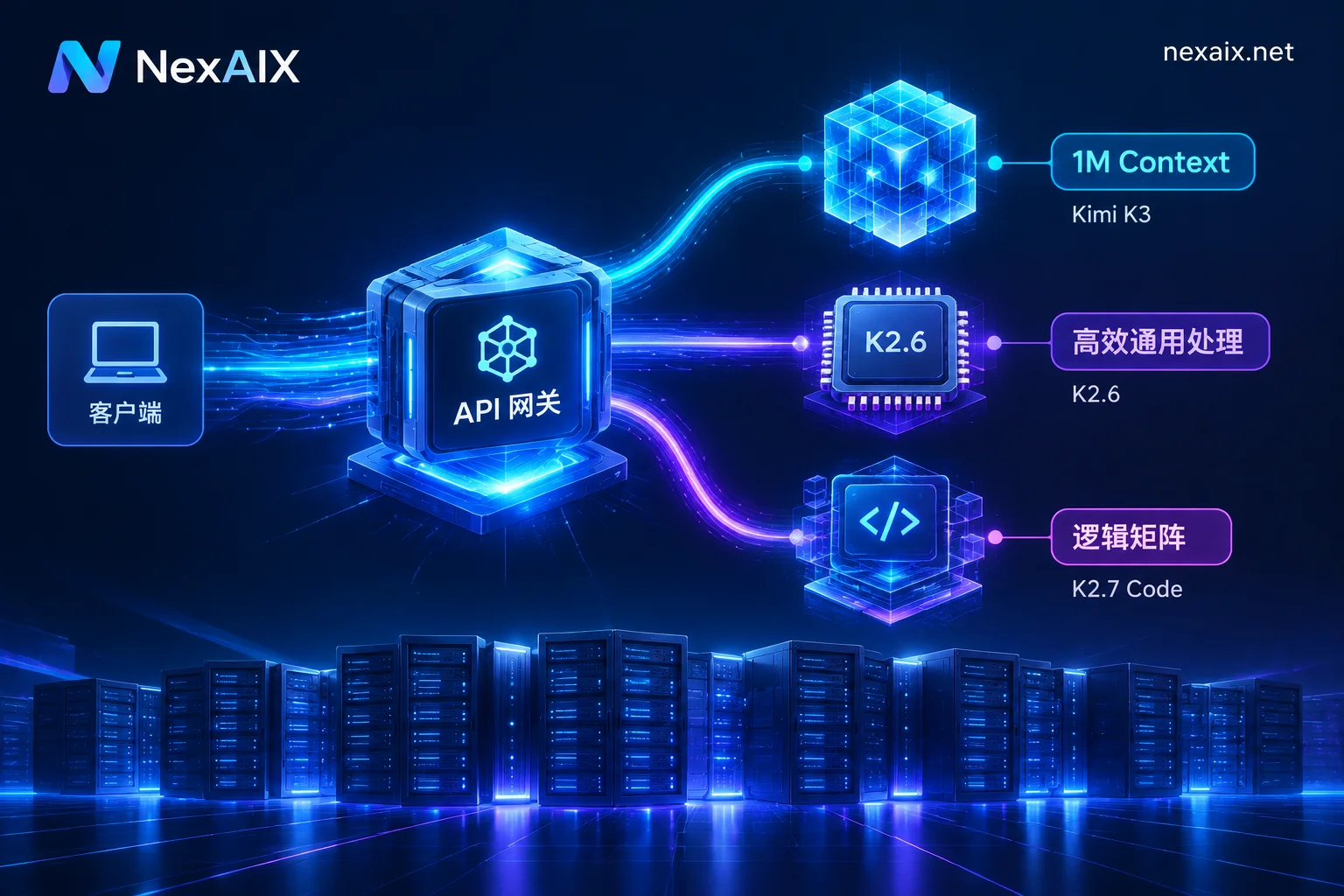
More importantly, one Key gives access to all activated models. When you are dealing with a particularly tricky cross-language low-level refactoring and want to hand the result to a closed-source model for secondary comparison, you don't need to change the SDK or create a new channel; simply change the model field in the request from glm-5.2 to the officially authorized channel's claude-opus-5 or gpt-5.6, and the interface format remains completely identical.
V. Four Engineering Self-Checks and Tuning Suggestions for Calling GLM API in Production
Before officially merging GLM API into production traffic, technical leads are advised to complete the following four verification points:
- Pay Attention to First-Token Latency (TTFT) and Cost Curve for Ultra-Long Inputs
Although GLM-5.2/5.3 supports million-level context, physically, ultra-long inputs require enormous computation in the Prefill stage, and first-token latency and per-call cost will rise significantly with input length. It is recommended to enablestream=Truestreaming output to improve front-end experience while reasonably trimming useless historical logs to avoid retransmitting hundreds of KB of redundant output in full for each multi-turn conversation. Use Four Methods to Self-Check "Original Without Dilution"
If you migrated from another channel and suspect previous model replacement or context shrinkage, you can refer to our No Dilution Self-Check Guide (or read the blog special How to confirm whether the API returns the original model) to perform four checks:- Check whether the
modelfield in the response body exactly matches the request; - Fix the prompt,
temperature=0, and random seed for cross-time retesting; - Construct input lengths close to the model's nominal limit for stress testing to confirm no premature length limit errors or loss of intermediate information;
- Ask the model to repeat all received messages to check whether the gateway secretly added hidden prompts.
- Check whether the
- Implement Client-Side Backoff Strategy Based on
Retry-After
Since NexAIX insists on transparent supply from a single endpoint and does not perform "automatic failover" that masks the true model identity, it is recommended to capture the429status code on the client side (e.g., using Pythontenacityor the built-in retry mechanism of the OpenAI SDK) and read theRetry-Afterseconds in the response header to perform exponential backoff, or let the business layer explicitly decide whether to switch to an alternative model (for error code handling, see How to read AI API error codes). - Record
request_idfor Precise Troubleshooting
Every API call on NexAIX returns a unique request ID in the response. Because we do not record your conversation content (Prompt/Completion not persisted), when encountering timeouts or abnormal status codes and needing to contact technical support, please be sure to keep the request ID in your logs and provide it so that the engineering team can locate the link based on metadata.
Conclusion
The open-sourcing of GLM-5.2 and GLM-5.3 gives development teams a truly open-source base capable of handling complex engineering tasks when building million-context repository-level Agents. Save the tedious operations of building multi-machine multi-GPU clusters yourself, avoid the implicit rule restrictions of consumer-grade packages, and you can directly go to the NexAIX Console to claim free test credits, or browse the Model List to view real-time specifications of the GLM series and major flagship models, and integrate the authentic self-owned compute into your production pipeline with a one-line base_url change. If you have enterprise-level high-concurrency quota, independent resource pool, or private deployment needs, please feel free to contact us at [email protected].


Comments(0)