 NexAIX-官方博客
In current AI application and Agent engineering practices, the era of a single model doing everything is over. A mature production pipeline often needs to orchestrate multiple model families simultaneously: use high-reasoning closed-source models for complex planning and core code generation, use high-throughput open-source weight models for long document summarization, structured information extraction, or high-frequency tool calls, and combine with multimodal models for image-text and video frame analysis.
To reduce the maintenance cost of integrating multiple vendors, the OpenAI-compatible API (an interface form based on the OpenAI Chat Completions specification) has become the de facto standard protocol in the industry. However, many development teams find when moving applications from Demo to production: "claiming OpenAI compatibility" and "being able to stably mix models in production" are separated by a huge engineering gap.
Previously, we discussed the basic operation of changing one line of base_url to connect an existing application to a new endpoint, and also broke down three must-change configurations and parameter checks when switching large model APIs. This article skips basic syntax and, from the perspective of architects and Agent developers, discusses how to select and architect your OpenAI-compatible API access layer around "protocol fidelity, underlying supply determinism, proactive disaster recovery, and billing governance" in the era of multi-model mixing.
I. Why does "nominal compatibility" frequently fail in production?
"OpenAI compatibility" is not an RFC standard with mandatory compliance tests, but a set of conventions formed by the community around /v1/chat/completions. In simple single-turn text conversations, almost all compatible endpoints work; but once you enter multi-step Agent orchestration or high-concurrency production environments, the ambiguity of protocol boundaries explodes:
- Tool Calling (Function / Tool Calling) structure distortion: Agents rely on strict JSON Schema to describe tools and parse the model's returned call instructions. Some non-standard relay layers, when doing protocol mapping, lose nested parameters or rewrite the
tool_callsarray structure, causing downstream parsers to throw exceptions directly. - Streaming output and multimodal format fragmentation: The SSE (Server-Sent Events) chunking rhythm and
finish_reasontrigger timing differ among vendors' native interfaces. If the compatibility layer is not aligned with the standard Chat Completions specification, frontend streaming rendering may stutter or truncate; similarly, if multimodal input does not uniformly follow the standardimage_urlor base64 structure, you have to rewrite a set of preprocessing logic for each model change. - Implicit tampering and parameter swallowing: To save costs or hide upstream errors, some low-quality aggregation channels silently truncate long contexts, swallow
temperatureandmax_tokensparameters, or even inject hidden system prompts, making Agent behavior unpredictable in production.
To truly implement "one codebase for multiple models," the access layer must strictly align on protocol fidelity and parameter passthrough.
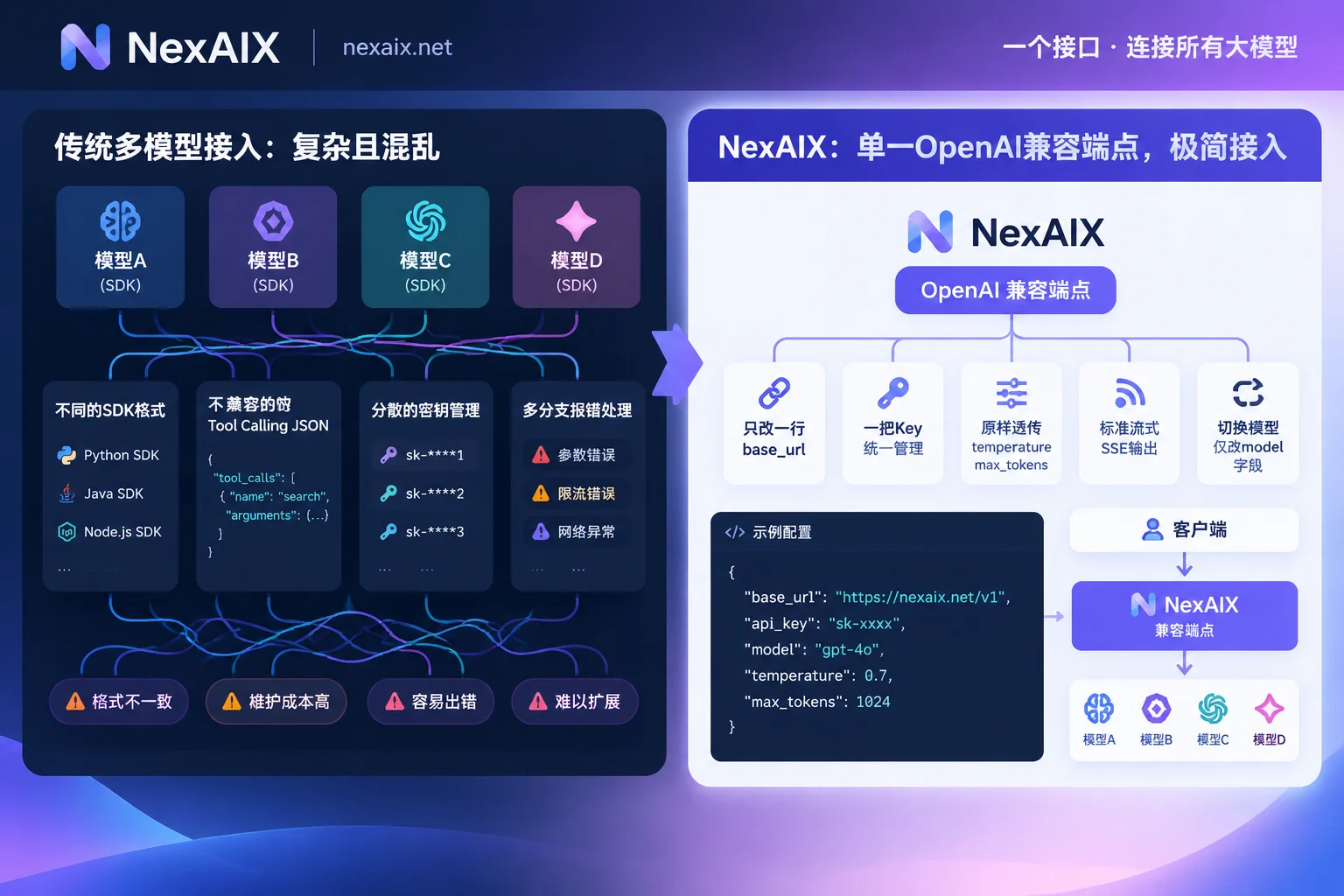
II. One codebase for open-source and closed-source: a true drop-in architecture
In the design of NexAIX, the core goal of OpenAI-compatible access is to eliminate if provider == xxx branching in the application layer. Whether calling open-source weight models or closed-source commercial models, the interface behavior remains highly consistent:
- Full coverage of core capabilities: Strictly implemented according to the OpenAI Chat Completions specification, fully supporting multi-turn conversations, streaming output, and function/tool calling that Agents critically rely on.
- Standard multimodal parameter passing: For models that support multimodality (check the input modalities marked on each model page), images are passed directly in OpenAI multimodal format as
image_urlor base64 encoding; video input is passed as a sequence of extracted frames, with no need for private SDKs. - One-line configuration to switch the global ecosystem: For projects already using the OpenAI SDK, most only need to change
base_urltohttps://api.nexaix.net/v1and replace with NexAIX's API Key to run. Meanwhile, all development frameworks and clients that support custom OpenAIbase_url—including LangChain, LlamaIndex, Vercel AI SDK, Dify, Cherry Studio, NextChat, Cline, OneAPI, etc.—can be seamlessly integrated directly (if you are using these tools, you can refer to our guides for LangChain, Dify, and Cline configuration).
Multi-model Agent role assignment code example
Access all activated models with one Key; switching between open-source and closed-source models only requires changing the model field in the request body. When building multi-step Agents, you can use the same client instance to complete scheduling for different roles:
from openai import OpenAI

# 统一初始化:一个端点、一把 Key
client = OpenAI(
    base_url="https://api.nexaix.net/v1",
    api_key="YOUR_NEXAIX_API_KEY"
)

def run_agent_step(role: str, messages: list, tools: list = None):
    # 按任务角色动态指定 model 字段,无需更换 SDK 或重写请求结构
    model_map = {
        "planner": "gpt-5.6",          # 复杂规划与多模态理解:走官方授权闭源模型
        "coder": "glm-5.2",            # 代码生成与长上下文工具调用:走自有算力开源权重
        "extractor": "deepseek-v3"     # 高频结构化提取:走自有算力开源权重(具体型号以官网模型页为准)
    }

    target_model = model_map.get(role, "glm-5.2")

    kwargs = {
        "model": target_model,
        "messages": messages,
        "temperature": 0.2,
        "stream": False
    }
    if tools:
        kwargs["tools"] = tools

    response = client.chat.completions.create(**kwargs)
    return response.choices[0].message
Selection and integration tip: When browsing the NexAIX Model Marketplace, the URL slug on a single model detail page replaces dots (.) in the model ID with hyphens (-). For example, to view the specifications and three-step integration code forglm-5.2, the page address ishttps://nexaix.net/models/glm-5-2/(directly spelling/models/glm-5.2/with the model ID returns 404), while themodelfield in the API request body still usesglm-5.2. If you need a specific open-source weight model not in the list, you can also send the model name and estimated usage to [email protected], and we will reply with scheduling after evaluating compute.
III. Beyond protocol surface: understanding underlying compute supply and parameter transparency
Once the interface format is unified, the core factor determining production stability falls on the underlying supply method. OpenAI-compatible channels on the market are mixed; many low-cost aggregation sites rely on "account pools" assembled from personal accounts or reverse-engineered web client protocols, which not only face account bans and service interruptions at any time but also suffer from severe intelligence degradation and truncation.
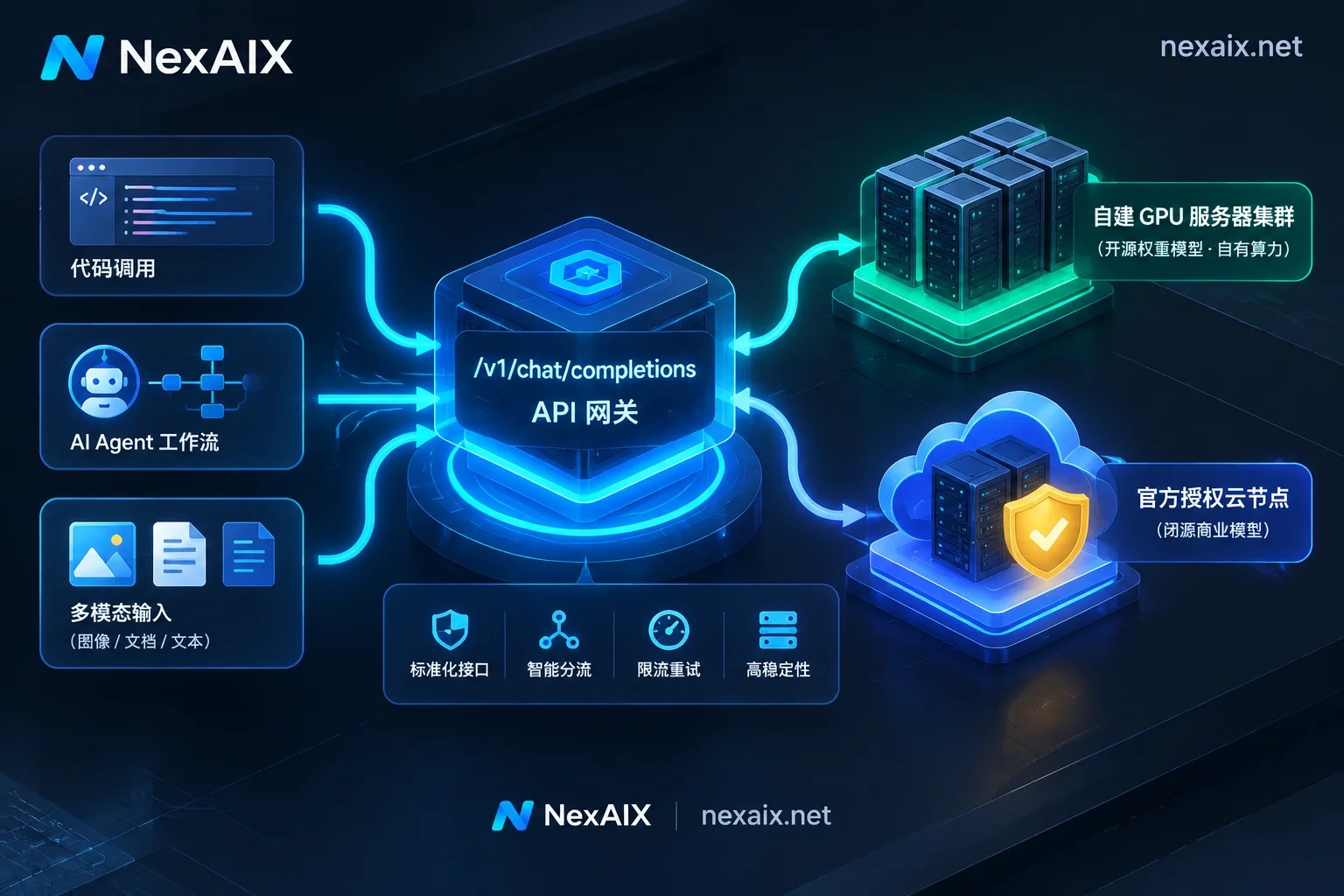
We have previously compared in detail the specific differences between open-source weight model APIs and official authorized channels. NexAIX adheres to only two transparent modes on the supply side, and every single model page must be labeled with either "Self-owned Compute Deployment" or "Official Authorized Channel":
- Self-owned Compute Deployment (open-source weight models): Officially released open-source weights (currently listed on the website: Kimi, GLM, DeepSeek, MiniMax, Qwen, gpt-oss series) are deployed directly on self-built and leased GPU clusters in our own data centers, operated by our team, and we never resell third-party quotas. Each model page clearly indicates context window, maximum output, inference precision (e.g., BF16, FP8, MXFP4, etc., as actually marked for the model), and open-source license.
- Official Authorized Channel (closed-source commercial models): The closed-source models currently listed on the website—Claude, GPT-5.6, Grok, Gemini series—all go through official commercial authorization from vendors, with contracts, invoices, and auditability; no account pools, no reverse-engineered client protocols (to understand the essential differences between these two supply methods and account pools/reverse engineering relays, and self-check methods, please refer to the Channel Transparency Statement).
Adhering to "Four No-Downgrade" and verifiable commitments
At the protocol forwarding layer, NexAIX strictly implements the no-downgrade commitment: the model field in the response body is the model actually executed; no switching to smaller models, no precision reduction, no truncation of context and maximum output, no injection of hidden system prompts, and the temperature, top_p, max_tokens in requests are passed through as-is.
Engineering teams do not need to rely on verbal trust; they can directly self-check in business code using four methods (see How to confirm whether the API returns the original model):
- Fix the prompt and random seed to retest output consistency;
- Check the
modelfield in the response body; - Stress test context and maximum output with lengths close to the model limit;
- Ask the model to repeat all received messages to check for hidden injections.
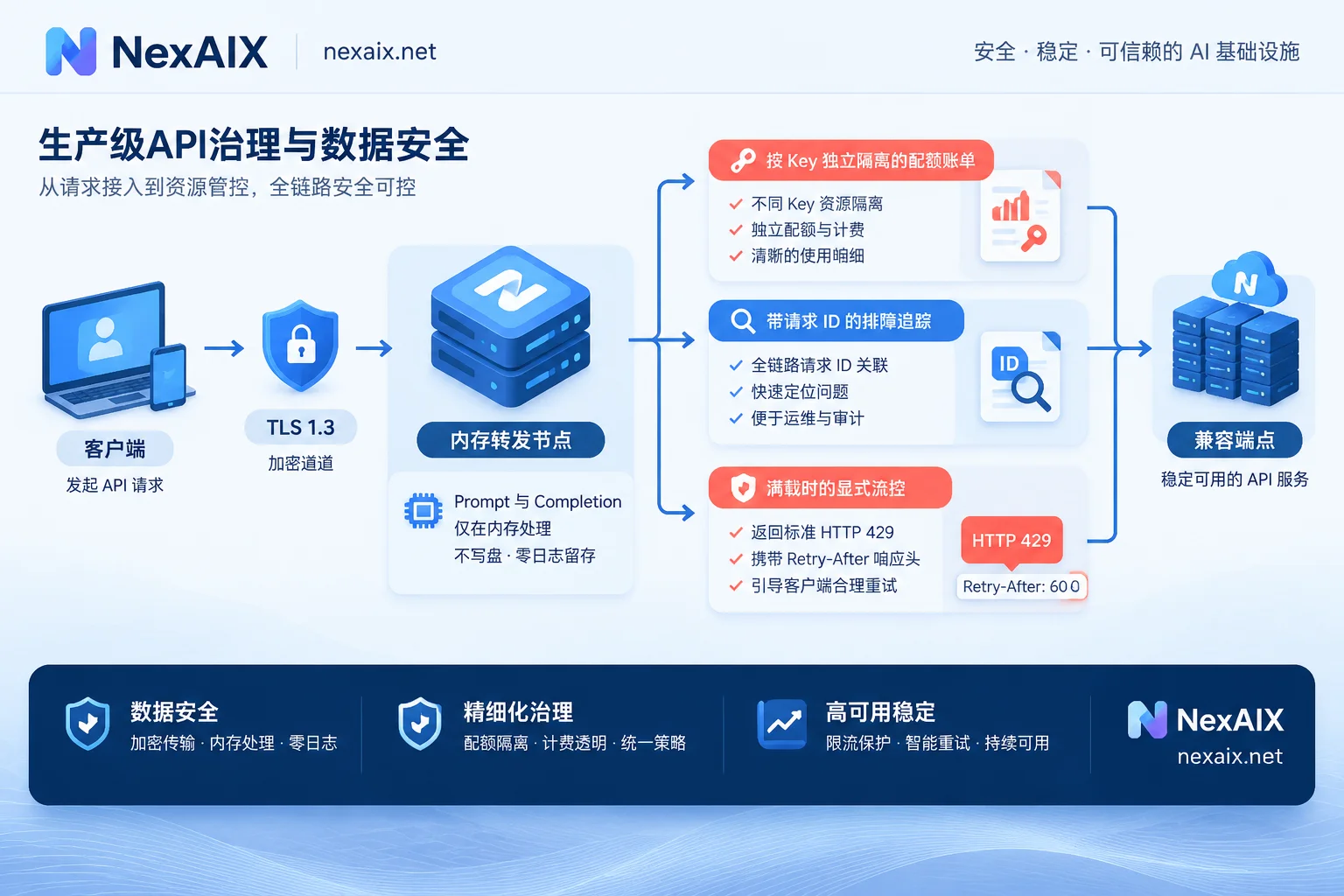
IV. Production governance: explicit 429 disaster recovery, per-Key isolation, and zero-log boundaries
When multi-model calls enter high-frequency production, technical leaders are most concerned about three governance issues: How does it behave during sudden full load? How to split billing and control permissions among multiple Agents or business lines? Will core business data leak?
1. Reject "black-box model switching," use standard 429 to support proactive disaster recovery at the application layer
Many aggregation gateways advertise so-called "intelligent routing and automatic failover," but in rigorous Agent production environments this is often a double-edged sword: when the primary model is rate-limited, if the gateway silently switches the request to another model with different capabilities or inference precision in the background, it can easily cause structured output failures or business logic errors.
NexAIX adopts a deterministic strategy with a single supplier and single endpoint, no automatic routing or failover:
- Capacity for open-source models comes from self-owned GPU clusters; closed-source models are constrained by upstream quotas.
- Each Key has independent RPM, TPM, and concurrency limits (higher quotas can be requested at any time; we will respond based on actual capacity).
- When encountering sudden traffic saturation, the system immediately returns a standard
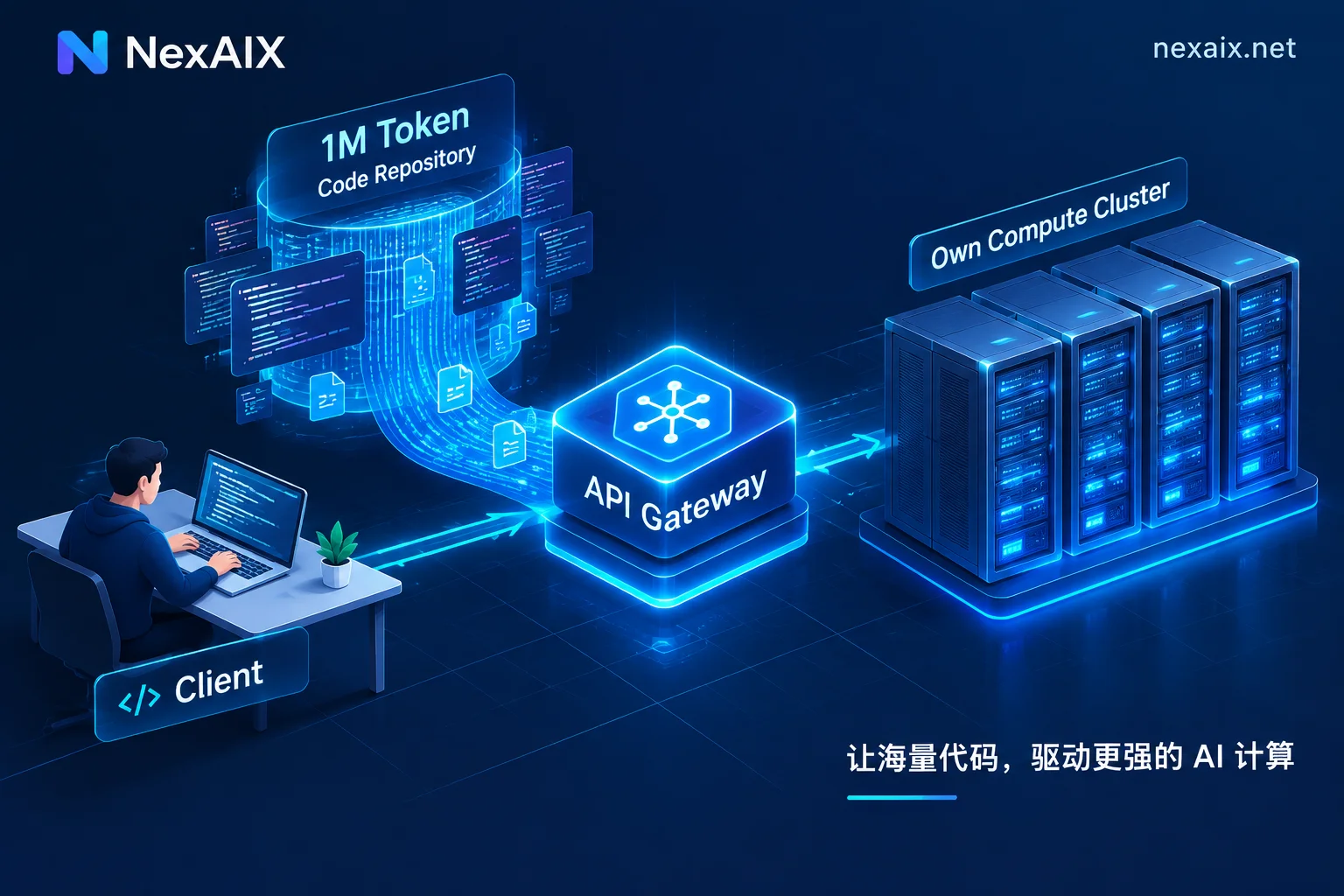
429status code with aRetry-Afterresponse header, never hangs the connection indefinitely, and never privately substitutes a cheaper model (also note: when handling ultra-long contexts of millions of tokens, first-token latency and cost naturally increase with input length; architecture design should include streaming reads and timeout reservations, see High Throughput and Rate Limiting Mechanisms and Retry Guide for 429 and Other Error Codes).
After receiving the explicit 429 and Retry-After, control is fully returned to your engineering code—you can clearly decide whether to back off and retry per second, enter a message queue, or explicitly switch to a backup model at the application layer.
2. Per-Key quota isolation and itemized billing
Opening several consoles at the end of the month for reconciliation, or not daring to revoke a master key after a leak because the whole team uses it, are common pain points in multi-model development. In NexAIX:
- Each Key is independently isolated: Each API Key has independent quotas, independent permissions, and independent usage billing. You can assign dedicated Keys by project, environment (development/testing/production), or different Agents; if a Key is accidentally leaked, it can be revoked separately without affecting other business lines (refer to AI API Key Isolation Best Practices).
- Fine-grained reconciliation and troubleshooting: Log in to the console to export usage details, with billing clearly itemized by model; each API call returns a unique request ID; for any abnormal troubleshooting, simply contact technical support with the request ID for quick location, without providing sensitive business messages.
3. Clear data retention and compliance boundaries
Regarding data security, NexAIX adheres to a strict no-conversation-logging policy:
- Zero persistence on our side: TLS 1.3 encryption is used throughout from client to inference node; your
promptandcompletionare forwarded only in memory and released after the request ends, not written to disk; not used for training, nor transferred to third parties for training. The system retains only metadata for billing and troubleshooting (request ID, model name, token count, timestamp, status code). - Objectively state upstream boundaries: The above zero-log commitment is a strict guarantee on NexAIX's side. For closed-source models, requests are handled according to each vendor's terms after reaching the upstream vendor; policies vary, and we cannot make commitments on their behalf (currently only two Claude model pages on the website separately indicate upstream retention: Opus 5 supports zero data retention, Fable 5 currently has 30-day retention; please refer to the official model pages for specific policies).
V. Conclusion: Three steps to start production-grade multi-model integration
Unifying multi-model calls onto a clean, transparent, verifiable OpenAI-compatible API not only frees the R&D team from tedious SDK adaptation and reconciliation but also provides a solid foundation for the long-term evolution of AI applications.
If you are selecting for a new project or planning to migrate an existing multi-model application to a more stable production endpoint, you can quickly verify in three steps:
- Get test credits: Visit the NexAIX Console and register with your email; you will receive test credits upon registration, and you can create your first API Key without submitting cumbersome enterprise qualifications.
- Choose target models: Go to the Model Marketplace to view the open-source weight models (self-owned compute deployment) and closed-source models (official authorized channels) on sale, and check the required context, inference precision, and multimodal capabilities.
- Smooth switching and enterprise integration: Replace
base_urlin your code or client withhttps://api.nexaix.net/v1to run tests. For teams and enterprises entering large-scale production, NexAIX has a proper legal entity, can sign contracts, issue invoices, and supports signing service agreements and data processing agreements; if you have higher compliance requirements, feel free to email [email protected] to discuss dedicated resource pools and private deployment solutions.


Comments(0)