 NexAIX-官方博客
A Production Incident That Shifted Selection Criteria from Price to Resilience
At 2 AM, your service monitoring suddenly alarms: the timeout rate for calls to a third-party LLM API spikes to 40%. You open the logs and see a flood of 429 and 5xx errors, forcing your business line to degrade to cached responses. In the postmortem, you realize that a single provider's hiccup was enough to paralyze your agent application for hours. This scenario is becoming the norm for backend engineers. And recent updates to OpenRouter's documentation elevate this pain point into a shift in industry standards: it explicitly splits failover into two independent levels—Provider-level and Model-level—and introduces a /benchmarks endpoint exposing real-time TPS, latency, and 30-day availability data. This means the competition among multi-model API gateways is no longer just about price arbitrage, but about who can provide more reliable and transparent disaster recovery when failures occur.
For technical leads, a new acceptance dimension must be added to the selection checklist: What are the trigger conditions for automatic failover? What level does it cover? After failover, can you still trust the returned model field? Based on OpenRouter's mechanisms, this article provides a ready-to-use acceptance checklist and reminds you of the observability debt that failover introduces.
Automatic Failover Comes in Two Layers: Provider-Level Retry vs. Model-Level Fallback
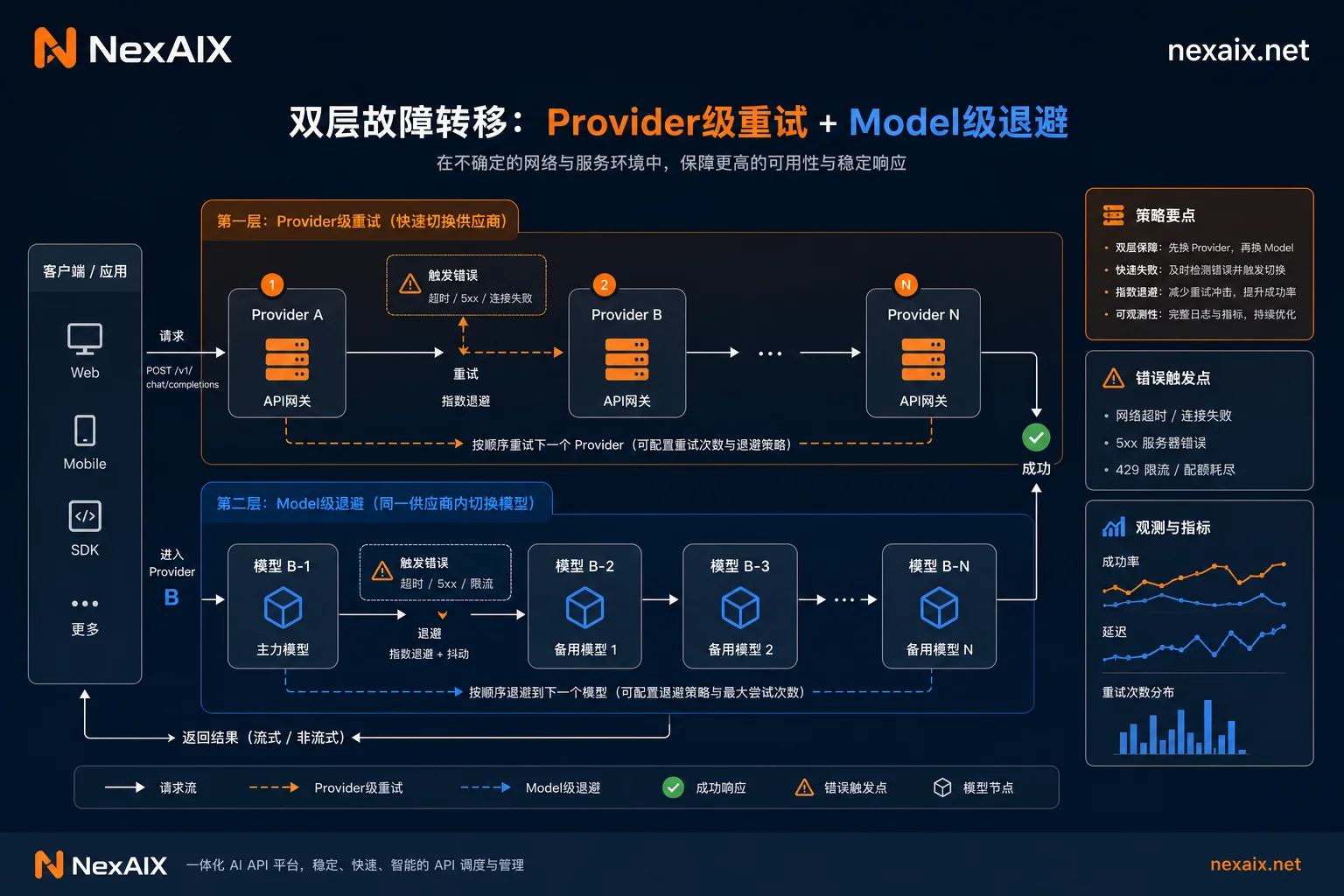
According to OpenRouter's documentation (updated August 2026), its failover mechanism is two-layered: Provider-level failover is enabled by default (allow_fallbacks: true). When a provider node returns 5xx or 429 errors, the gateway automatically forwards the request to another provider node, while temporarily downgrading the erring node over the past 30 seconds to avoid repeated hits. Model-level fallback, on the other hand, requires explicit configuration of a models array. When all providers for the primary model are unavailable, or in scenarios like context length exceeded or moderation refusal, the gateway switches to a fallback model.
These two mechanisms solve entirely different problems and cannot substitute for each other. Provider-level retries address supply node failures for the same model and are transparent to the business. Model-level fallback is a degradation at the model level and may affect output quality. Understanding this distinction is the first step in disaster recovery acceptance. If your gateway merely claims "failover," you need to ask: Is it Provider-level or Model-level? Do the trigger conditions include 429, 5xx, timeouts, and context length exceeded?
After Failover, Do You Still Know Which Model You're Running On?
This is the core controversy of this article. While automatic failover improves availability, it introduces three types of observability debt:
- Streaming Interruption: When a request is mid-stream and the underlying provider fails, the gateway may abort the stream. According to third-party analysis (Requesty, July 2026), some providers still charge for cancelled streams (Cancelled Stream), leading to a mismatch between cost bills and service quality.
- Non-Idempotent Retries: If a request has side effects (e.g., calling external tools, writing to a database), the gateway's automatic retry may execute it multiple times, causing data inconsistency.
- Model Field Distortion: After failover, the
modelidentifier in the response may not match your configured model, directly affecting cost accounting, eval result attribution, and production issue analysis.
More severe is "silent degradation": some gateways may route requests to cheaper models without informing you to save costs. This transparency issue should be a red line in vendor evaluation. You need to confirm whether the gateway truthfully returns the model field and whether it allows you full control over degradation policies.
What the Client Still Needs to Do: Idempotency Keys, Timeout Budgets, and Backoff Strategies
The gateway's resilience capabilities cannot replace client-side robustness. You still need to generate idempotency keys for side-effectful calls and deduplicate at the application layer. Split the end-to-end timeout into three segments: connect, TTFT, and total duration, to avoid gateway retries stacking and blowing up the P99. Retries should use exponential backoff with jitter, combined with circuit breakers, to prevent retry storms from upstream failures. For streaming scenarios, prepare logic to regenerate from breakpoints; don't assume seamless continuation.
Remember: automatic failover only reduces the probability of interruption, not eliminates it. Your architecture design must account for the worst case.
Multi-Model API Gateway Disaster Recovery Acceptance Checklist: 8 Actionable Test Items
The following checklist is based on OpenRouter's mechanisms and industry best practices. We recommend incorporating it into vendor evaluation and pre-release regression testing.
| Test Item | Method | Pass Criteria | Failure Signals |
|---|---|---|---|
| 1. Standard Error Codes | Deliberately trigger 429/5xx (e.g., hit rate limits with real requests) | Gateway returns standard 429 or other 5xx codes; does not swallow errors | Error codes converted to 200 or non-standard content returned |
| 2. Context Length Fallback | Construct an over-long context request to trigger Context Length on the primary model | Gateway explicitly errors or switches models per models array, and indicates the actual model in the response | Silent truncation or meaningless content returned |
3. Response model Field | Make consecutive requests and record the response model field vs. request config | model field matches the actually executed model; if switched, it is clearly indicated | model field mismatches expectations or is always the preset value |
| 4. Cancelled Stream Billing | Cancel a streaming request mid-way and compare billed tokens vs. output tokens | Cancelled streams are not double-billed, or billing rules are transparent | Billed tokens far exceed actual output |
| 5. Idempotent Retries | Submit a side-effectful request and observe gateway retry behavior | Gateway does not cause duplicate side effects or provides idempotency key support | Same request executed multiple times |
| 6. TTFT Jitter | Inject provider failure and record first-token latency during failover | TTFT jitter within acceptable range (e.g., <1s) | Failover time exceeds business tolerance |
| 7. Error Code Swallowing | Check gateway logs to see if error codes are intercepted | Gateway preserves original error codes and surfaces them in response or logs | Error codes lost or uniformly converted to 200 |
| 8. Silent Degradation | Ask for a written commitment from the vendor and spot-check request logs | Vendor commits to not silently switching models, and logs are auditable | No explicit commitment or unexplained model switches |
How to Use Routing Benchmark Data: Treat Benchmarks as Clues, Not Conclusions
OpenRouter's /benchmarks endpoint aggregates third-party evaluation data from Artificial Analysis, Design Arena, and tau-bench/GPQA, allowing filtering by task_type or source, and combining p90 throughput with 30-day availability for routing constraints. Such data helps you narrow down candidate model sets, but it reflects macro distributions, not your actual performance under your traffic. Therefore, the correct approach is to use it as a preliminary screening reference; final decisions must rely on your own eval sets and production canary data. Treat benchmark data as "clues," but "conclusions" must come from your own validation.
Use a Unified OpenAI-Compatible Interface to Run a Real Disaster Recovery Drill
For disaster recovery acceptance, you need an integration method that can seamlessly switch between multiple models. We recommend using a unified OpenAI-compatible interface, so the same code can be used for comparative eval across different gateways and models. You can design three types of fault injection: timeout, stream cancellation, and over-long context, then record latency, error codes, and model fields for each solution.
Taking NexAIX as an example, its public service commitments can serve as a reference for transparency standards: returns standard 429 and retry suggestions when overloaded, does not silently switch to cheaper models, the model field in responses corresponds to the actually executed model, and only retains troubleshooting metadata such as request ID, model name, token count, timestamp, and status code. Its OpenAI Chat Completions compatible interface (base_url: https://api.nexaix.net/v1)支持流式与工具调用,便于你用同一套代码做容灾演练与横向对比。具体规格、价格与可用性,请以NexAIX当前模型页、定价页与状态页为准。
Conclusion: Availability and Transparency Must Be Scored Together
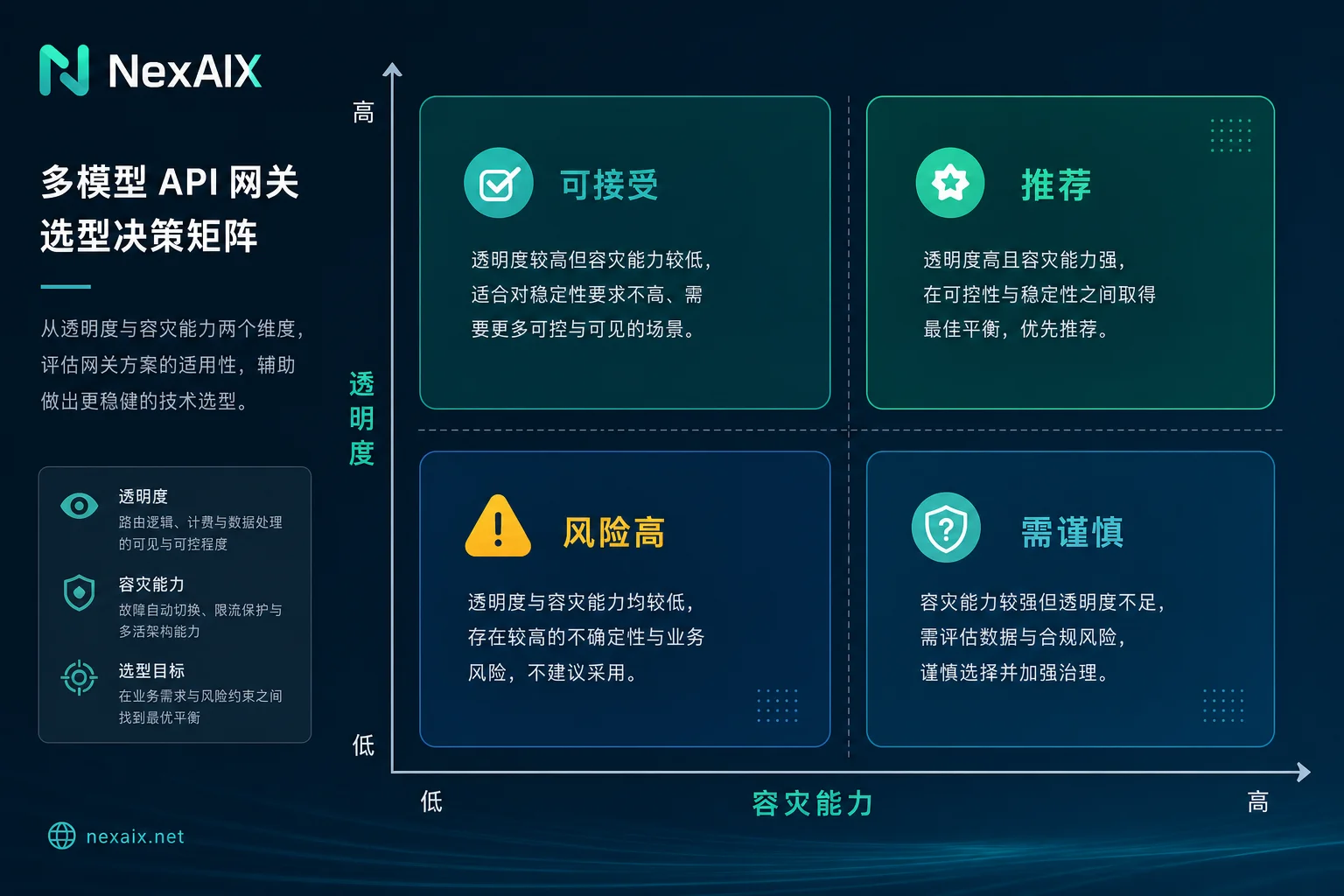
The resilience capability of multi-model API gateways is evolving from "can auto-retry" to "clear trigger conditions, idempotent retries, no silent degradation, and truthful model field reporting." When selecting, score resilience and transparency together, and incorporate this article's checklist into your evaluation process. Remember, the gateway itself introduces routing overhead, and resilience only reduces the probability of interruption, not eliminate it. Treating availability and observability as equally important is the correct approach for production-grade architecture.



Comments(0)