 NexAIX-官方博客
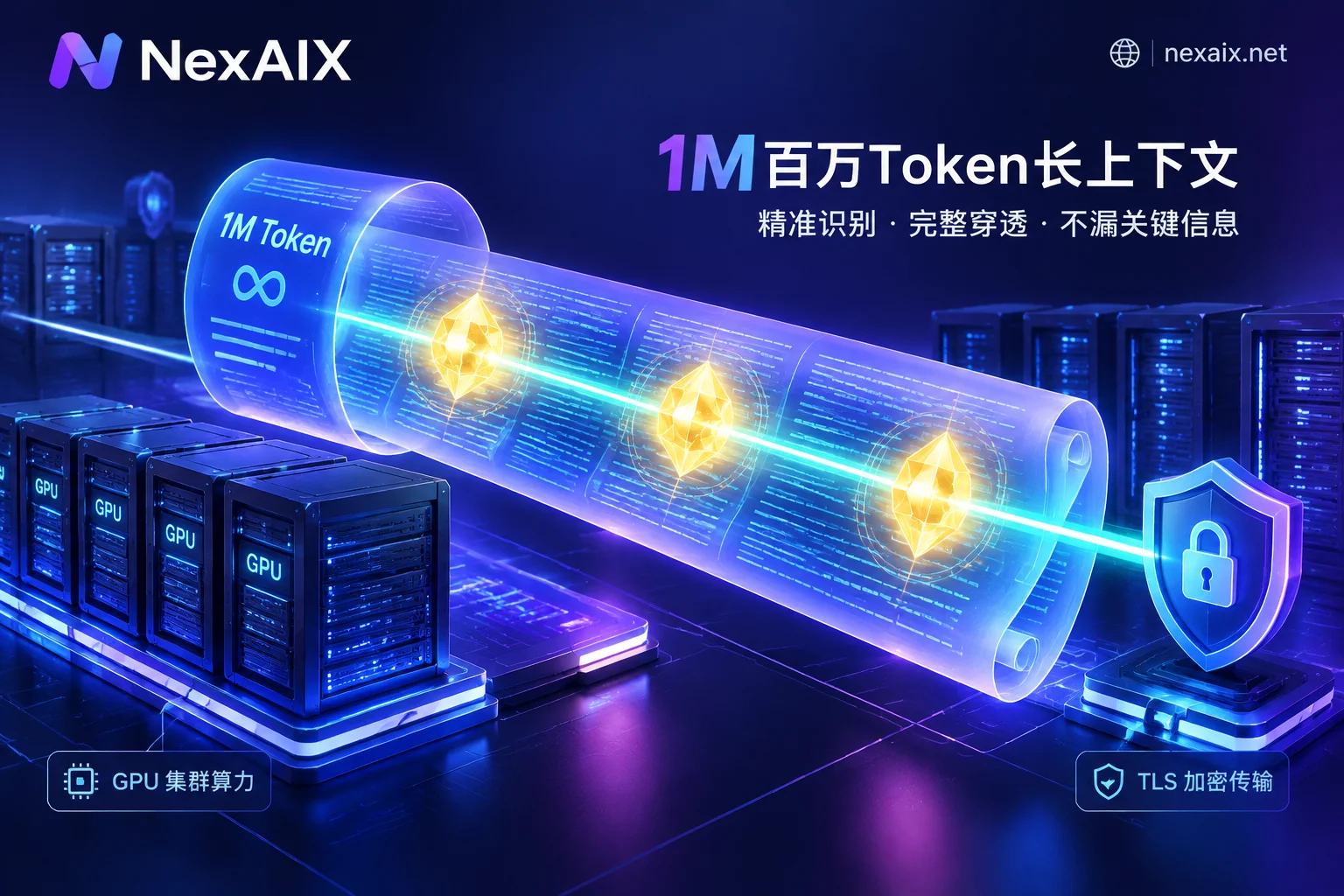
Entering the second half of 2026, the "context window race" in the large model field has crossed the million-token threshold. Whether it's full codebase refactoring, cross-comparison of dozens of financial and legal due diligence documents, or long-horizon AI agents accumulating sandbox state and environment memory across multiple tool calls, the long-context API has evolved from an early "novelty parameter" to a core infrastructure for production systems.
However, many technical teams migrating from short conversations of thousands of tokens to long-context calls of hundreds of thousands or even millions of tokens often encounter severe engineering gaps: APIs claiming million-token windows frequently lose key facts in the middle during actual calls, time-to-first-token (TTFT) becomes so long that gateway timeouts occur, and some unofficial channels silently truncate without errors.
This article starts from the underlying physical bottlenecks of long-context inference, systematically analyzes the four hidden traps of long-context APIs in production environments, and provides an engineering implementation plan covering anti-truncation stress testing, streaming timeout management, and hybrid multi-model scheduling.
I. Why "Claimed Million-Token Window" Does Not Equal "Production-Ready": Unpacking Four Engineering Traps
When evaluating a long-context API, the window limit advertised by the model publisher is only theoretical capacity. When a single request carries hundreds of thousands of tokens into the inference cluster, the underlying computation and memory access patterns change qualitatively, exposing four production risks:
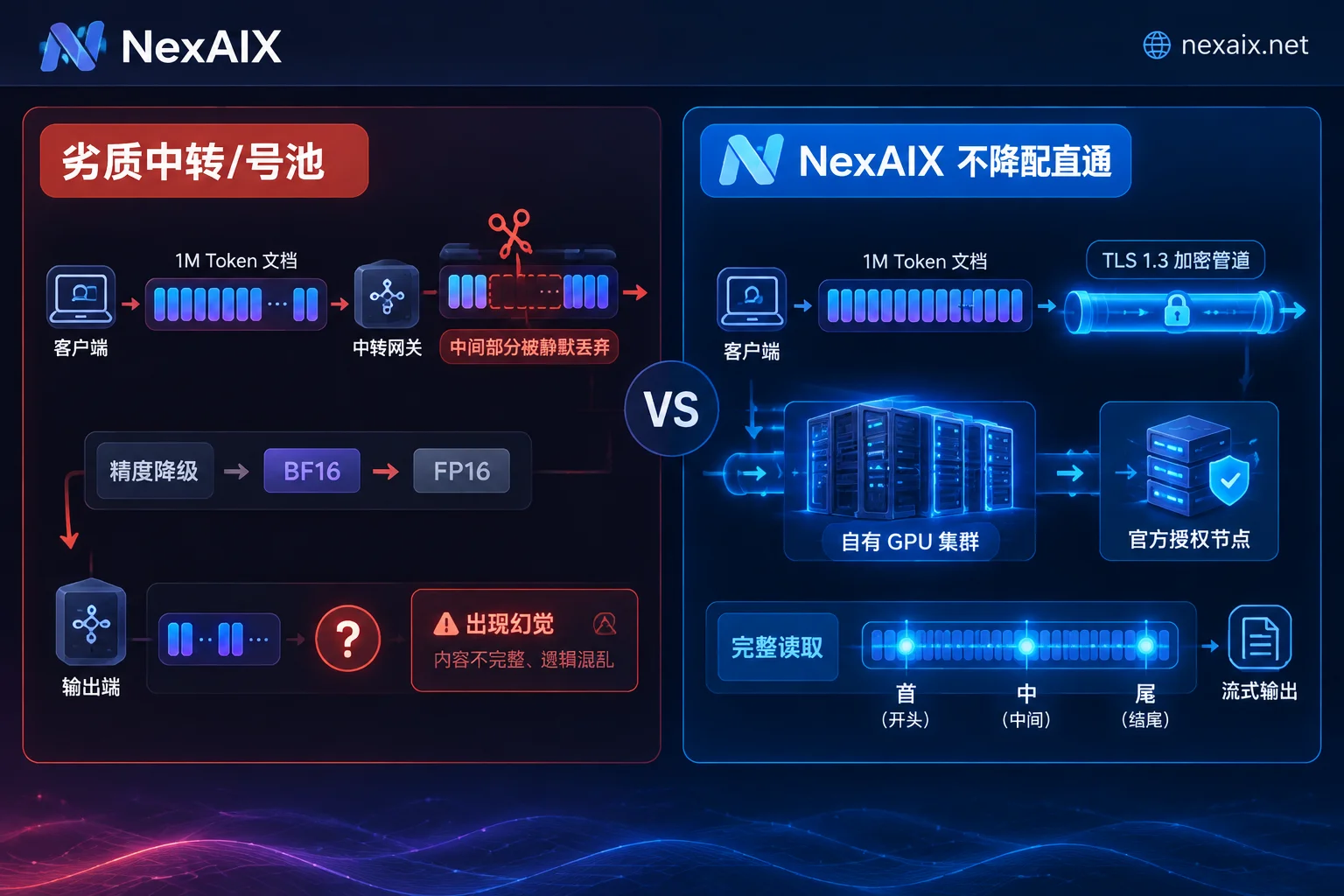
1. "Silent Truncation" and Accuracy Degradation Under Memory Wall
During the prefill stage of large model inference, the system must compute the full input sequence and generate massive key-value caches (KV Cache). As context length grows linearly, KV Cache occupancy of GPU high-bandwidth memory (HBM) skyrockets by orders of magnitude.
To save expensive memory overhead, some low-quality relay stations or account pools lacking compute guarantees perform silent sliding window truncation at the gateway layer (quietly discarding middle paragraphs to preserve head and tail instructions), or forcibly quantize model weights and activations to extremely low precision. This results in clients receiving seemingly normal 200 OK responses, but the model actually never "sees" the truncated document content. (For troubleshooting output truncation, refer to the site article "What to Do When Large Model API Output Is Truncated: First Check finish_reason, Then Fix by Cause".)
2. "Lost-in-the-Middle" and Multi-Hop Reasoning Degradation
Mainstream long-text evaluations (such as RULER, AI-Needle, and other multi-task benchmarks) show that even if a model scores high in single-fact needle-in-a-haystack (NIAH), its effective recall accuracy in the 200K to 1M range can still significantly decline when facing cross-paragraph multi-fact recall (Multi-Needle) or long-chain logical reasoning. If the underlying inference engine's precision (e.g., choice between BF16 and FP8) is not strictly aligned, this middle attention degradation worsens, directly causing contract review misses or code hallucinations.
3. TTFT Spikes and Gateway Disconnections Caused by Prefill Compute Peaks
Long-context requests are typical "heavy input, light output" or "long input, long thinking" tasks. When 500K tokens are sent at once, the inference node may take seconds or even tens of seconds to complete the attention matrix computation in the prefill stage. This causes time-to-first-token (TTFT) and cost to rise significantly with input length. If the client uses non-streaming calls or short timeout configurations from the short-text era, connections are easily dropped by load balancers before the first byte is received.
4. Data Retention Anxiety from Feeding Core Assets in Full
With traditional RAG (Retrieval-Augmented Generation), developers send only a few scattered retrieved chunks to the API each time; in the long-context paradigm, teams often load entire microservice code repositories, unpublished merger agreements, or full-year financial working papers into the prompt at once. If the API platform records plaintext logs on disk or routes through unknown third parties via reverse-engineered client protocols, the enterprise's core trade secrets face extremely high leakage risks.
II. Four Hard Criteria for Production-Grade Long-Context API Selection
To address the above engineering traps, technical leads introducing long-context APIs to their teams should not only look at the nominal price per million tokens, but establish an auditable and verifiable infrastructure admission standard:
1. Transparent Compute and Channels: No Account Pools or Reverse-Engineered Wrappers
Long-context tasks have extremely high requirements for memory continuity and concurrency quotas per request. "Account pools" assembled from personal accounts or reverse-engineered web interfaces typically come with severe implicit length limits and extremely fragile session states, incapable of supporting production-grade long-text loads.
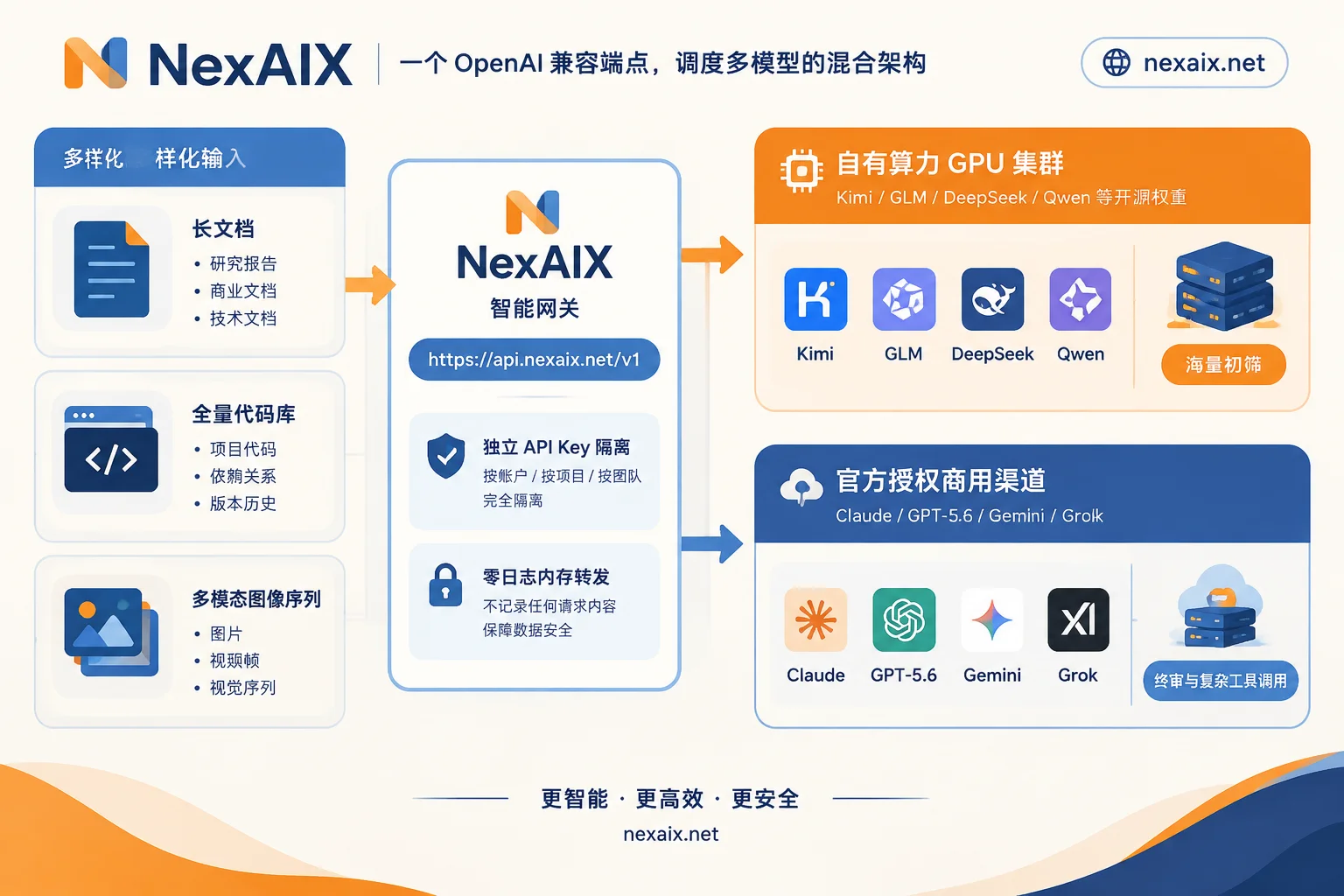
In NexAIX's supply system, all models use only two transparent supply methods (see Transparency and Channel Description):
- Own compute deployment (open-source weights): Official open-source weights are deployed directly on self-built and leased GPU clusters in self-owned data centers, independently operated by our own team, never reselling third-party quotas. The website currently covers mainstream series such as Kimi, GLM, DeepSeek, MiniMax, Qwen, gpt-oss, with each model page clearly indicating context limit, maximum output, inference precision (e.g., BF16, FP8, MXFP4), and open-source license. (For model selection details, see "Kimi API Integration and Migration Guide" and "GLM API Integration and Selection Guide".)
- Official authorized channels (closed-source models): For closed-source flagship series such as Claude, GPT-5.6, Grok, Gemini, we strictly use official commercial authorization channels with contracts, invoices, and auditability, never account pools or reverse-engineered client protocols.
2. Native Full Spec: 100% Transparent Passthrough of Context, Max Output, and Parameters
Long-context applications fear middle layers that "outsmart" by compressing input. NexAIX strictly adheres to the no-downgrade commitment:
- The
modelfield in the response body indicates the model actually performing inference; we never secretly swap to a smaller model or covertly lower inference precision (for precision differences, see "What's the Difference Between Model Inference Precision BF16 and FP8"). - No truncation of context or max output, no injection of hidden system prompts.
- Control parameters such as
temperature,top_p,max_tokensin requests are passed through to the underlying inference engine as-is.
3. Clear High-Load Rate Limiting Contract (429 + Retry-After)
Long-context requests instantly consume large TPM (tokens per minute) quotas. Under NexAIX's high-throughput architecture, open-source model capacity is directly supported by our own GPU clusters, while closed-source models are constrained by upstream official quotas. Each API key has explicit RPM, TPM, and concurrency limits (for higher quotas, contact us; responses are based on actual capacity assessment).
When the cluster is fully loaded during sudden peaks, the API explicitly returns standard HTTP 429 status code with Retry-After response header—never hanging connections indefinitely to block business threads, never silently degrading to cheaper models in the background, fully returning control of backoff retries or switching to alternative models to the business's orchestration code.
4. In-Memory Traceless Forwarding and Clear Compliance Boundaries
Regarding privacy concerns of feeding long documents, NexAIX implements a strict no-conversation-logging mechanism on the platform side:
- User
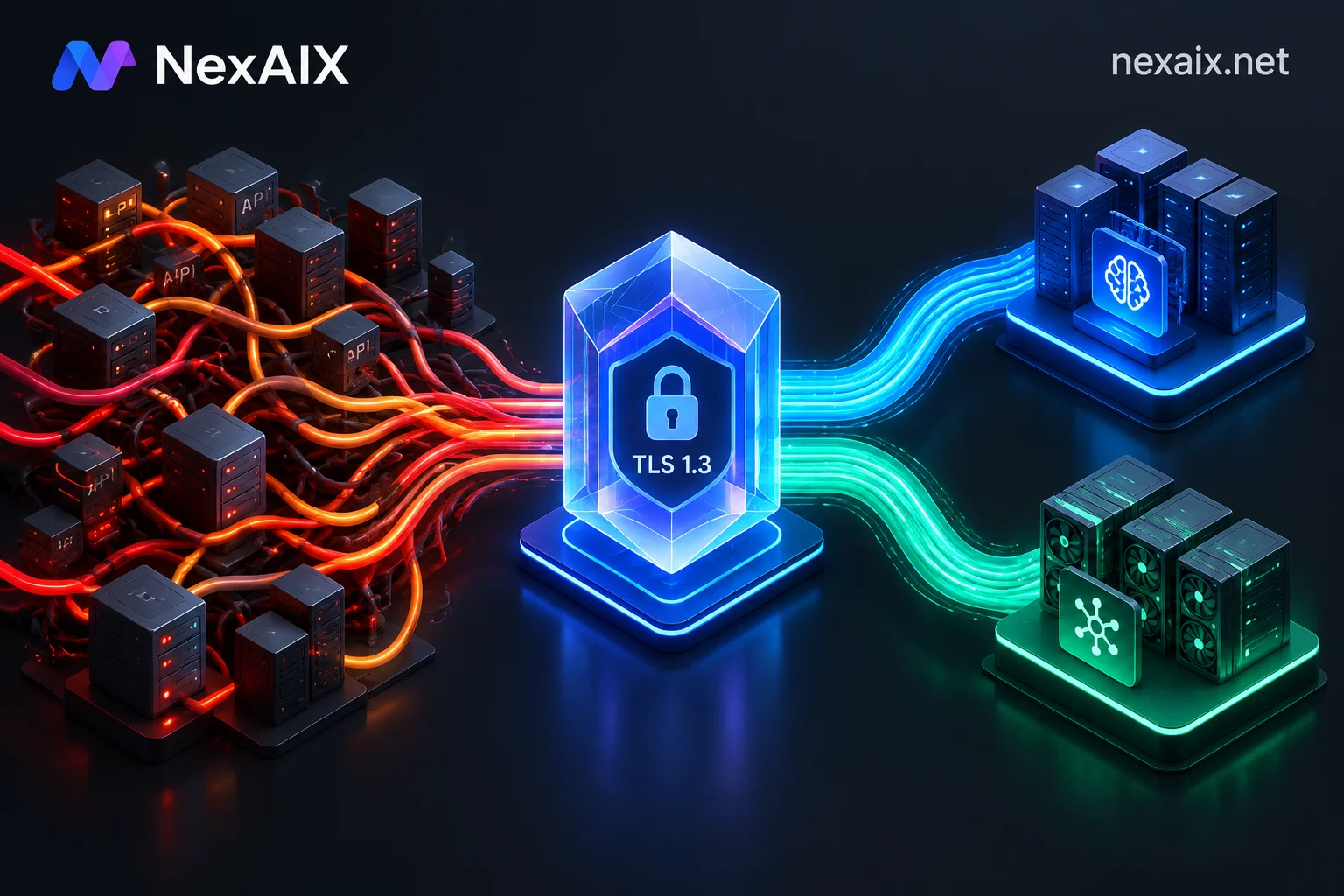
promptandcompletionare forwarded only in memory and released immediately after the request ends, never written to disk, not used for any model training, nor handed to third parties for training. - The platform retains only metadata for billing and troubleshooting (request ID, model name, token count, timestamp, status code), and uses TLS 1.3 encryption throughout from client to inference node.
- Objectively transparent upstream boundaries: For closed-source models, data retention after requests reach the vendor side follows each vendor's official commercial terms; this site does not make false commitments on their behalf. Currently, the website separately notes upstream retention rules on the two Claude model pages (e.g., Opus 5 supports zero data retention, Fable 5 currently has 30-day retention); other models are subject to real-time annotations on the official model pages.
III. Hands-On Verification: How to Stress Test Long-Context API for Anti-Truncation and Recall?
Before integrating million-token context into core business, we recommend engineering teams use the four self-check methods provided by NexAIX (fixed prompt and random seed retesting, verifying the model field, length stress testing near the limit, and asking the model to repeat all received messages) for pre-launch acceptance. (For the complete verification system, see "How to Confirm If an API Returns the Original Model: Four Reproducible Inspection Methods".)
Below, using Python's OpenAI-compatible SDK, we demonstrate how to construct a multi-needle long-context stress test script to simultaneously verify the interface's true window depth, streaming first-token latency, and parameter passthrough integrity:
import time
from openai import OpenAI

# 1. 仅需修改 base_url 与 api_key,即可无缝接入 NexAIX
client = OpenAI(
    base_url="https://api.nexaix.net/v1",
    api_key="sk-your-nexaix-api-key",
    # 超长输入 Prefill 耗时较长,建议显式放宽连接与读取超时
    timeout=300.0
)

def build_long_context_payload(target_chars: int = 400000) -> str:
    """构造包含首、中、尾三个唯一校验暗桩的长文本负载"""
    needle_head = "【暗桩A-位于头部:项目代号为 AURORA-7749】"
    needle_mid  = "【暗桩B-位于50%深水区:核心清算阈值为 0.0428%】"
    needle_tail = "【暗桩C-位于尾部:最终审批哈希为 9f86d081884c】"

    filler_unit = "这是一段用于压测长上下文窗口容量的非结构化行业基准背景文本。" * 20
    half_filler_len = (target_chars // 2) // len(filler_unit)

    part_1 = filler_unit * half_filler_len
    part_2 = filler_unit * half_filler_len

    return f"{needle_head}\n{part_1}\n{needle_mid}\n{part_2}\n{needle_tail}"

def verify_long_context_api(model_id: str):
    long_document = build_long_context_payload()
    prompt = (
        f"请仔细阅读以下长文档,不要遗漏任何中间信息:\n\n{long_document}\n\n"
        "请严格按 JSON 格式提取文档中的三个暗桩信息:项目代号、核心清算阈值、最终审批哈希。"
    )

    start_time = time.time()
    first_token_time = None
    actual_model = None
    collected_content = []

    # 2. 强烈建议对超长上下文开启 stream=True,避免网关等待超时
    response = client.chat.completions.create(
        model=model_id,  # 例如传入模型页标注的 model ID,如 glm-5.2
        messages=[
            {"role": "system", "content": "你是一个严谨的文档审计助手。"},
            {"role": "user", "content": prompt}
        ],
        temperature=0.0,
        max_tokens=512,
        stream=True
    )

    for chunk in response:
        if first_token_time is None and chunk.choices and chunk.choices[0].delta.content:
            first_token_time = time.time() - start_time
            actual_model = chunk.model
        if chunk.choices and chunk.choices[0].delta.content:
            collected_content.append(chunk.choices[0].delta.content)

    total_time = time.time() - start_time
    print(f"[验证结果] 实际执行模型: {actual_model}")
    print(f"[性能指标] 首 Token 延迟 (TTFT): {first_token_time:.2f}s | 总耗时: {total_time:.2f}s")
    print(f"[召回内容] {''.join(collected_content)}")

if __name__ == "__main__":
    # 实际可用模型 ID 及上下文规格请以 https://nexaix.net/models/ 为准
    verify_long_context_api("glm-5.2")
Integration detail note: When browsing the NexAIX model catalog, the URL for a single model detail page uses the format of replacing dots with hyphens inslug(e.g., visithttps://nexaix.net/models/glm-5-2/to view context specs, inference precision, and three-step integration code; directly spelling/models/glm-5.2/returns 404), but in the code'smodelrequest field, you still need to fill in the original model ID as indicated on the page (e.g.,glm-5.2).
IV. Architecture in Practice: Long-Context Multi-Model Hybrid Scheduling and Cost Governance
In real enterprise applications, blindly throwing all requests to the most expensive closed-source million-context model often leads to runaway compute bills. (For more cost accounting tips, see "AI API Cost Optimization Practical Guide: From Agent Multi-Model Tiering and Hidden Loss Troubleshooting to Multi-Key Billing Governance".)
With NexAIX's OpenAI-compatible single-endpoint capability, development teams only need to maintain one base_url (https://api.nexaix.net/v1) and one API key to flexibly orchestrate open-source and closed-source long-context models by switching the model field under the exact same interface specification:
- Massive unstructured cleaning and initial screening (own compute open-source weights):
For scanning millions of words of raw logs, prospectuses, or full code repositories, prioritize calling Kimi, GLM, DeepSeek, MiniMax, or Qwen series models deployed on NexAIX's own GPU clusters. You get highly competitive throughput cost-performance and capacity stability under high concurrency backed by own compute. - High-density final review and complex tool orchestration (official authorized closed-source flagships):
Pass the distilled core context and multi-step decision chains to Claude, GPT-5.6, Gemini, or Grok series via official authorized channels for final logic verification or function calling. - Seamless multimodal long-context fusion:
When long documents contain many architecture diagrams, financial charts, or long video frame sequences, directly select models supporting visual input according to the "input modalities" noted on model detail pages. Images are passed in standard OpenAI multimodal format asimage_urlorbase64, and videos as frame-extracted image sequences, without refactoring gateway code. - Zero-modification integration with ecosystem tools:
If your team uses LangChain, LlamaIndex, Vercel AI SDK to build document pipelines, or Dify, Cherry Studio, NextChat, Cline, OneAPI for daily development assistance, simply point the custom OpenAI base URL to NexAIX to immediately unlock all activated long-context models. - Per-key isolation and precise troubleshooting:
In production, we recommend creating separate API keys for "long-document batch processing pipelines" and "online real-time interactive agents". NexAIX supports independent quotas, permissions, and per-model usage billing for each key; if a business line has abnormal calls or key leakage, it can be revoked separately at any time. Additionally, each API call returns a unique Request ID; when troubleshooting timeouts or rate limits, simply contact technical support with the request ID to quickly locate link status.
V. Summary and Quick Start Guide
As context windows enter the million-token era, the success of AI applications is often determined not by theoretical scores on leaderboards, but by whether the underlying API infrastructure can achieve true window without truncation, true precision without downgrade, no hanging under high load, and no disk writes for sensitive documents.
Whether you are an architect upgrading an existing RAG system to long context or a technical lead maintaining complex agents in production, you can quickly verify with NexAIX in three steps:
- Get credits and start testing: Visit the NexAIX Console (api.nexaix.net) and register directly with your email—no enterprise qualification required, free test credits upon registration. Generate an API key with one click and export usage details anytime.
- Select target model: Go to the Model Marketplace (nexaix.net/models) to check context length, max output, inference precision, and three-step integration code for desired open-source or closed-source models; if your business requires specific open-source long-text models not in the list, send the model name and estimated usage to [email protected], and the engineering team will assess compute capacity and reply with scheduling.
- Enterprise-grade compliance assurance: For teams and enterprise clients with strict audit requirements, NexAIX has a complete legal entity and supports signing formal commercial contracts, issuing invoices, and signing service level agreements (SLA) and data processing agreements (DPA); for core confidential long-document scenarios, you can further contact [email protected] to discuss dedicated resource pools and private deployment solutions.


Comments(0)