 NexAIX-官方博客
In the last two weeks of October 2026, technical leads and developers maintaining production AI applications experienced three representative industry shocks in succession:
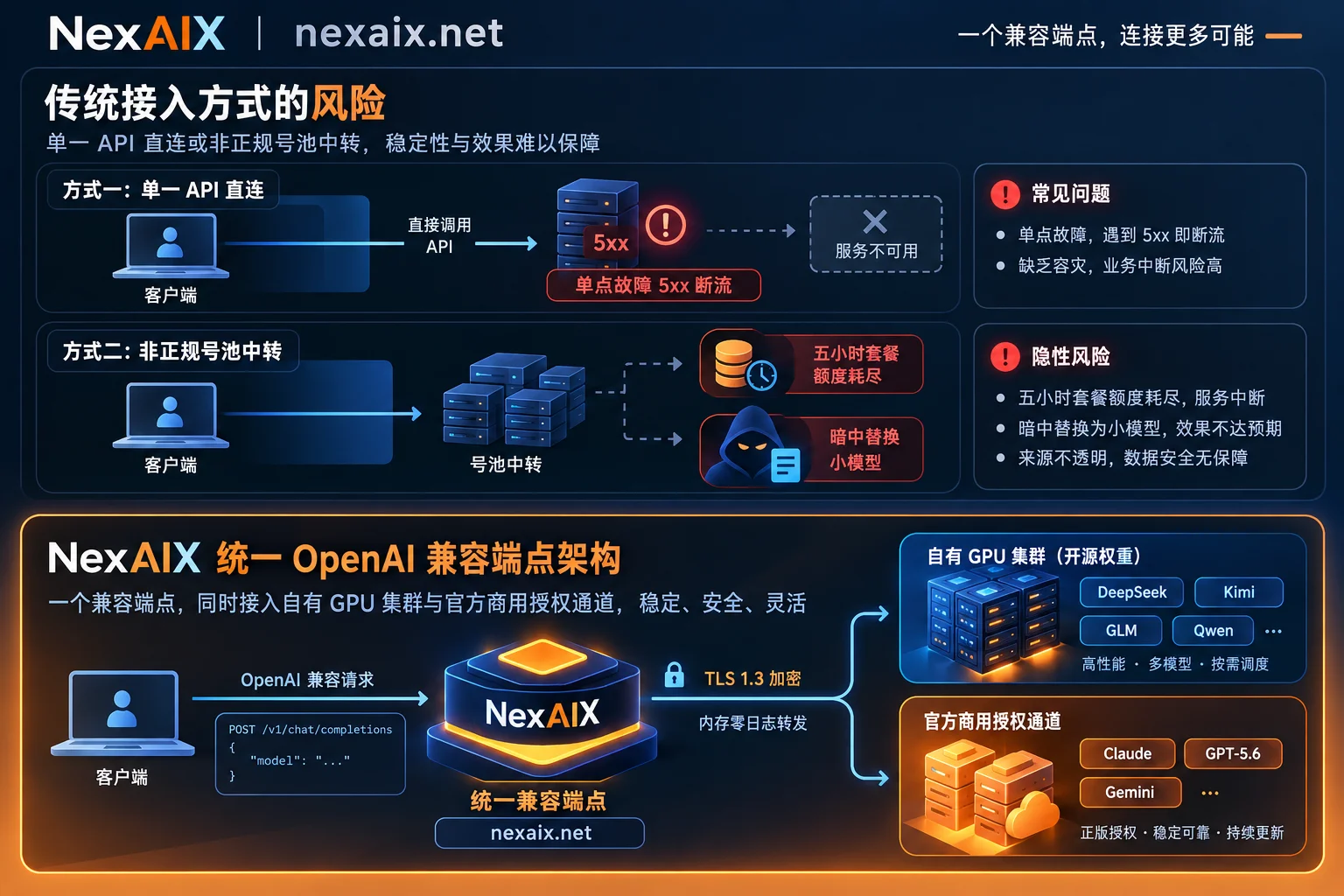
- Single-point service outage: During the morning peak on October 15, the official open platform and web interface of a leading open-source model suddenly experienced a service anomaly lasting nearly 5 hours. Although the official team later offered a sincere full compensation plan for 7 days of consumption, for online businesses heavily reliant on a single official direct connection, 5 hours of
5xxerrors meant the front-end business process came to a direct halt. - Third-party tool key leak crisis: On the weekend of October 18, a popular open-source AI coding tool with over 200,000 GitHub stars exposed an unauthorized access vulnerability in its legacy system, leading to the leak of some third-party LLM API keys bound to the cloud. Many developers had their quotas drained by malicious scripts while sleeping, and even triggered cloud provider anti-fraud risk controls, causing production accounts to be completely suspended.
- The game between model iteration and compute hunger: As new-generation models such as DeepSeek V4.1 Flash, MiniMax M3.1 Flash, and Kimi K3.1 Pro were intensively released in October, coding and complex agent tasks pushed daily token consumption to new highs. Many teams relying on monthly subscription plans (Pro/Max accounts) or unofficial "account pool relays" found that running a few complex tasks quickly hit the hidden five-hour quota limit.
These three incidents jointly point to a fact: when AI applications move from demo to core production environments, "which model to choose" is only the starting point; "how to ensure the determinism, security, and compliance of the LLM API链路" is the cornerstone that determines business survival.
This article will break down a practical production-grade LLM API access solution from four engineering dimensions: architectural redundancy, key governance, supply chain verification, and client-side backoff.
1. Breaking "Single-Point Dependency": Why Direct Connection to the Original Manufacturer Also Needs Backup Compute Channels?
In early project development, directly connecting to the original manufacturer's API is the most natural choice. But in production environments, the original manufacturer's API often faces dual challenges: first, during new model releases or morning/evening peaks, the official cluster simultaneously carries massive C-end users on the web and API traffic, making it highly prone to long-tail latency or service degradation due to compute contention; second, once a data center-level or gateway-level failure occurs, if the R&D team temporarily registers an account with another vendor, reads heterogeneous documentation, and refactors authentication and request code, the recovery time (MTTR) is usually measured in days.
To eliminate single points of failure, the core lies in "standardization of interface protocols" and "decoupling from underlying physical compute".
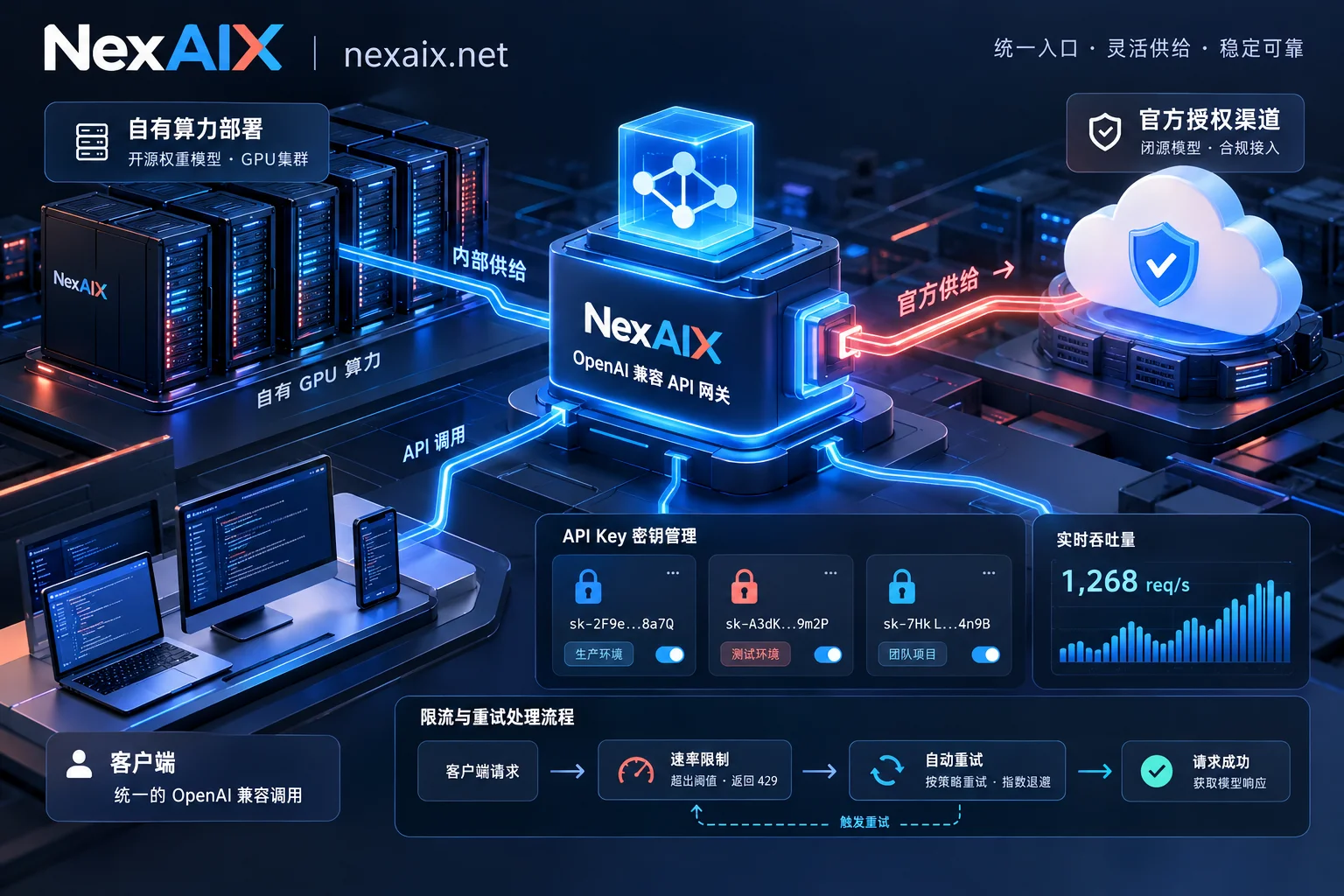
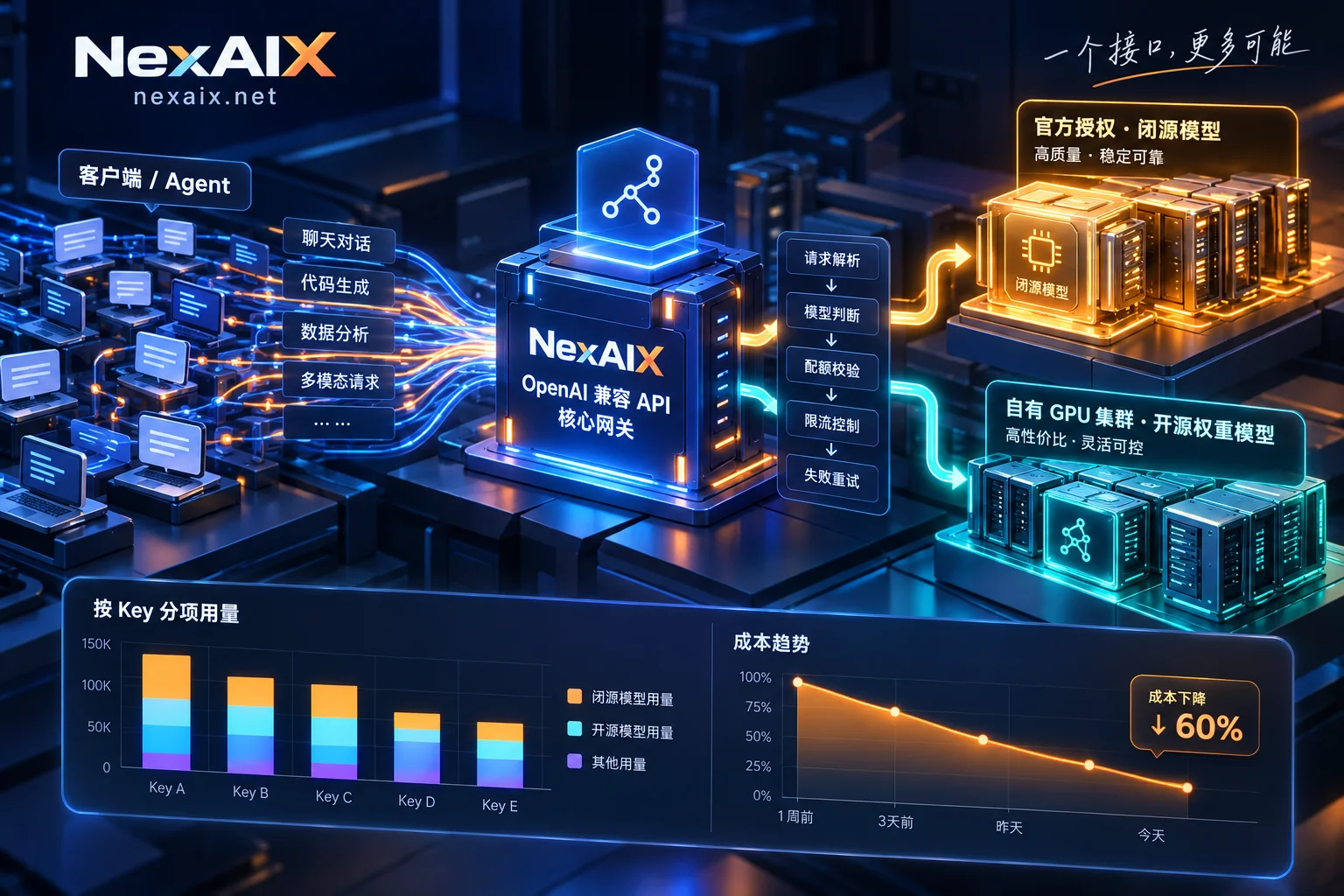
At NexAIX, through a unified endpoint (https://api.nexaix.net/v1) fully compatible with the OpenAI Chat Completions specification, we converge open-source weight models and closed-source commercial models under the same calling standard:
- Self-owned compute deployment (physical-level decoupling): For open-source weight models officially released by DeepSeek, Kimi, GLM, MiniMax, Qwen, gpt-oss, etc., NexAIX does not resell third-party API quotas but deploys the models directly on self-owned GPU clusters in self-built and leased data centers for independent operation and maintenance. This means that even if some external public open platform experiences gateway congestion due to traffic peaks, open-source weight instances running on NexAIX's self-owned clusters can still provide independent compute support.
- Officially authorized channels (compliant closed-source supply): For closed-source models such as Claude, GPT-5.6, Grok, and Gemini, NexAIX accesses them through the vendors' official commercial authorization channels, with contracts, invoices, and auditability. Capacity is constrained by upstream commercial quotas, fundamentally isolating the risks of personal account bans and reverse protocol failures.
The specific list of models on sale, context windows, maximum output, and inference precision (such as BF16, FP8, MXFP4, etc.) can be checked in real time on the NexAIX Model Marketplace. For the boundaries of these two supply methods and self-check methods, please also refer to our previous article "What's the Difference Between Open-Source Weight Model APIs and Official Authorized Channels: Precision, Context, Retention, and Rate Limiting".
2. From "One Key for Everything" to "Per-Key Isolation": Coping with Key Leaks and Internal Audit
Looking back at the key leak incident of the open-source coding tool in mid-October, many teams suffered heavy losses because they shared the same highest-privilege API key across local IDE plugins (such as Cline, Cursor), internal test workflows (such as Dify), and online production services. Once a third-party tool has a security vulnerability or an employee's device is infected with a Trojan, attackers can use this key to drain the entire enterprise account's quota, and even cause core online business to be cut off due to arrears or risk control.
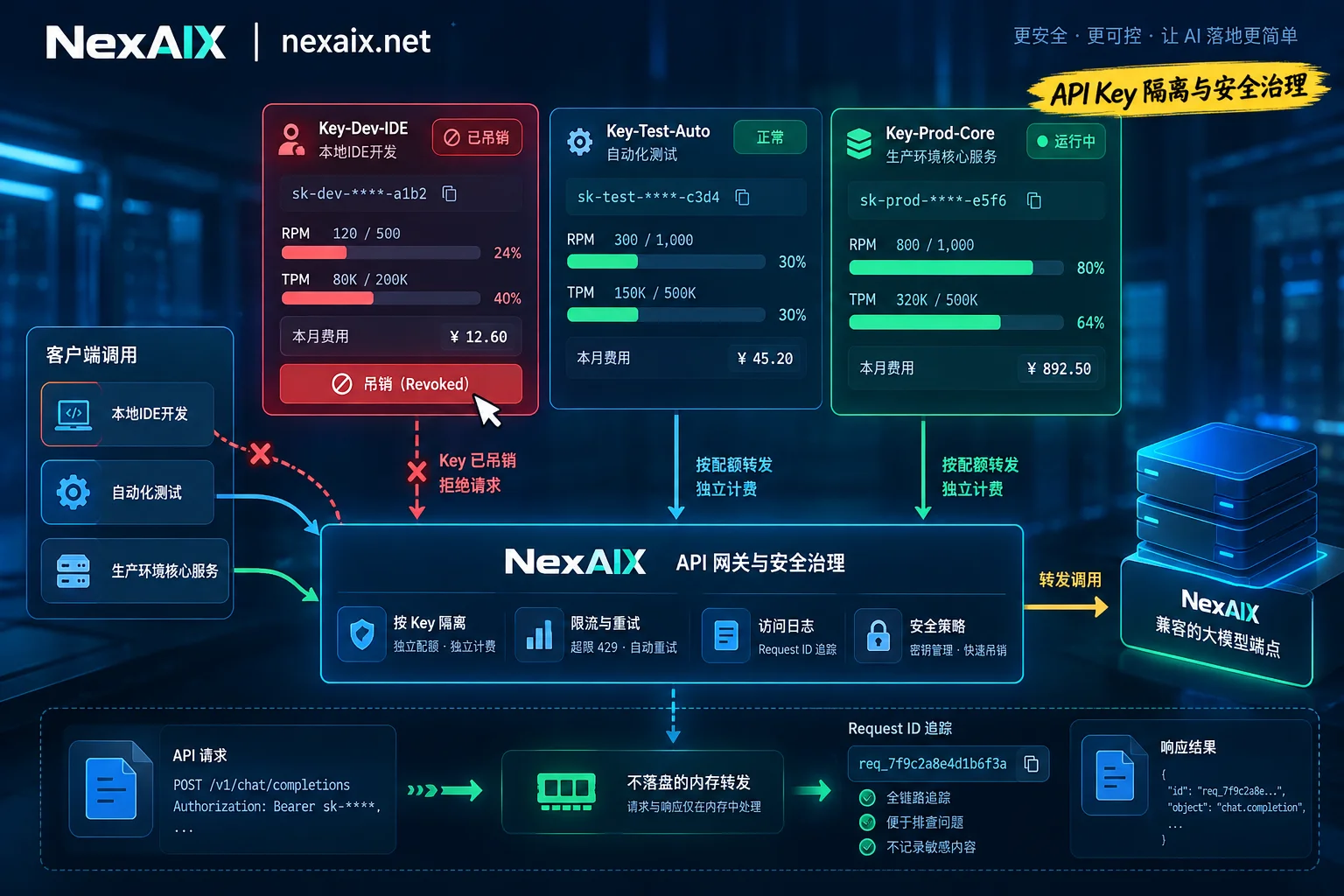
Managing LLM APIs in production requires strict enforcement of the principle of least privilege and physical isolation. In NexAIX's security and privacy design, we provide clear key isolation and log desensitization mechanisms:
- Each key has independent quotas, independent permissions, and independent billing: Technical leads can create different API keys for "R&D local IDE", "CI/CD automated testing", and "production business A". Each key's RPM (requests per minute), TPM (tokens per minute), and concurrency limits are independent. Even if a developer's external plugin leaks a key, administrators only need to revoke that leaked key separately in the console, and the production service key is completely unaffected. For more detailed key tiering practices, please refer to "How to Obtain, Store, and Distribute AI API Keys: Access and Isolation from Local Development to Production".
- Per-model itemized billing and request ID tracking: The console supports exporting usage details, with bills clearly itemized by key and model, completely eliminating multi-platform confusion. Each API call returns a unique request ID (Request ID); when troubleshooting or auditing abnormal calls, simply include the request ID for quick localization.
- No conversation content logging (Zero-Logs): At the data security level, the entire path from client to inference node is encrypted with TLS 1.3. On the NexAIX side, users'
promptandcompletionare only forwarded in memory and released immediately after the request ends; they are never written to disk, not used for model training, nor shared with third parties for training; the platform only retains metadata such as request ID, model name, token count, timestamp, and status code for reconciliation and troubleshooting. (Note: After requests for closed-source models reach the upstream vendor, their upstream data retention is handled according to each vendor's commercial terms. For example, the Claude model page currently separately notes that Opus 5 supports zero data retention, while Fable 5 currently has 30-day retention; please refer to each model page for details.)
3. Avoiding Pitfalls in Channels During the Era of Tightening Compute: Reject "Account Pool Carpooling" and "Hidden Downgrading"
With the popularity of complex agents and million-level long context tasks, it has become normal for a single task to consume hundreds of thousands or even millions of tokens. Recently, many developers have reported that some relay stations in the market under the banner of "ultra-low discounts" frequently show cliff-like drops in answer quality, inexplicable loss of context, or bizarre 403/502 errors when running high-intensity code generation or long document analysis.
According to evaluation reports from independent research institutions, there are two major chronic problems in the current unofficial relay market:
- Fragility of reverse engineering and account pools: Using batch-registered personal Pro/Max membership accounts to form an "account pool" and providing APIs through reverse-engineered web or client protocols. Once the original manufacturer tightens the five-hour quota of subscription plans or upgrades risk control, such channels will experience large-scale errors and interruptions.
- "Model swapping" and "precision reduction" during peak periods: When compute is tight or to compress costs, some platforms secretly route requests intended for flagship models to lightweight small models in the background, or use extremely low-precision quantized weights that greatly degrade quality, or even forcibly truncate input context and inject hidden system prompts to limit output length.
In production environments, this unpredictable "black-box operation" is more dangerous than direct errors—it can directly cause Agent tool calling format parsing failures or distortion of financial/code risk control logic.
To address this pain point, NexAIX adheres to the engineering bottom lines of Transparency and No-Dilution:
- Only two legitimate supply types: All models on the site only carry the labels "Self-owned compute deployment" and "Official authorized channel", completely eliminating account pools and reverse protocols.
- Parameters passed through as-is and full precision: The
modelfield in the response body is the model that actually performed inference. No swapping to smaller models, no precision reduction, no truncation of context or maximum output, no injection of any hidden system prompts; parameters such astemperature,top_p,max_tokensin requests are passed through as-is. The specific inference precision (such as BF16, FP8, etc.) of each model is publicly stated on the model detail page (Note: When accessing a single model detail page, the slug in the URL needs to replace dots in the model ID with hyphens. For example, to view the specifications and three-step integration code forglm-5.2, please visit https://nexaix.net/models/glm-5-2/, while themodelfield in the API request body should still be filled withglm-5.2). - Support for four verifiable self-check methods: We encourage technical teams to conduct strict verification before and after integration—including retesting with fixed prompts and random seeds, checking the
modelfield in the response body, stress-testing context with lengths close to the limit, and inducing the model to repeat all received messages to detect hidden prompts. For detailed verification steps, please refer to "How to Confirm Whether an API Returns the Original Model: Four Verifiable Inspection Methods".
4. Practical Client-Side Controllable Disaster Recovery: Building Resilient Architecture with Standard 429 and Streaming Output
It should be clear that to ensure absolute transparency and predictability of the call chain, NexAIX adopts a single-supplier and single-endpoint design and does not provide black-box "automatic routing and failover". When a self-owned cluster of an open-source model or the upstream quota of a closed-source model reaches its concurrency/rate limit and is fully loaded, NexAIX will not hang the connection indefinitely causing client timeouts, nor will it arbitrarily route your request to another cheaper model; instead, it will immediately return the standard HTTP 429 Too Many Requests status code and include a clear Retry-After time in the response header (see Throughput and Rate Limiting documentation).
Returning control to the business side means architects can write fully controllable backoff, queuing, or cross-model degradation strategies based on the real needs of their business. Since all open-source and closed-source models on NexAIX use the same OpenAI-compatible interface and the same key, switching to a backup model only requires changing the model field in the request.
Below is a production-grade client-side disaster recovery example based on the official Python openai SDK: when the primary model triggers rate limiting (429) or encounters a brief network anomaly, first read Retry-After for controlled backoff; if an immediate response is still needed, explicitly switch to a backup model under the same endpoint (all models support streaming output and tool calling):
import time
from openai import OpenAI, RateLimitError, APIStatusError

# 仅需修改 base_url 并填入 NexAIX API Key
client = OpenAI(
    base_url="https://api.nexaix.net/v1",
    api_key="YOUR_NEXAIX_API_KEY",
    timeout=60.0,
    max_retries=0  # 关闭默认黑盒重试,由业务层显式控制退避与切流
)

def chat_with_controlled_fallback(messages, primary_model, backup_model):
    try:
        return client.chat.completions.create(
            model=primary_model,
            messages=messages,
            temperature=0.2,
            stream=True
        )
    except RateLimitError as e:
        # 捕获标准 429 限流,读取 Retry-After 响应头
        retry_after = int(e.response.headers.get("Retry-After", 2))
        print(f"[Warn] 主模型 {primary_model} 触发限流,建议等待 {retry_after}s。Request ID: {e.request_id}")

        # 策略分支:若等待时间在可接受阈值内则退避重试,否则显式切至备用模型
        if retry_after <= 3:
            time.sleep(retry_after)
            return client.chat.completions.create(
                model=primary_model,
                messages=messages,
                temperature=0.2,
                stream=True
            )
        else:
            print(f"[Fallback] 显式切换至备用模型: {backup_model}")
            return client.chat.completions.create(
                model=backup_model,
                messages=messages,
                temperature=0.2,
                stream=True
            )
    except APIStatusError as e:
        print(f"[Error] 状态码 {e.status_code},Request ID: {e.request_id},切至备用模型 {backup_model}")
        return client.chat.completions.create(
            model=backup_model,
            messages=messages,
            temperature=0.2,
            stream=True
        )
Engineering tip: When handling million-level ultra-long context inputs, the first token latency (TTFT) and cost will naturally increase with input length. It is recommended to enable streaming output (stream=True) in production to optimize front-end interaction experience and avoid gateway-level connection timeouts. For in-depth handling of various error codes, please refer to "How to Read AI API Error Codes: Causes, Retries, and Degradation for 400, 401, 404, 429, 5xx, and 529".5. Summary and Integration Guide
Whether dealing with sudden service outages, preventing key leaks from external tools, or solving compute throttling in the Agent era, the core of building production-grade AI applications lies in choosing an LLM API channel with transparent supply sources, zero data retention, complete isolation mechanisms, and compliance auditability.
- Quick testing and migration: Individual developers and technical teams do not need enterprise qualifications; they can register with an email on the NexAIX Console and receive test credits. If you are using OpenAI SDK, LangChain, LlamaIndex, Vercel AI SDK, or clients such as Dify, Cherry Studio, NextChat, Cline, OneAPI, you only need to change
base_urltohttps://api.nexaix.net/v1and replace the key for seamless integration. - Higher quotas and customization needs: If the RPM/TPM quota of your existing key cannot meet your high-concurrency business, you can apply for a quota increase in the console; if the open-source weight model you need is not in the current model list, or if your enterprise has compliance requirements such as corporate contracts, VAT invoices, data processing agreements (DPA), independent resource pools, and private deployment, please feel free to email [email protected] (including the required model and estimated usage). Our engineering team will evaluate compute and provide scheduling and customization plans.


Comments(0)