 NexAIX-官方博客
Privacy Risks Span Two Layers: Vendor Retention and Relay Logs
During AI API calls, prompts, generated content, and context pass through two stages: the upstream model vendor's inference clusters and the relay or gateway services on the call path. Privacy risks correspond to these two layers:
- Vendor Layer: Whether the model provider (OpenAI, Anthropic, etc.) uses request data for training and how long logs are retained in the cloud for security auditing purposes
- Relay Layer: Whether self-built gateways or third-party relay services record plaintext conversation content and whether API key permissions are isolated per account
The data handling policies of these two layers are completely independent and need to be verified separately.
Vendor Layer: Commercial APIs Don't Train, but Logs Retained 7-30 Days by Default
Mainstream commercial APIs have two basic promises in their privacy policies:
- No customer data for training: OpenAI and Anthropic's commercial API terms explicitly state that content submitted through developer interfaces like
/v1/chat/completionsis not used by default for training or improving generative models - Short-term retention of abuse monitoring logs: For security and abuse monitoring needs, vendors encrypt and retain API request and response data in the cloud for a period. OpenAI retains for up to 30 days by default, and Anthropic has a similar mechanism
Note that web-based chat products (such as ChatGPT free or personal subscriptions) follow completely different data agreements than developer APIs. Most personal web chat versions use or prompt users to enable conversation training authorization, while commercial APIs used in production fall under enterprise data with higher privacy protection. Developers must not confuse the two.
Zero Data Retention (ZDR) Requires Application
If a business cannot tolerate any short-term cloud retention, vendors typically offer Zero Data Retention (ZDR) agreements for enterprise customers: all content is deleted immediately after the request ends, with no log archiving. However, such agreements require separate application, usually involving enterprise qualification review or a paid higher service tier.
For most application scenarios, the default 7-30 days encrypted retention meets compliance requirements. Scenarios that truly need ZDR are concentrated in heavily regulated industries like healthcare and finance, or enterprise internal tools handling highly sensitive data such as core code or trade secrets.
Relay Layer: Core Risk Is Whether Plaintext Conversations Are Recorded
When using relay or gateway services, data exposure risks concentrate on whether the service persists request bodies. If a relay site logs the full prompt and generated content of each call into a database, that data resides long-term in a third-party system, with privacy risks far exceeding vendor short-term encrypted logs.
A compliant relay service should follow the release on request completion principle:
- Only record metadata needed for billing, such as token count, model name, timestamps
- Do not persist conversation content, system prompts, or function call parameters
- Enforce strict isolation of quotas, permissions, and usage bills via API keys, with each key independently accounted and logs not shared across accounts
When choosing a relay service, you need to confirm the following three points:
- Whether conversation content is recorded: The service's privacy statement or technical documentation should explicitly state that plaintext bodies of requests and responses are not saved
- API key isolation mechanism: Whether each key's quota, rate limits, and usage logs are independent to prevent cross-tenant data leaks
- Log audit scope: If the service claims to retain logs for troubleshooting, clarify the degree of desensitization and automatic deletion period
For example, NexAIX promises not to record conversation content, releases data as soon as requests finish, and only audits token counts for billing; API keys are strictly isolated per account, with transparent quotas and rate limits. Such mechanisms can be verified on the advantages page.
Sensitive Data Tiered Routing: Combining Private Compute and Official Licensing
For highly sensitive data (e.g., medical records, financial transactions, core code), relying solely on vendor or relay privacy promises may not suffice. Production environments typically adopt a tiered strategy:
- Non-exportable data: Route to open-weights models deployed on private compute, with data never leaving the enterprise intranet or dedicated clusters
- Ordinary business data: Call official commercial licensing channels, accepting short-term log retention
- Pre-desensitization: Deploy PII (personal identifiable information) and credential desensitization middleware on the client network layer, filtering sensitive fields before sending to models
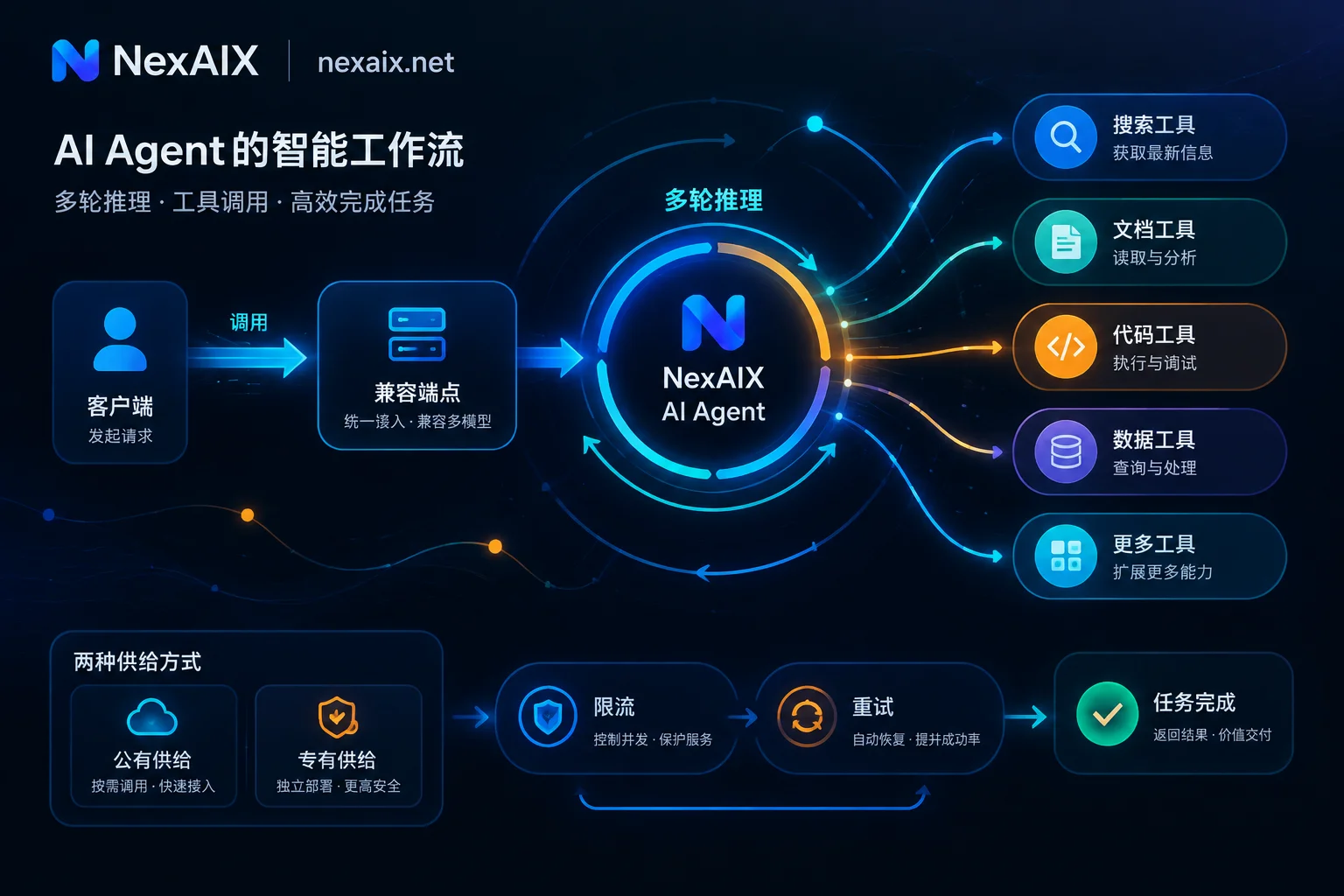
When choosing a relay service, confirm whether it supports hybrid supply. For example, NexAIX deploys open-weights models on its own compute clusters, while closed-source models go through vendor official licensing channels. Each model's supply method is indicated on the model list, allowing developers to choose routing strategies based on data sensitivity.
Verification Checklist: Four Confirmation Points for Privacy Risks
When integrating or migrating AI APIs, confirm privacy risks in this order:
- Vendor agreement: Confirm whether the commercial API of the target model promises not to use customer data for training, the log retention period, and whether ZDR is supported
- Relay recording: If using a relay service, clarify whether it logs conversation content and whether data is released immediately after requests
- Key isolation: Confirm whether API key quotas, rate limits, and usage are accounted independently per account to prevent cross-tenant data mixing
- Tiered routing: For highly sensitive data, assess whether some requests need to be routed to open-weights models deployed on private compute
If you need to quickly verify a relay service's privacy mechanisms, you can obtain a test key from the integration documentation and perform actual calls to inspect response headers, log scope, and billing details, confirming that data handling meets expectations.



Comments(0)