 NexAIX-官方博客
The core of routing control on AI API aggregators lies in three elements: the model identifier in the request, upstream binding, and the fallback switch—all of which must be verifiable. In August 2026, mainstream gateway updates strengthened derived credential restrictions, but black-box routing mechanisms can still divert requests to alternate models, causing subtle style drift on the business side. For applications that demand high determinism, the priority is to turn this inexplicable success into explicit failure or controlled retries.
Understanding Routing Control on AI API Aggregators
In the typical chain shown in 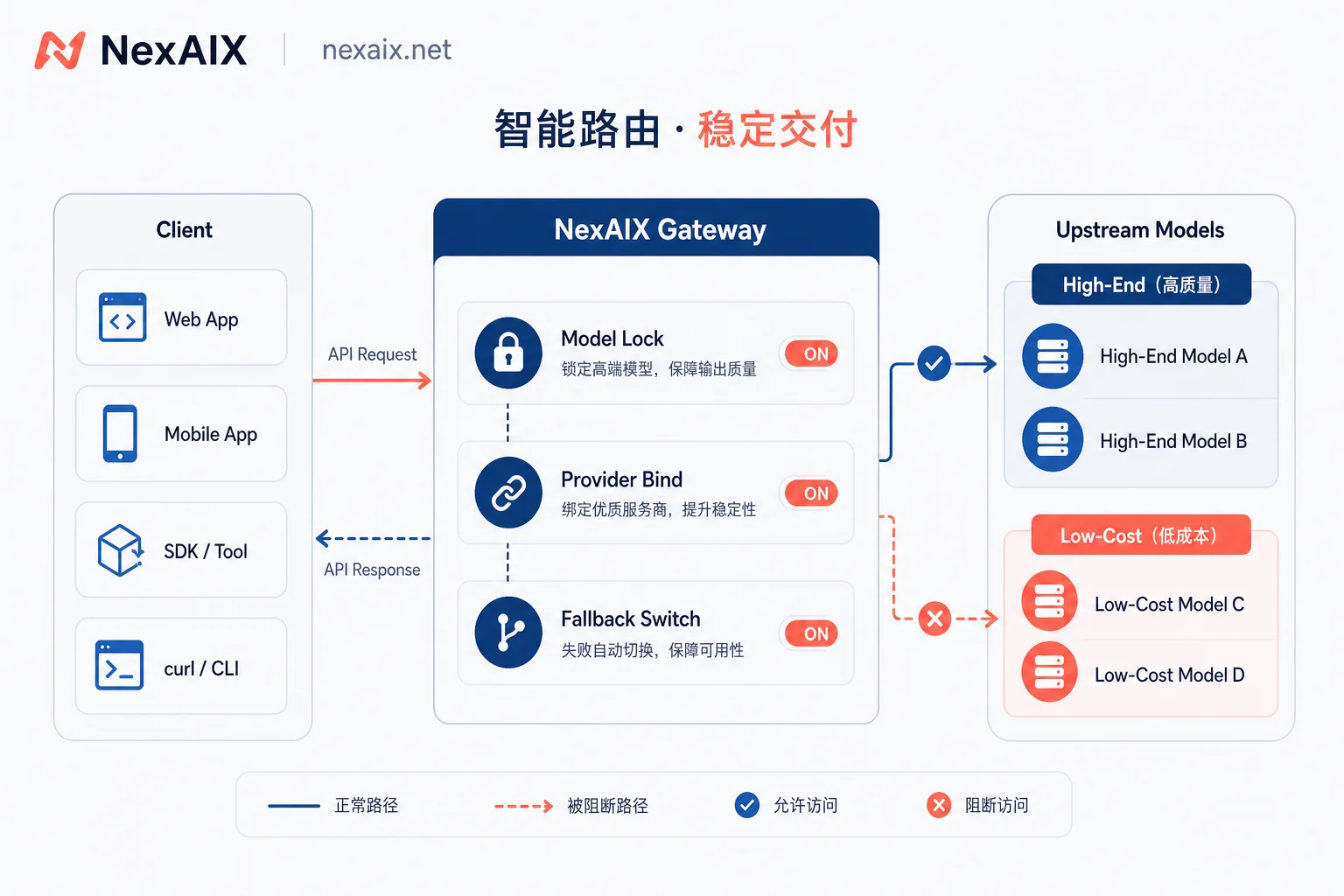 , many teams mistakenly believe that a multi-tier architecture provides availability insurance—but this is not the case. In chains sensitive to output consistency, the default auto-routing might, when the primary provider is congested, compensate by switching to another provider or even a cheaper model. This mechanism maintains HTTP 200 status but sacrifices output style consistency and structured output compliance, causing downstream business logic to silently fail due to subtle data format changes. To regain control, configuration must be applied at three levels:
| Control Level | Key Parameter/Mechanism | Description |
|---|---|---|
| Request Layer | model identifier | Must use the full versioned ID, not an alias, to prevent service provider internal mapping substitution |
| Gateway Layer | provider binding | Explicitly specify upstream ownership to avoid random node assignment by load balancing algorithms |
| Credential Layer | allowed_models | OpenRouter updated its specifications on August 19, 2026, allowing restriction of available models at key issuance time |
These parameters, combined with account-level workspace policies, form a closed loop. Relying solely on temporary code specifications is easily overridden by backend default routing policies. When selecting a platform, refer to the evaluation dimensions in How to Choose AI API Aggregators, focusing on their support for routing transparency.
Configuration Details for Forcing a Specific Model and Bypassing Auto-Routing
In OpenAI-compatible interfaces, the core of forcing a specific model and bypassing auto-routing lies in the proper use of extension fields. Field names vary slightly among platforms, but the common logic is to explicitly disable the fallback switch and lock candidate order in the upstream selection object within the request body. During integration, carefully check the platform's documentation to see if account-level default routing policies might override per-request settings. Only when the priorities of the request layer and gateway layer align can traffic be prevented from being diverted unintentionally. For example, some platforms support similar structured injection; the specific syntax should follow the standard compatibility layer configuration mentioned in How to Change OpenAI base_url, avoiding hard-coded private fields.
Trade-offs When Disabling Fallback Under Load
Once fallback is disabled, the system behavior changes from “silent switching” to “explicit errors.” The most noticeable change is frequent HTTP 429 errors under high load. What to do if you get 429 after disabling fallback? This requires distinguishing between two scenarios: first, account-level RPM/TPM quota exhaustion, which requires adjusting limits or shaping requests; second, server-side transient saturation, in which case you should implement exponential backoff with jitter. DeepInfra's Priority Service Tier, introduced in June 2026, offers a pay-for-determinism solution: for 1.5x the base price, you can skip the queue, suitable for latency-sensitive high-value chains. However, this is not a panacea; standard chains still need scientific backoff algorithms to avoid retry storms.
Triple Cross-Check to Verify Model Consistency
How can you be sure you are actually getting the specified model? Simply checking the response status code is insufficient. Perform the following three-step verification:
- Field Comparison: Check whether the
modelfield in the response matches the request exactly (including version suffix). If not, determine whether it's alias normalization or actual substitution. - ID Tracing: Use the Request ID in the response to query the actual execution record of that call in the console, confirming billing and log attribution. For details on log retention, see How to Verify Zero-Log AI APIs.
- Usage Verification: Verify that the token counts in
usagematch the unit price of the selected model, preventing abnormal cost fluctuations due to switching to a cheaper model.
Together, these three checks form a strong evidence chain; the absence of any one dimension may lead to misjudgment.
Shadow Degradation Detection by Running the Same Test Cases with Different Endpoints
To continuously monitor how to detect if an aggregator is secretly switching models, it is crucial to build a reproducible detection script. Fix the prompt set, sampling parameters (e.g., temperature to zero), and concurrency window, and only change the base_url and API key, comparing outputs across different providers or the same provider at different times. Focus on distribution changes rather than single differences: if the word-for-word consistency rate of output text collapses overall, or the first-packet latency distribution becomes bimodal, a routing policy change is highly likely. Scheduling this script as a periodic task provides a better reflection of production stability than one-time tests. In 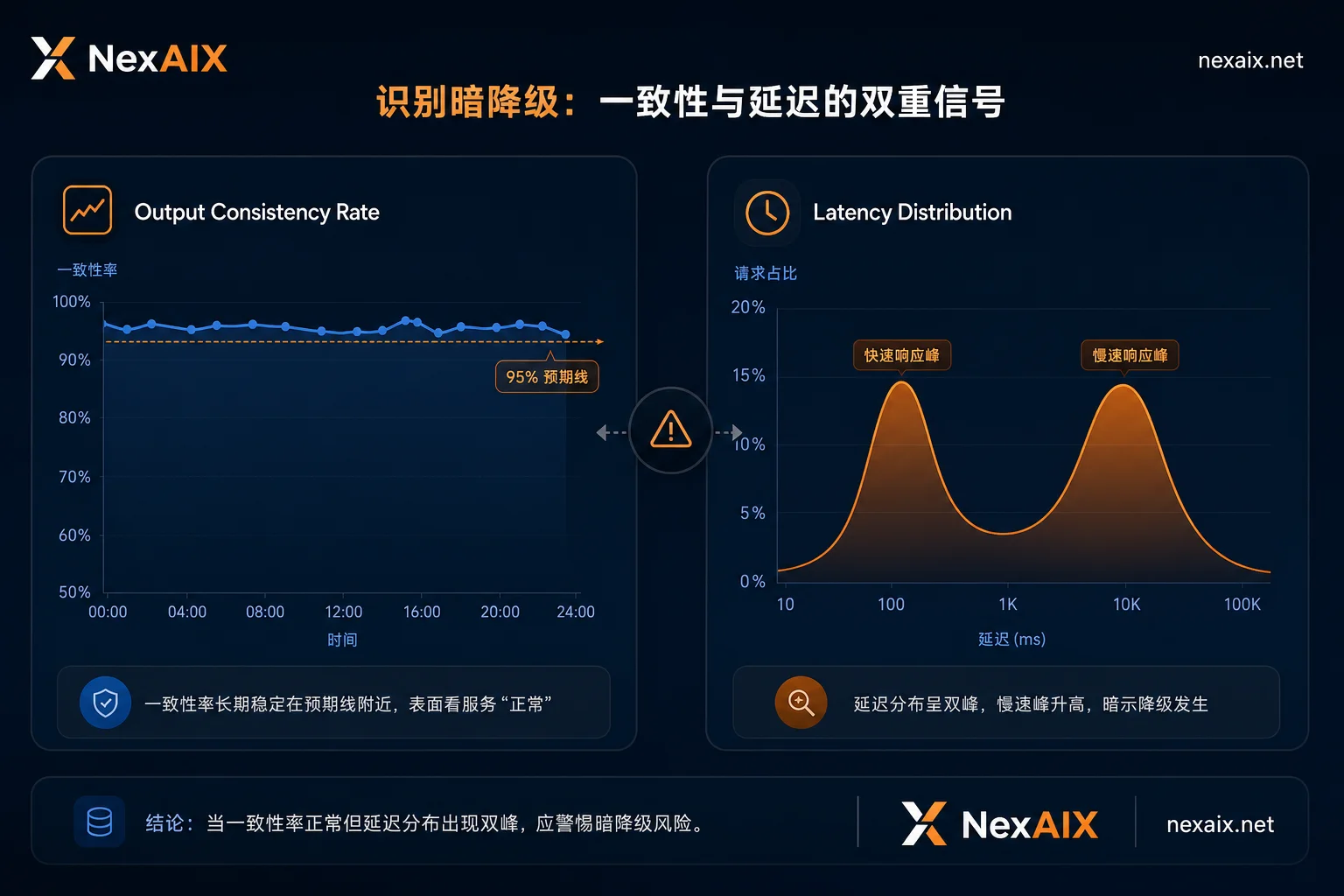 , we should look at the distribution shape rather than individual values, using it as the baseline after performance testing. For specific testing methods, refer to the standard process in AI API Performance Testing.
Boundaries and Exceptions of Client-Side Verification
Although the methods above can verify routing behavior, there are hard boundaries. The quantization accuracy of weights, whether the upstream is an official channel, and whether the server retains prompts cannot be reliably inferred from responses; they depend solely on the service provider's contractual terms and public commitments. Additionally, output quality degradation might stem from context truncation strategies or cache hit differences. During troubleshooting, first rule out these factors before suspecting model substitution. For some domestic providers with overseas nodes where real-time failover latency is opaque due to insufficient SLA transparency, it is advisable to rely on continuous endpoint probing for self-monitoring.
Frequently Asked Questions
Can auto-routing send requests to cheaper models?
Yes, this is an inherent risk at the mechanism level. When the primary provider is congested or fails, the default Auto-routing/Fallbacks may switch to other providers or even cheaper models. The request still returns 200, but it can cause style drift or non-compliance in structured output. It is recommended to prioritize platforms that support explicit locking of Model and Provider, or handle unavailability by disabling fallback and exposing explicit errors.
Why does the model field in the response differ from the request?
This usually has two causes: first, the service provider performs alias normalization, mapping short names to standard IDs; second, actual model substitution occurs. To determine the cause, use the Request ID to check the underlying execution log in the console and verify the Usage billing. If the unit price doesn't match the expected model, degradation is likely. Transparent platforms like NexAIX strictly return the actual executed model in the response, allowing users to verify via the triple cross-check method described herein.
What should I do if I keep getting 429 after disabling fallback?
First, distinguish between quota limits and transient saturation. If RPM/TPM limits are exceeded, apply for higher limits or implement request shaping. If the server is transiently saturated, configure exponential backoff with jitter to avoid retry storms. For extremely high-priority business, consider DeepInfra's Priority tier, which skips the queue at 1.5x the base price. Do not simply re-enable Fallback, as it will lose control over output consistency.
Besides request parameters, can I restrict models from the service provider side?
Yes. In its August 19, 2026 update, OpenRouter introduced BYOK permission controls, allowing you to set allowed_models, allowed_user_ids and other fields when creating derived credentials. This means you can physically isolate credentials that only allow specific models from the moment of key issuance, fundamentally preventing team members from bypassing locks in code or misusing expensive models. This refines governance granularity from team-wide shared credentials to project-level allocation.
How can I ensure a specific request does not participate in routing and only uses a specified model?
You need to simultaneously lock the model identifier at the request layer, bind the specific provider ID, and explicitly disable the fallback switch. These three control points are indispensable; locking only the model can still result in assignment to unintended upstream by load balancing algorithms. If the provider supports credential-level allowed_models restrictions, you can further eliminate unauthorized calls from the source.
We suggest turning the fixed test case set and the triple cross-check into a small reusable script, first running a baseline on your existing provider, then using NexAIX's test credits and OpenAI-compatible base_url https://api.nexaix.net/v1 to run the same test cases across endpoints for horizontal comparison. Record the routing behavior and model field performance before deciding whether to switch.



Comments(0)