 NexAIX-官方博客
In comparing API relays, the correct approach is to first calculate the weighted unit price for each path based on your traffic distribution, then decide routing based on version lock-in needs. The decision order is: first confirm whether the pricing model matches your traffic timing, next assess the convenience of switching endpoints for multi-model needs, then verify version determinism for business traceability, and finally check quota governance to cover team spending caps.
Four Questions to Ask First
When integrating multiple models, developers need a decision tree that can be walked through on the spot. First, is your traffic concentrated during official peak hours? For example, since August 16, 2026, DeepSeek has doubled fees during UTC 01:00-04:00 and 06:00-10:00, and halved them otherwise. Second, do you need to switch between multiple models and can you accept changing only the endpoint? Third, can your business tolerate silent alias changes, or must you lock to a dated version? Fourth, do multiple team members share a key and need member-level spending caps? The priority order is cost model, multi-model needs, version determinism, and quota governance. If your traffic mostly falls in official off-peak hours and you have strong version sensitivity, direct connection is usually better.
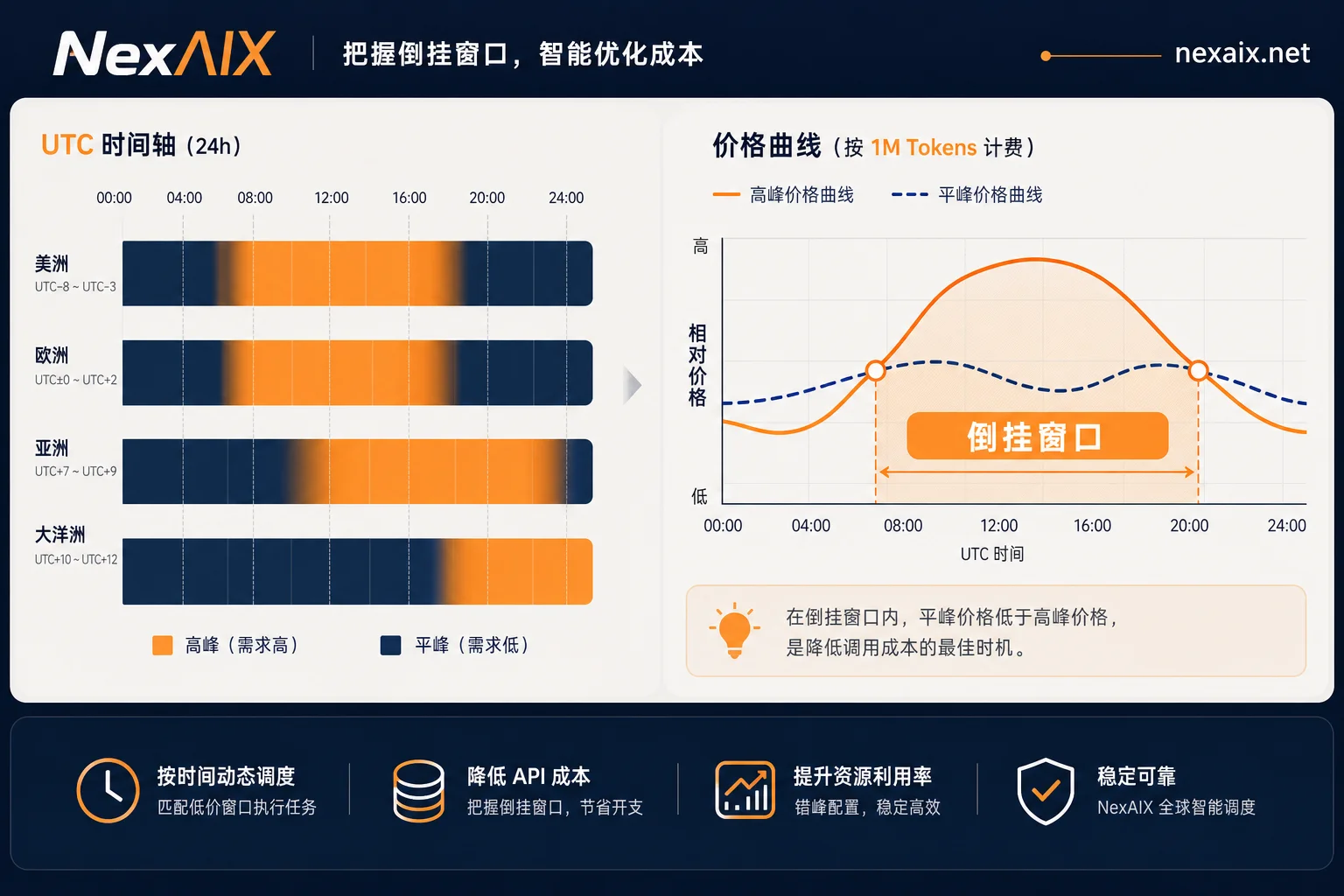
Where Is the Crossover Between Peak/Off-Peak and Fixed Fees?
Official APIs typically use a time-based pricing structure that fluctuates by UTC hour, while most third-party relays maintain a flat all-day rate. This structural difference means that during off-peak hours, direct connection often has a cost advantage, while during peak hours, relay prices may be lower than official. Developers need to convert local time to UTC and examine where their traffic curve falls. For batch or offline tasks, actively shifting to off-peak hours or using offline batch processing channels is an effective way to avoid peak premiums. For specific platform mirror pricing details, you must check their official pages.
Weighted Unit Price Method for Time and Input/Output Ratio
Comparing nominal prices without context is meaningless; you need a reproducible weighted unit price. Let the proportion of peak-hour requests be $P_{peak}$. Based on DeepSeek's time-based rules, peak multiplier is 2.0, off-peak is 0.5. For direct official, the weighting factor is $K_{official} = P_{peak} \times 2.0 + (1 - P_{peak}) \times 0.5$. When $K_{official} > 1$, i.e., $P_{peak} > 33.3\%$, a relay with a fixed rate (assuming factor 1) may have a price advantage; otherwise, direct is cheaper.
Additionally, input token weighting and output token weighting should be computed separately. Input relates to cache hit pricing, which varies by platform, so refer to each pricing page. Output is directly affected by the multiplier. For long-context business cost criteria, see long-context API cost criteria. Finally, put the weighted values from both paths into a comparison table to arrive at the true cost difference.
| Dimension | Direct Official Basis | Relay Gateway Basis |
|---|---|---|
| Pricing model | Official pricing page (UTC fluctuating) | Relay pricing page (mostly fixed all day) |
| Weighted price verification | Console bill details + time logs | Bill details + exchange rate/service fee notes |
| Model version lockability | Supports exact dated versions (e.g., v4-pro-0813) | Need to check if response model field matches actual executed model |
| Quota and spending cap granularity | Account-level limits | Workspace/Key-level independent caps (e.g., OpenRouter guardrails) |
| TTFT determinism | Depends on official cluster load, usually stable | Depends on upstream scheduling, variance possibly higher |
Locking to Dated Version and Verifying Response model Field
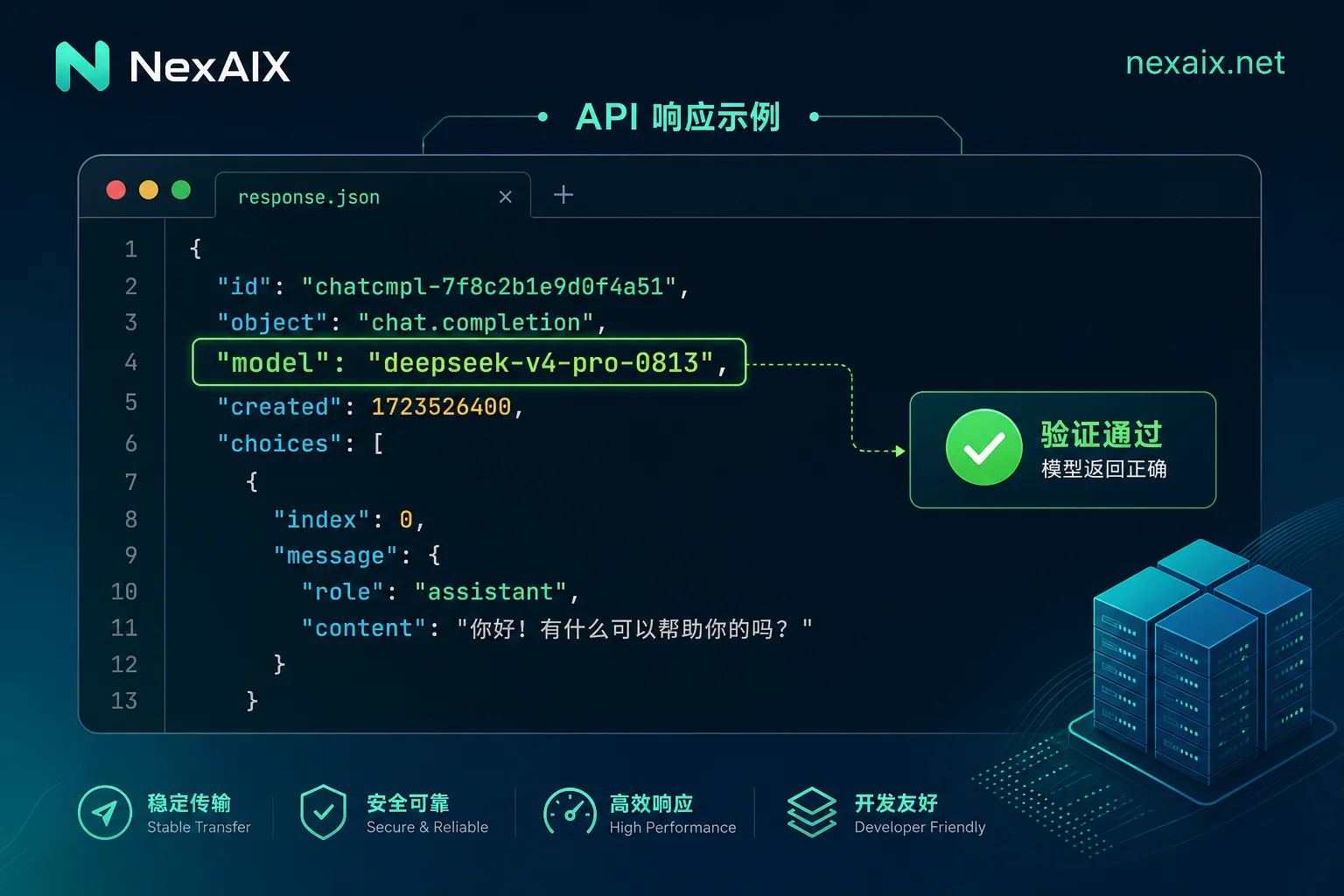
Floating aliases pose a high risk of silent replacement. For example, Together AI deprecated the deepseek-ai/DeepSeek-V4-Pro old identifier on its Serverless endpoints on September 2, 2026, forcing migration to deepseek-ai/DeepSeek-V4-Pro-0813. This means that the build pointed to by the same alias can change at any time without error. Verification should include writing the dated version number in the request and comparing the response's model field with the request parameter one-by-one. It is recommended to log the request ID, model field, and token count for each request, and during full load, observe whether you receive a standard 429 error or a normal response with silent switching to another model. Some services publicly commit that the response's model field corresponds to the actual executed model and that standard 429 is returned on overload without silent switching; such commitments can be directly used as verification items. For example, NexAIX publicly commits that its response model field matches the actual executed model, returns standard 429 on overload without silent switching, allowing developers to use identical OpenAI-compatible code with only a changed base_url for real comparative testing. For specific configuration on how to lock models on an AI API relay, refer to relevant technical documentation.
What Can Key-Level Spending Caps and Provider Whitelists Block?
Quota governance capability is the key differentiator between proxy tools and enterprise gateways. OpenRouter launched workspace guardrails in mid-2026, allowing independent spending caps for individual members and API keys, locking models and provider whitelists, and supporting zero data retention and pre-request regex interception of prompt injection. These capabilities can effectively prevent infinite loop scripts from draining the bill, solve the problem of cost attribution to individuals, and prevent requests from being routed to unintended upstreams. However, they cannot stop instantaneous consumption from a single overly long context, nor do they guarantee upstream availability. When multiple people share one key, the minimal migration sequence should be: split keys first, then set caps, and finally review attribution reports.
Should TTFT Variance Be Included in Selection?
The same model may exhibit several-fold differences in time-to-first-byte (TTFT) across different upstreams. Auto-routing under lowest-price strategies is prone to scheduling to a provider with high queue backlog, causing latency spikes or even timeouts. Additionally, with long contexts and cache misses, the waiting time for the first token during the Prefill phase rises non-linearly. Therefore, interactive dialogue and multi-step Agent chains should treat TTFT variance as a hard metric, while offline batch processing can focus only on throughput and unit price. If latency determinism is desired, you must lock to a provider or connect directly, but this means giving up price comparison.
Trial Testing Checklist: What to Record When Only Changing Endpoints
To reach a reliable conclusion, strict comparative testing is required. Fix the same set of prompts and random seed parameters, change only the base_url and key, keeping the request body identical byte-for-byte. For each request, log the request ID, model requested, model in response, input and output token counts, TTFT, total time, HTTP status code, and timestamp. Run one round during official peak hours and another during off-peak hours. Also, create concurrency during full load to verify standard 429 responses. Finally, convert the data from both rounds to a consistent cost using the weighted formula, and cross-check with the pricing pages and update logs' effective times to define the time boundary of your conclusion.
FAQ
How to determine whether a relay is cheaper than direct official?
Do not just look at list prices. Extract the last 30 days of call data, split into peak and off-peak buckets by UTC time, calculate the weighting factor, and then apply input/output ratio. If your traffic is mainly concentrated in official off-peak hours, direct is usually cheaper; if a large number of requests fall in peak double-time hours, a fixed-fee relay may have a price advantage.
How do I confirm that I'm really using the specified model?
Check whether the model field in the response matches the request parameter exactly. Be wary of services that rely only on alias matching; require version numbers with full date suffixes. During testing, deliberately send specific fingerprint data and compare response hashes across different paths. If you detect silent model switching, immediately stop using that path.
What is the difference between a model alias and a fixed version number with a date?
Aliases like v4-pro may change to different underlying builds over time, causing behavior drift without errors. Fixed versions like v4-pro-0813 lock the weights and inference logic at that date. In production, always use the latter so that if anomalies occur, you can trace back to an exact code version rather than a vague "latest."
Which businesses should stick to direct official API?
Real-time interactive systems that are extremely sensitive to latency, compliant entities that do not accept an additional processing party or need strict contract audit credentials, and businesses whose traffic is mostly distributed during official off-peak hours. Additionally, if your team lacks the ability to maintain multi-layer quota governance, direct connection can reduce architectural complexity.
Will relay paths change automatically when official prices or billing rules change?
Not necessarily. Most relays maintain a flat all-day rate and do not mirror official peak/off-peak fluctuations in real time. Be sure to regularly check the relay platform's update logs to confirm whether they have followed the latest billing rules. Note that official rules apply per UTC hour, and whether relays follow suit must be compared point-by-point; conclusions have time boundaries.
Final recommendations: Fix the weighting factors and test cases as above, and run a dual-path test changing only the base_url. After initial screening, refer to NexAIX documentation to verify the current list of supported model identifiers and rate limit quotas to further validate its stability under specific high-concurrency scenarios.


Comments(0)