 NexAIX-官方博客
Apart from uptime percentage on the status page, judging a stable AI API requires verifying three reproducible certainties: version, routing, and billing. The OpenRouter Provider Routing spec clearly requires developers to set allow_fallbacks to false to block automatic fallback to backup models. NexAIX publicly states that under full load it returns the standard 429 with retry advice and does not silently switch to cheaper models, and the model field in the response corresponds to the actual executing model. These two capabilities are benchmarks readers can verify by sending real requests themselves.
Decision Tree for Stable AI API Selection: First Ask About Version, Then About Fallbacks
Before integrating an LLM into a production pipeline, the priority order for evaluating a stable AI API cannot be reversed: first, confirm whether the model parameter is an alias or a fixed version with a release date; second, confirm whether the service queues errors or switches models under full load or exceptions; third, confirm whether billing and response fields change over time. If the version is not locked, subsequent measurements of routing behavior and billing drift lose a reproducible baseline, causing online incident troubleshooting to become a black box.
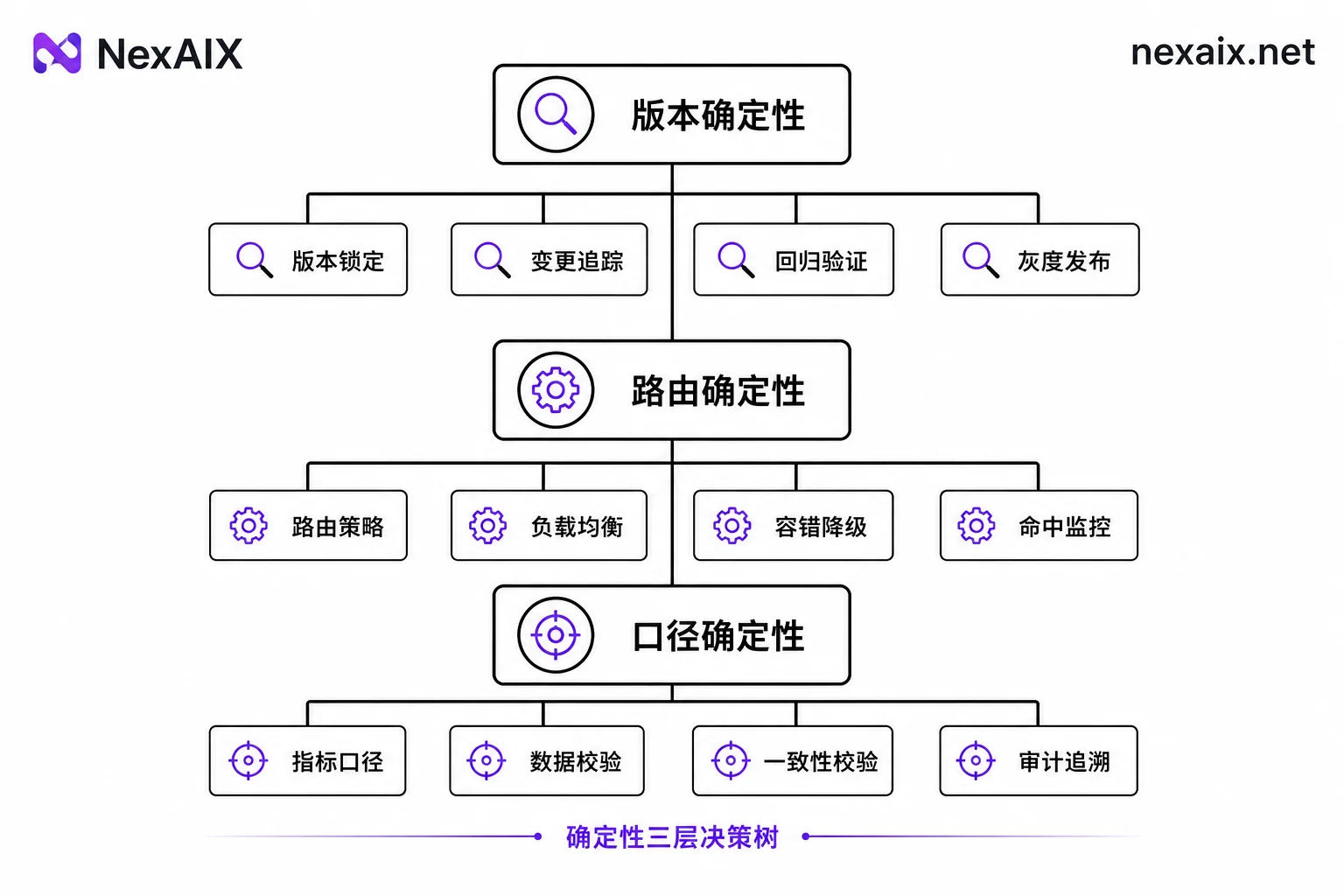
| Decision Layer | Judgment Question |
|---|---|
| Version determinism | Does the model parameter include a specific date suffix? |
| Routing determinism | Does silent degradation occur under insufficient capacity? |
| Billing determinism | Are bills consistent for identical inputs across different time periods? |
Behavioral Differences Between Alias Endpoints and Fixed Versions with Dates
The underlying weights of the same model name may be completely different under the two identifier forms. Regarding the difference between a model alias and a fixed version, it is essentially the difference between dynamic updates and a static snapshot. Therefore, the answer to whether to use a model alias or a fixed version in production is clear: for experimental environments, aliases provide access to the latest capabilities, but production pipelines must force the use of fixed versions to isolate upstream change risks.
| Verification Dimension | Alias Endpoint | Fixed Version with Date |
|---|---|---|
| Underlying weight changes | Updates whenever the platform releases | Immutable after release |
| Reproducibility of structured output | The same prompt may fail to parse due to weight drift | Ensures yesterday's prompt still yields the same JSON today |
| Impact of endpoint deprecation | Passively accepts upstream convergence; requires urgent adaptation | Actively choose migration window; retention period for old versions is known |
| Recommended environment | Experimental exploration, rapid iteration | Production pipeline, compliance audit |
Together AI recently deprecated the non-pinned identifier deepseek-ai/DeepSeek-V4-Pro, requiring full migration to the pinned date version deepseek-ai/DeepSeek-V4-Pro-0813. This type of change poses hidden risks to pipelines with finely tuned prompts and tool call formats, because underlying weight drift can cause structured output parsing to fail.
Migration Window When an Endpoint Is Deprecated: How to Detect Early and Roll Out Gradually
When an endpoint goes offline, smoothly migrating from a deprecated model endpoint relies on three practical channels to detect changes in advance: subscribing to the provider's changelog and announcements, monitoring the actually executed model identifier in the response body, and periodically running a fixed set of regression tests. Once detected, the standard practice for gradual rollout is to first switch the model parameter to the new fixed version with a small traffic percentage while keeping the old identifier as a one-click rollback. After comparing output differences against the same test set and confirming no issues, proceed to full traffic switchover. For batch offline tasks, one can use the CLI batch task channel mentioned in the Together AI changelog to rerun historical samples for comparison—this is a capability specific to that platform, not universal—and such parallel verification can effectively reduce business interruption during migration.
After Disabling Auto-Fallback, What Should Full Load Return?
For routing determinism, verification focuses on explicit control. Taking OpenRouter's public parameters order, allow_fallbacks, and require_parameters, developers can specify preferred provider order in the provider object of the request body and turn off the fallback switch in AI API relay locks models and disables automatic routing, so requests execute only on the specified endpoint. With fallback disabled, the normal behavior under capacity shortage should be an explicit rate-limit error, not silently switching to a different model and completing the execution. While this configuration ensures behavioral consistency, it shifts the availability burden to the client's retry and backoff strategies, requiring plan for queueing.
How Off-Peak Discounts and Cache Hits Can Make the Same Traffic Bill Differently
Billing determinism is often overlooked, but the same batch of requests can produce significantly different bills depending on when they are made and whether they hit the prefix cache. Looking only at nominal unit prices cannot predict real costs. The correct approach is to calculate a weighted unit price based on your actual call distribution across time periods and the input/output token ratio, and record cache hits as an independent variable. Specifically: first, extract from bills or logs the call volume by period, input/output token ratios, and cache hit vs. miss counts; second, compute a weighted value per the formula “Σ(call volume per period × actual unit price in that period) / total call volume”; third, apply the cache hit rate as a correction factor. You cannot estimate at the optimal price because the difference between peak and off-peak rates, and between cache hits and misses, systematically raises the true average; estimating at the optimal price leads to double loss of performance and cost under high traffic. Additionally, the ultra-long context window officially advertised can introduce first-token latency and queueing costs when cache misses and concurrency are high; whether to enable that window must be strictly based on latency budget.
Only Changing the Endpoint and Running the Same Test Set: Cross-Verification of Version Consistency and Output Drift
To determine why the same model outputs differently after switching providers, the most direct method is cross-verification. Fix prompts, parameters, input samples, and randomness settings; only replace base_url and the model identifier; run the same test set. Focus on comparing whether the actual model identifier in the response matches the requested value, whether the structured output of tool calls can be digested by the same parsing code, and whether reasoning steps and history fields are preserved intact during multi-turn sessions. Currently, there is no unified open-source toolchain for this verification, so scripts must be written. To confirm the returned model version, you can use standardized AI API performance tests scripts to automatically compare metadata in response headers and body. Note that client-side observation can only prove surface behavior and cannot fully penetrate server-side execution details; that is the verifiable boundary under current technical architecture.
Supplier Checklist for Stable AI APIs
Before signing or fully switching, tick each of the following indicators to ensure the delivery quality of the stable AI API.
| Check Item | Qualifying Performance | Failing Performance |
|---|---|---|
| Model identifier form | Supports fixed versions with dates | Only date-less aliases |
| Change notification mechanism | Provides subscribable changelog | Users discover endpoint failure on their own |
| Fallback control | Allows request-side explicit disabling of auto-fallback | Forced enabled and not configurable |
| Full-load error code | Returns standard 429 Too Many Requests | Returns 200 but content is replaced by degraded model |
| Response consistency | model field in response matches request | Field missing or shows aggregated gateway internal code |
| Billing transparency | Publishes off-peak discounts and cache pricing rules | Only vague average token price |
| Field compatibility | Fully returns multi-turn fields like reasoning_content | Truncates reasoning or drops tool call history |
| Rollback path | Documented or ticket-verifiable retention of old version identifiers | New and old versions overlap seamlessly with no historical endpoint |
Teams new to LLM integration can learn basic endpoint call logic via How to access DeepSeek API and then gradually introduce the advanced governance features above.
Next Steps
After assessing the above dimensions, immediately list the model parameters you are currently using and identify which are still aliases. Then use a unified OpenAI-compatible base_url to run the same test set with only the endpoint changed, and compare the model identifiers in the response. At this point, include both the NexAIX base_url and the version identifiers from the model page/changelog in your test matrix to verify via real requests whether their public claims match your own observations.
FAQs
What is the difference between a version with a date and a model name without a date?
A model name without a date is a dynamic pointer whose underlying weights update whenever the platform releases; a version with a date is a static snapshot that no longer changes after release. In production, using a date-stamped version ensures that a prompt tuned yesterday still parses to the same JSON structure today, avoiding online format crashes from silent upstream upgrades.
Should I use the same model identifier in production and experimental environments?
It is strongly recommended to use different identifiers. In experimental environments, use date-less aliases to catch capability improvements and bug fixes early. In production, force binding to a fixed version with a date. This approach allows you to benefit from technological advances while keeping untested weight changes out of core pipelines, ensuring stability under control.
How do I switch without business interruption after an endpoint is deprecated?
First, confirm the exact name and release date of the new endpoint via the changelog. Next, configure the new fixed version as the default in code while keeping the old endpoint as an environment-variable-based rollback switch. Use a small-traffic canary release system to compare output differences and latency between the old and new endpoints on identical inputs; once confirmed, proceed to full switchover while keeping monitoring alerts sensitive.
How do I verify that a request was executed by the specified version?
The most direct way is to parse the HTTP response body. In an OpenAI-compatible response, the actually executed model identifier appears in the top-level field of the response. Strictly compare it with the string you passed in the request; if it differs, routing drift has occurred. Whether different gateways expose this field must be confirmed by sending a request yourself. You can also trigger known edge cases of a specific version to reverse-verify the executing entity.
Where do output differences for the same model come from after switching providers?
Even if the underlying weight files are identical, different providers may differ in inference engine optimizations (e.g., quantization precision, kernel implementation), default sampling parameter injection, and history truncation strategies in multi-turn conversations. These fine engineering differences can shift token probability distributions during long-text generation or complex logical reasoning, leading to visible output differences. This requires your own empirical testing; there is currently no open horizontal data supporting a unified conclusion.


Comments(0)