 NexAIX-官方博客
Before integrating with an API relay station, developers and technical leads must confirm three things: whether the supply source is transparent and verifiable, whether client migration maintains code compatibility, and how to prevent model substitution/downgrade and troubleshoot rate limiting/truncation at the engineering level. These three factors directly determine data security, cost accounting, and service stability in production.
Migrating Configuration for OpenAI-Compatible Endpoints
To connect to a relay station that follows the OpenAI-compatible specification, you only need to replace the client's basic configuration, keeping the original request and response structure. The core configuration items are three: API key, model ID, and API Base URL.
The most common configuration error is missing the version path at the end of the Base URL. For example, configuring it as https://api.example.com instead of https://api.example.com/v1, causing the SDK's assembled request path to fail or fall back to the default official endpoint. Python SDK example:
from openai import OpenAI

client = OpenAI(
    api_key="你的密钥",
    base_url="https://api.nexaix.net/v1"  # 必须包含 /v1
)

response = client.chat.completions.create(
    model="gpt-4o",
    messages=[{"role": "user", "content": "测试"}]
)
The SDK configuration logic for Node.js and other languages is identical—only modify the baseURL and apiKey items. The relay proxy establishes a network relay between the client and the upstream model, handling layers including identity authentication, rate limiting, model routing, cache checks, and failure retries. Its network latency overhead is typically controlled at the millisecond level (usually below 50ms), and the downstream code logic and response parsing flow remain consistent.
Supply Source Transparency and Data Security Risks
Unofficial or unauthorized gray API relays carry two severe risks: data theft and model downgrade.
The relay proxy has complete plaintext visibility into request prompts, chain-of-thought, and generated output. Some relay stations may use this data to steal trade secrets or fine-tune third-party models. This poses a serious compliance risk when handling internal corporate documents, customer data, or business logic.
Some low-quality proxies, to cut costs, may silently downgrade (Downgrade/Substitution) high-value commercial models in the background or route to cheap open-source small models. Developers pay for GPT-4 but may actually be calling a reduced-precision version or a completely different model. This water-downed behavior directly affects generation quality, business decision accuracy, and user experience.
A legitimate relay station should clearly label the supply method for each model. For example, the NexAIX Model List shows that open-weight models are deployed on their own computing clusters, while closed-source models go through official vendor-authorized channels, with each model page indicating which category it belongs to. This transparency lets developers assess data flow and quality assurance. Additionally, confirm whether the relay station commits to not recording conversation content and releasing data immediately after requests are complete.
Logprobs-Based Model Downgrade Detection
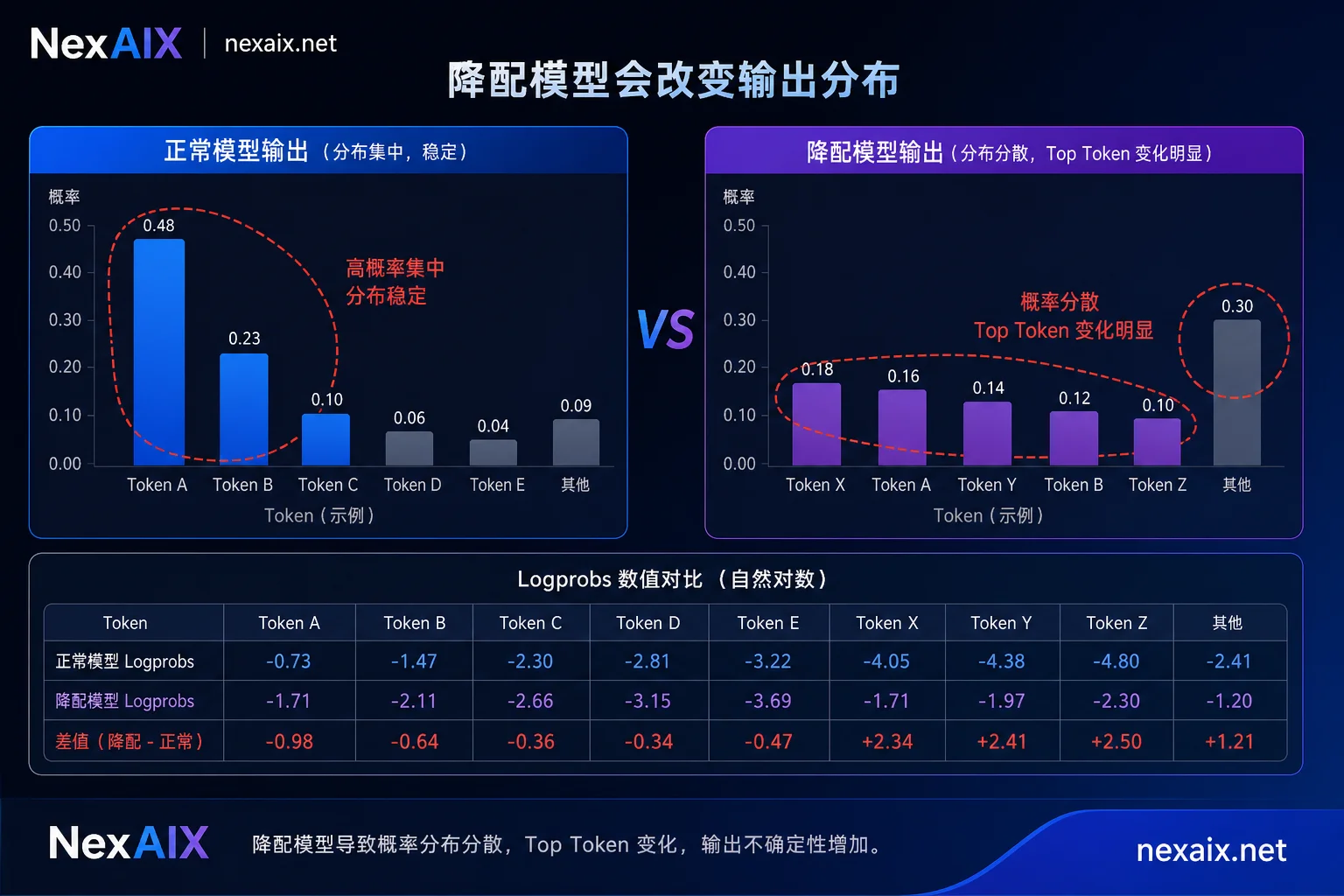
Academia and industry have proposed a statistical monitoring approach based on token log probabilities (Logprobs) to verify whether the model has been swapped or downgraded. Because the prediction distributions of models of different sizes or fine-tuned versions differ significantly, by requesting single-token log probabilities and performing statistical tests, you can detect subtle changes and downgrades in the underlying model with minimal computational cost and high sensitivity.
The specific method is to enable the logprobs parameter in the request and record the model's token probability distribution for specific inputs. The same input should produce a stable probability distribution on the same model; if the distribution suddenly changes, the underlying model may have been replaced. The advantage of this method is that it does not require labeled datasets or complex performance benchmarks—just periodic comparison against historical probability logs.
In an OpenAI-compatible endpoint request, configure:
response = client.chat.completions.create(
    model="gpt-4o",
    messages=[{"role": "user", "content": "测试句子"}],
    logprobs=True,
    top_logprobs=5
)

# 记录并对比 response.choices[0].logprobs
Use the probability distribution of a specific test sentence as a baseline, and regularly send the same request to compare probability changes. If the Top-K token probability distribution shows a significant shift (e.g., standard deviation exceeds a threshold), further verification is needed to determine whether the model version has changed or been downgraded. For detailed verification methods, refer to How to Choose a Stable AI API? Verification Methods for Version Identification and Routing Fallback and Request Configuration and Verification for Locking the Model and Disabling Automatic Routing in AI API Relay Stations.
Classified Handling of 429 Rate Limit Errors
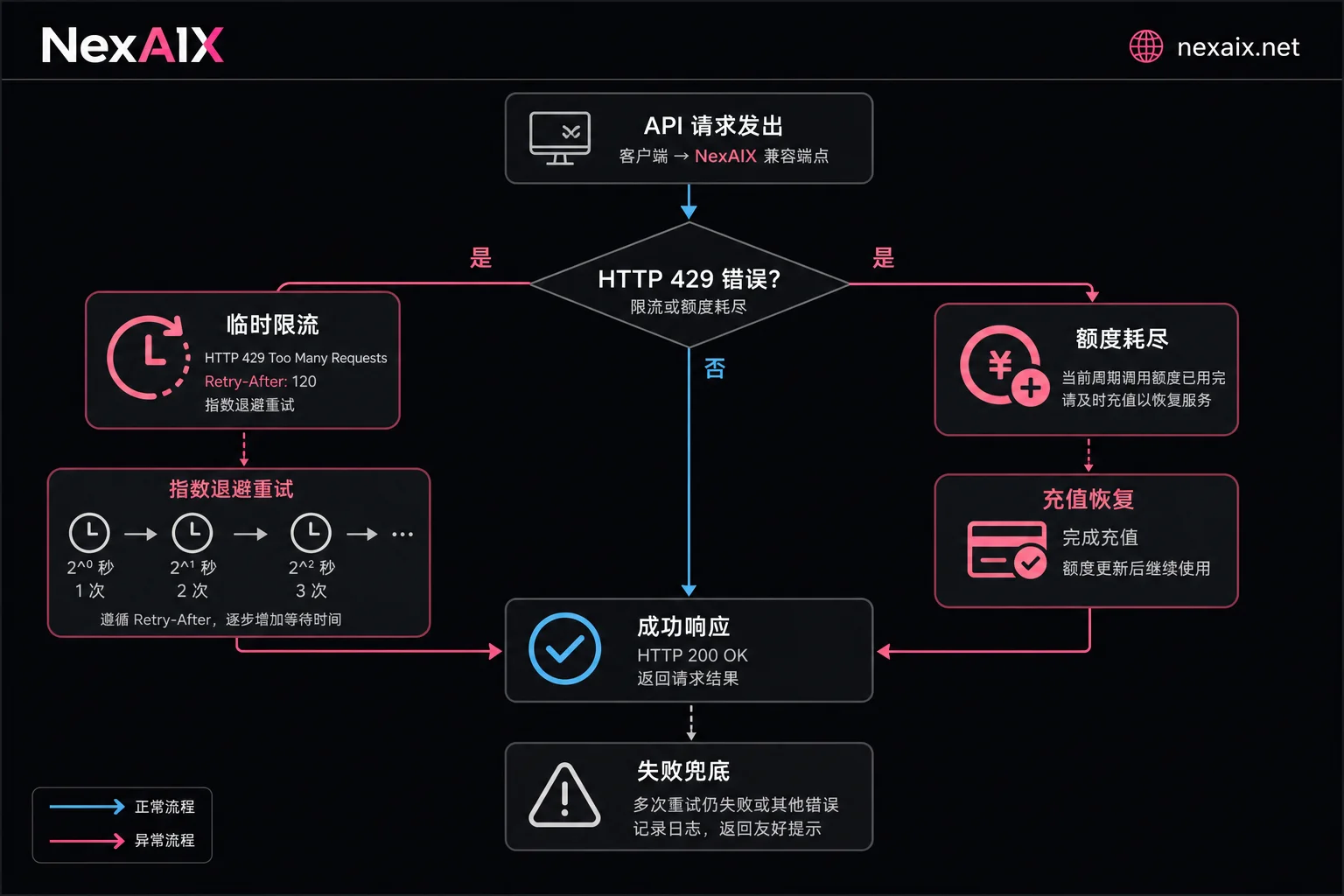
When a call encounters an HTTP 429 error, it is necessary to distinguish between a temporary burst rate limit (Rate limit reached/slow_down) and quota exhaustion (credit_balance_exhausted/insufficient_quota).
For temporary rate limits, official SDKs and gateways typically support reading the Retry-After header in the response for exponential backoff retries. This header provides a recommended wait time in seconds; looping retries directly will exacerbate the per-minute limit exhaustion and prolong the ban. The correct handling approach:
import time
from openai import RateLimitError

try:
    response = client.chat.completions.create(...)
except RateLimitError as e:
    retry_after = e.response.headers.get('Retry-After')
    if retry_after:
        time.sleep(int(retry_after))
    else:
        # 指数退避:第一次等 1 秒,第二次等 2 秒,第三次等 4 秒
        time.sleep(2 ** retry_count)
If the error message clearly indicates quota exhaustion (insufficient_quota), you need to top up or check your account quota; retrying is futile. A legitimate relay station should publicly disclose quota and rate limit rules, such as isolating quotas per API key and clearly defining per-minute request limits (RPM) and daily token limits (TPD). For more detailed retry strategies, see How Long Should Exponential Backoff Retry Wait? First Check Whether 429 Has retry-after.
Handling Context Length Exceedance
Unlike rate limiting, context_length_exceeded (HTTP 400) indicates that a single request exceeds the size limit rather than a frequency limit. This error occurs before generation and does not consume token fees; exponential backoff cannot resolve it.
It must be handled at the client or relay pre-processing stage using the following methods:
- Prompt compression: Remove redundant context, use summaries instead of full historical conversations.
- Context truncation: Retain the last N rounds of conversation, discarding earlier rounds.
- Switching to a model with a larger context window: For example, switch from an 8K context model to a 128K or 1M context version.
Estimating the token count before the request can avoid this error. In Python, use the tiktoken library:
import tiktoken

encoding = tiktoken.encoding_for_model("gpt-4o")
token_count = len(encoding.encode(prompt_text))

if token_count > model_max_tokens:
    # 执行截断或压缩
    prompt_text = compress_or_truncate(prompt_text)
Context window specifications vary significantly across models; you need to confirm the specific limits in the relay station's model list.
Selection Recommendations and Integration Entry Points
When choosing an API relay station, prioritize checking the labeling of supply methods, data handling commitments, and the openness of quota and rate limit information. If a relay station can indicate whether each model is deployed on its own computing resources or through official authorized channels, and commits to not logging conversations, not downgrading models, and isolating quotas by key, it can reduce data leakage and quality risks.
For integration, you only need to change one line of base_url, keeping the OpenAI SDK code structure unchanged. After integration, periodically sample model stability using Logprobs. When encountering a 429, first read Retry-After before deciding on a retry strategy. When encountering context limit issues, pre-process at the client or switch models.
If you want to see available models and supply methods, visit the NexAIX Model List; for integration documentation and obtaining test quotas, see the 'Documentation' and 'Get API Key' sections in the official site navigation.



Comments(0)