 NexAIX-官方博客
If you already have a codebase built on the OpenAI SDK and want to switch to Claude, the real cost usually isn't model capability—it's four concrete spots: where the system parameter goes, the structural constraints on messages, how tool call results are returned, and how streaming events are parsed. Once these four are addressed, the rest is a selection question. Conversely, for a new project without calling code yet, deciding on the protocol first is easier than deciding on the model first.
Start by Task
- Long document processing, cross-file code changes, workflows that must strictly follow complex system instructions: Claude series reasons include native large context (commonly 200K and above), performance on long-chain multi-step reasoning and code tasks, and relatively stable adherence to complex instructions.
- Speech transcription, TTS, real-time voice and other multimodal pipelines, or needing a high-throughput low-latency small model for front-end routing: GPT series has a more complete surrounding ecosystem, and many open-source frameworks and SDKs default to OpenAI format compatibility, so integration requires almost no changes.
- General text tasks both can handle: The deciding factor is often not benchmark scores, but which protocol your existing code uses, whether caching can hit, and whether quotas and rate limits meet your concurrency.
Specific model versions and their specs change quickly; when selecting, refer to the model page annotations, and don't rely on model names from articles six months old.
Where the Two Protocols Differ
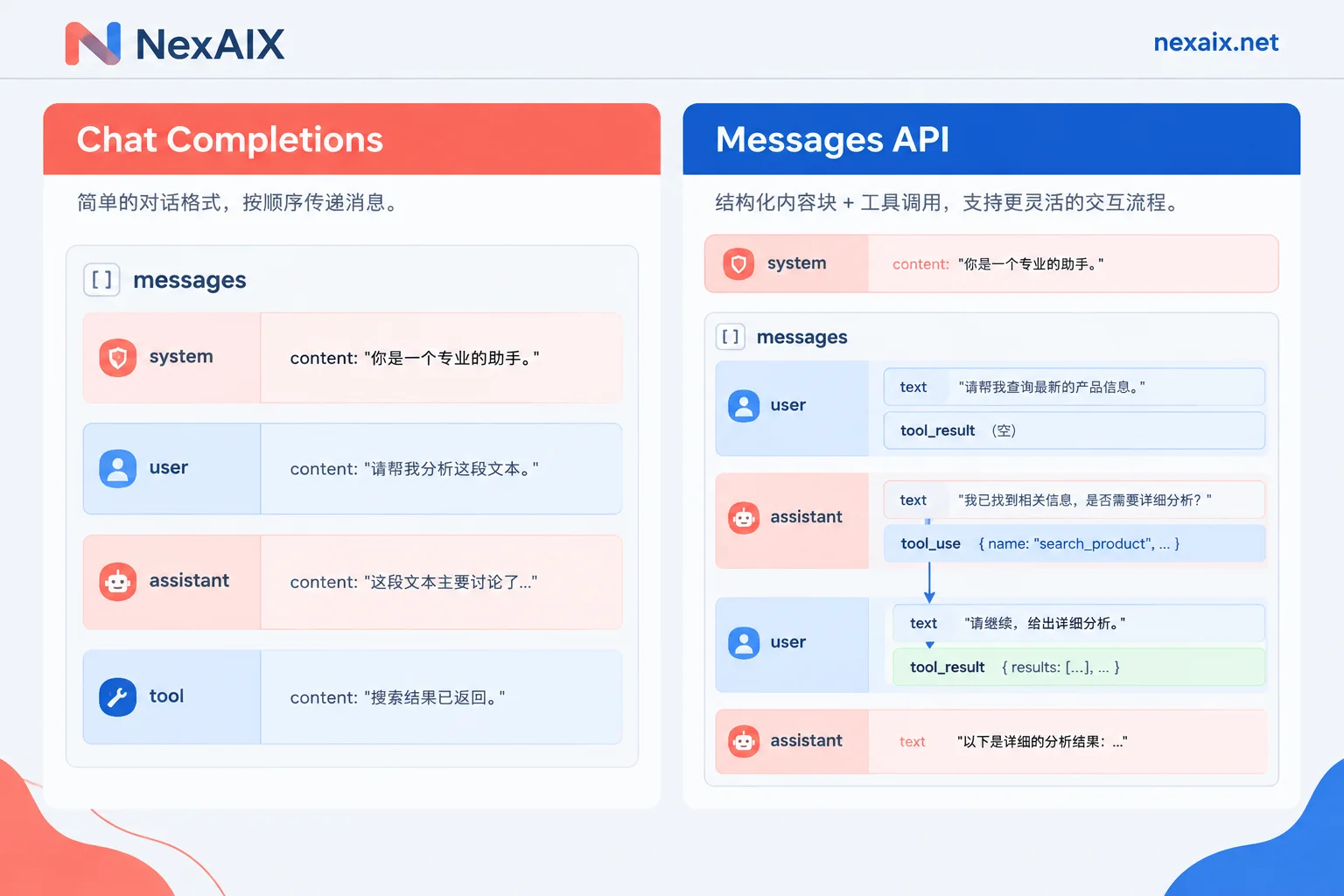
The mainstream standard on the OpenAI side is POST /v1/chat/completions: messages is a flat list, where system, user, and assistant are all items in the array, and content is mostly a string directly. The newer Responses API is a different parameter organization; if you maintain both paths, treat them as two formats.
On the Anthropic side, it's POST /v1/messages: system is elevated to the top level as a separate parameter rather than an item in messages; within messages, user and assistant must strictly alternate, and two consecutive same-role messages need merging; content is organized as structured content blocks rather than a string.
In terms of migration, the two most common pitfalls: first, if you originally concatenated system prompts into messages[0], you need to extract it to the top level; second, if the multi-turn history contains consecutive assistant messages (most likely in tool call intermediate states), you need to reassemble to satisfy the alternation constraint.
Tool Calls: Different State Assembly Methods
The OpenAI path: the model returns tool_calls in an assistant message; after local execution, you append a separate message with role as tool in the next turn, using tool_call_id to correlate.
The Anthropic path: the model returns content blocks of type tool_use; you put blocks of type tool_result into the next user message, binding with tool_use_id.
The essence of the difference: OpenAI treats tool results as an independent role, while Anthropic treats them as a block within the user turn. When using an existing Agent framework, this logic is hidden inside the executor and you might not notice; if you write the tool loop yourself, you must implement two separate assembly methods. For how to validate the tool loop itself, refer to How to Integrate Agent API: Four Validation Points from Framework Configuration to Tool Calls.
Streaming: Two Event Models
On the OpenAI side, you handle a series of SSE chunks, extracting deltas from delta.content and concatenating. On the Anthropic side, it's events like content_block_start / content_block_delta / content_block_stop, which need to be placed by block index and reassembled, especially when there are both text blocks and tool_use blocks. The timing of usage fields also differs, so don't directly reuse token counting code. For streaming parsing and proxy layer stuttering troubleshooting, see How to Integrate Streaming Output API: SSE Parsing, Token Counting, and Proxy Stuttering Troubleshooting.
Prompt Caching: One Automatic, One You Mark
This is where the two differ most and also affects long-term cost the most.
OpenAI is fully automatic: static prefixes over 1024 tokens are automatically matched in 128-token steps, no code changes needed, and upon hit, input cost is roughly halved.
Anthropic uses explicit breakpoints: you mark cache boundaries in the request with cache_control: {"type": "ephemeral"}. The first write incurs an extra write fee (about 1.25x), but hit reads can get up to 90% discount. The trade-off is that prefix order must be strictly stable.
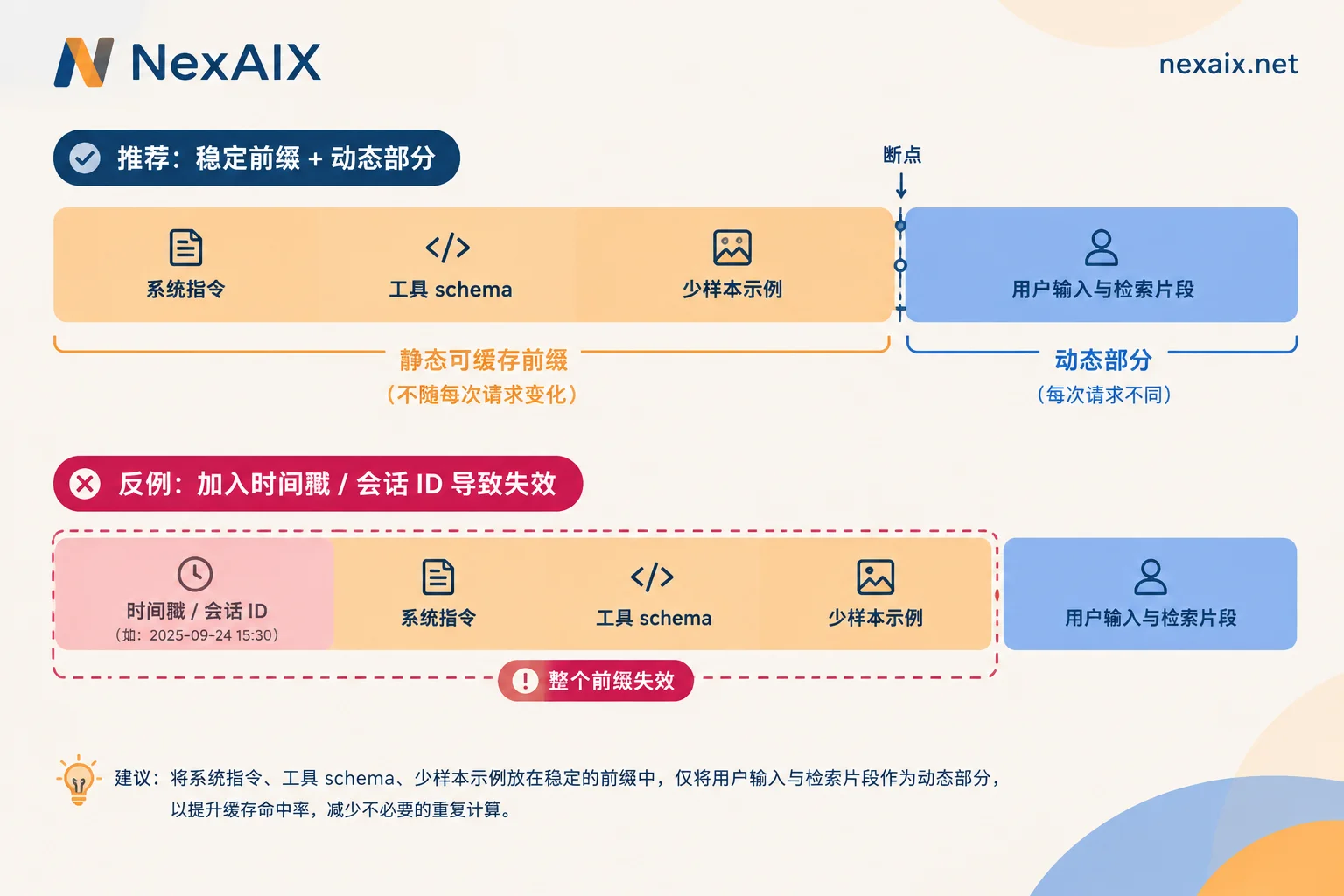
Regardless of which side, the practical conclusion is the same: place static system instructions, tool schemas, and few-shot examples first, and dynamic user inputs and retrieval snippets later. Some code habits concatenate timestamps, session IDs, or current dates at the beginning of system prompts, making the prefix different for each request, which causes both automatic and explicit caching to fail—if caching doesn't work, check this first.
Migration: Maintain an Adapter Layer or Use a Unified Endpoint
Two paths, with clear trade-offs.
First, write a conversion layer on the client side: perform bidirectional mapping of message structure, tool returns, and streaming parsing. The advantage is that you can use each vendor's proprietary parameters; the disadvantage is that when the upstream interface changes you have to follow, and both streaming parsers need long-term testing.
Second, use an OpenAI-compatible endpoint: The Chat Completions format is already the de facto standard for cross-vendor adaptation; the gateway smooths over underlying protocol differences. You only change base_url and the Key, and can switch scheduling between GPT and Claude models. Suitable when the application is already written based on the OpenAI SDK and you want to first put different models in the same codebase for horizontal comparison.
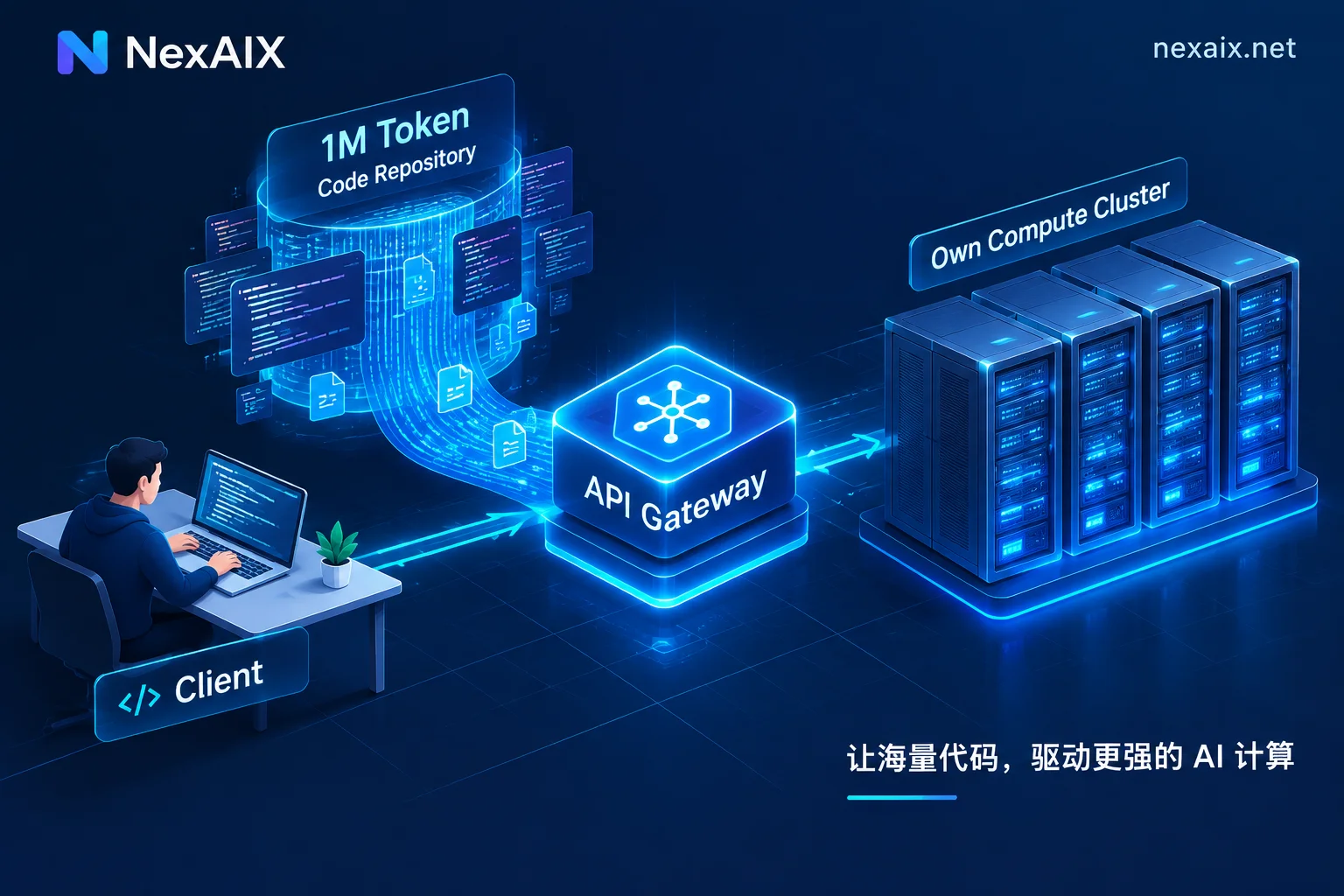
NexAIX follows the second path: OpenAI-compatible endpoint https://api.nexaix.net/v1, requiring only base_url change. Its model page indicates the supply method for each model—open-weight models deployed on its own compute cluster, closed-source models through official vendor-authorized channels. This annotation is worth a look first, because it determines whether you get original vendor behavior or self-deployed behavior, which affects your expectations for output consistency. For which models are currently listed and their specs, refer to the model list page.
A boundary to clarify: if your cost model heavily relies on Anthropic's explicit cache breakpoints, before switching to any compatible endpoint, first confirm whether proprietary parameters like cache_control are passed through as-is or handled by the upstream—refer to the model page and integration docs, don't assume from experience.
Run These Four Things Before Production
- Whether degraded. Run several rounds with a fixed prompt, comparing output completeness, actual usable context length, and stability of usage fields. Don't skip this step after switching providers; NexAIX writes no model downgrade, no precision loss, no context truncation as a commitment and provides validation methods; you can verify any channel with the same approach. Registration comes with test credits, enough for a round of comparative experiments.
- Rate limiting behavior. Read the headers returned with 429 before deciding backoff, don't just fixed sleep. Refer to How to Handle AI API Rate Limiting? From 429 Headers to Backoff Retries and Traffic Isolation and How to Design AI API Retries.
- Truncation detection. The two vendors have different max output parameters and stop reason field names; if your code only recognizes one after migration, long responses will be silently treated as normal completion.
- Conversation content retention. Vendor logging and intermediary layer disk writes are two different risk layers; confirm separately before handling sensitive data; see Where Are the Two Layers of AI API Privacy Risks.
Final judgment: If your main work is long-context reasoning and code changes, and you're willing to write dedicated prefix strategies for caching, it's worth fully leveraging Claude's capabilities; if your application form leans toward multimodal pipelines, or you need to repeatedly compare price and performance across multiple models, first unify integration to OpenAI-compatible format, then pick models—this minimizes rework.


Comments(0)