NexAIX-官方博客
In the wave of AI engineering in 2026, open-weight models have completely crossed the stage of "toys and alternatives" and are fully taking over core production workloads. A landmark event recently hotly discussed in tech circles is that Revolut, a leading European fintech unicorn, announced that it has fully switched its internal AI programming foundation for 2,000 engineers to the open-source GLM series, thereby reducing overall inference costs by about 90%. Meanwhile, the latest industry statistics show that in monthly token consumption in production environments, the matrix of open-source models represented by DeepSeek, GLM, Kimi, Qwen, and MiniMax has accounted for more than 70% of traffic share.
However, when technical leaders and architects actually decide to fully introduce open-source models into their businesses, they often find that: although the inference unit price of the models themselves has come down, the "hidden engineering costs" surrounding model access, compute O&M, and quality assurance are rising sharply.
This article starts from real engineering pain points in production environments, analyzes the two major challenges teams face when using open-source large models—"the heavy burden of self-built compute" and "fragmented interfaces across multiple platforms"—and explores how to achieve efficient, auditable multi-model collaboration through a transparent and standardized open-source LLM API architecture.
I. The Ideal Is Plump: Three "Hidden Engineering Taxes" When Deploying Open-Source LLMs in Production
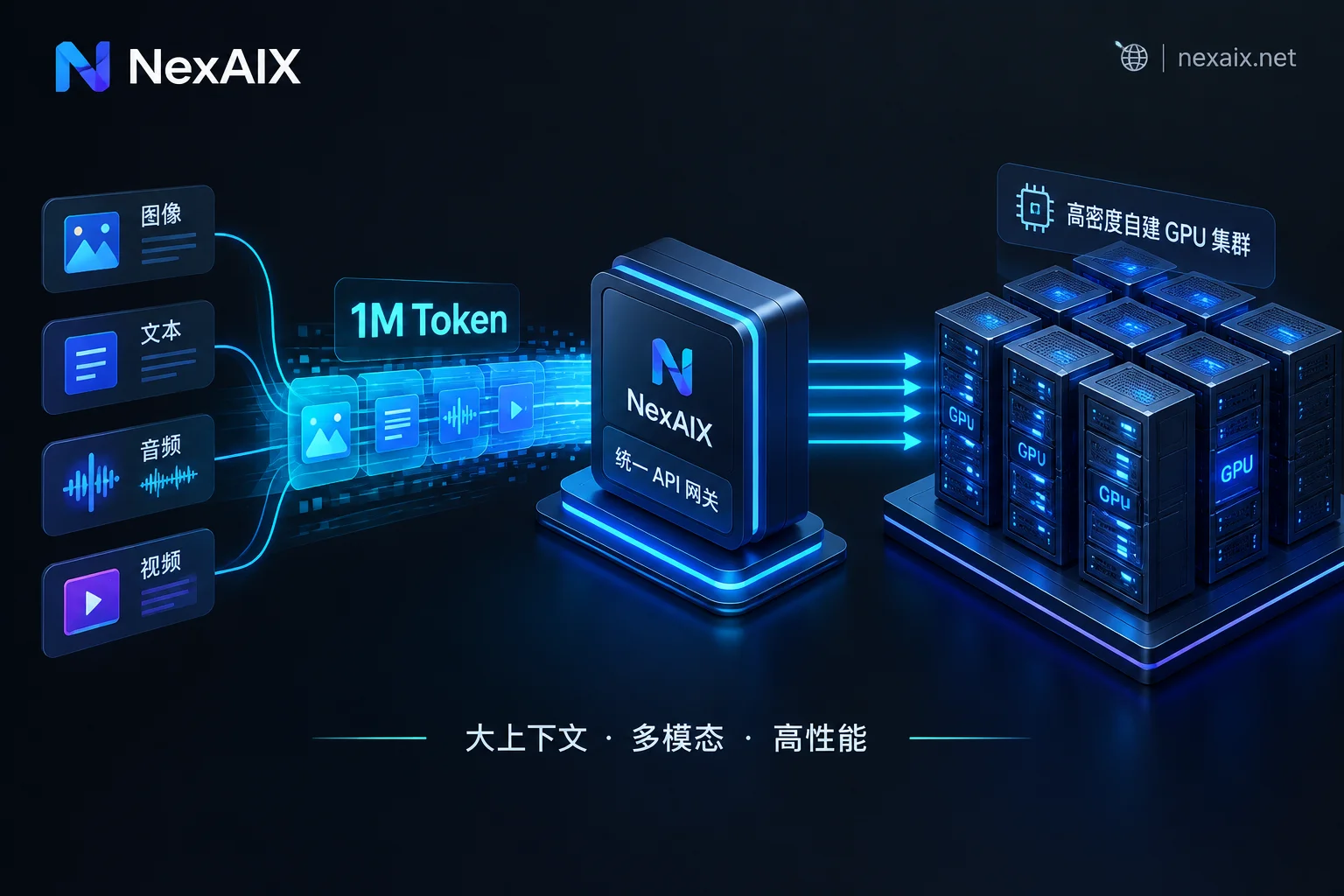
Seeing the impressive performance of open-source models in code generation, million-level long context (1M Context), and Agent tool calling, many teams' first reaction is either "buy/rent GPUs and build it themselves" or "register APIs separately on each vendor's official website." But in practice, these two paths often run into three high walls:
1. Hardware Threshold and O&M Black Hole of Self-Built GPU Clusters
Self-hosting open-source models like Revolut can indeed push marginal token costs to the extreme, but the premise is that they used 56 Nvidia B200 GPUs and equipped a dedicated infrastructure team to maintain the inference engine. For the vast majority of small and medium-sized R&D teams or enterprises focused on the application layer, full-blooded MoE (Mixture of Experts) open-source large models often have hundreds of billions or even trillions of parameters, with huge VRAM requirements. Renting bare-metal GPUs and deploying them yourself not only faces high idle compute costs but also requires handling heavy underlying O&M work such as operator optimization, KV Cache memory management, and node failure recovery.
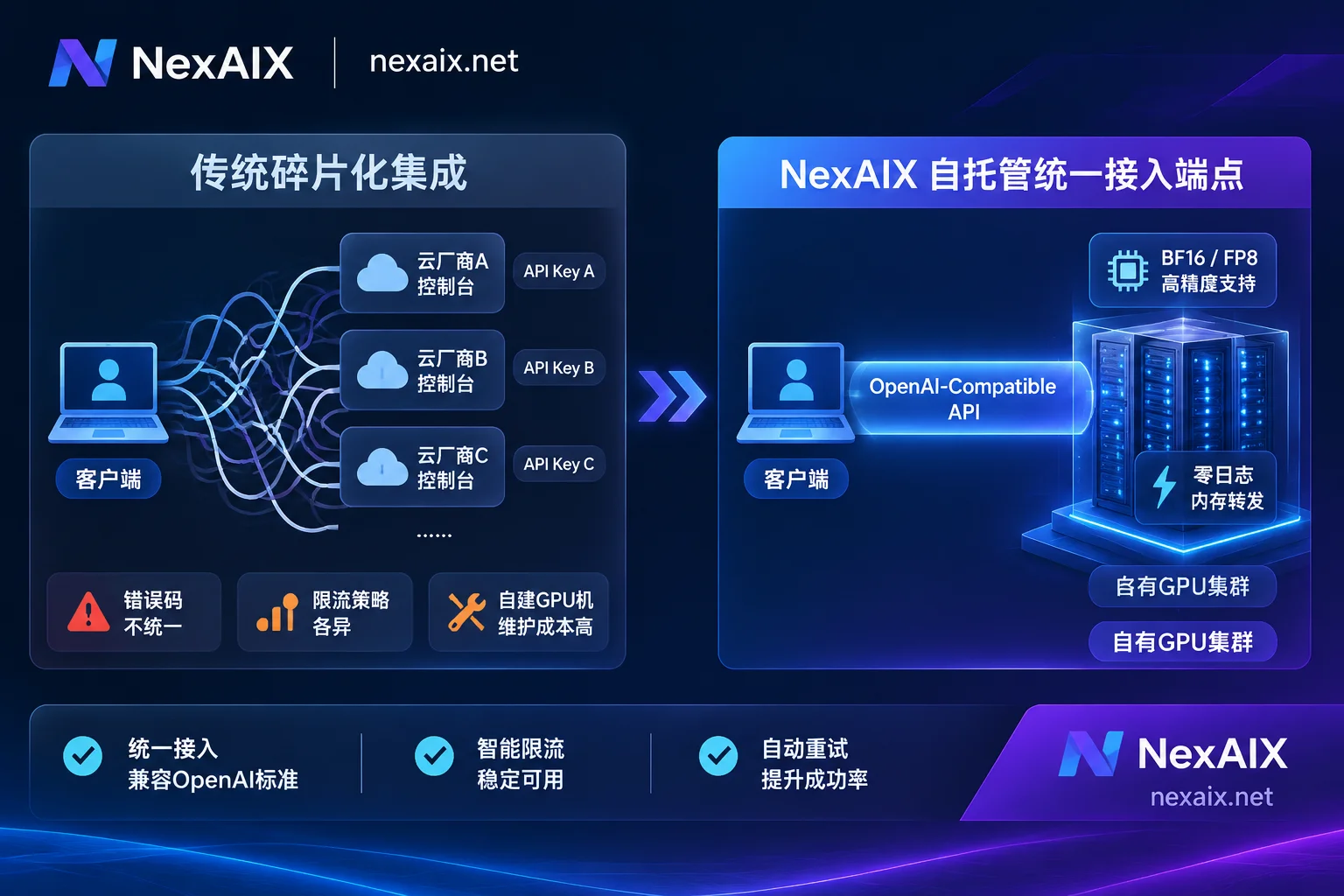
2. "Interface and Billing Fragmentation" Caused by Direct Multi-Vendor Connections
In actual Agent orchestration or complex business flows, teams rarely use only a single model: usually DeepSeek is needed for difficult code and logical reasoning, Kimi or MiniMax handles million-level long documents and multimodal parsing, GLM is responsible for precise structured output and long-horizon tasks, and Qwen handles high-concurrency general interactions.
If connecting to each vendor's official API or different hosting providers one by one, R&D teams will immediately fall into a fragmentation quagmire:
- Different protocol details: Authentication methods, streaming end-frame formats, and Function Calling error codes are incompatible across vendors, so every model switch requires rewriting a set of adaptation and retry logic.
- Scattered accounts and bills: Developers need to switch between five or six consoles to top up; when finance calculates the AI costs of each project and microservice at the end of the month, they can only manually export multiple CSV tables and piece them together with difficulty.
- Chaotic URL and model ID mapping: Model naming rules differ across platforms, and a slight configuration mistake can cause online
404failures.
3. "Implicit Quantization" and Data Exposure of Low-Price Resale Gateways
To save the trouble of multi-endpoint integration, some teams try to access low-price aggregation gateways on the market. But as we analyzed in "How to Choose an Open-Source LLM API: A Pitfall Guide from Self-Built Clusters and Low-Price Resale to Production-Grade Hybrid Calls", many platforms doing "second-hand quota resale" secretly replace open-source weights that should run in BF16 or FP8 with excessively quantized INT4 versions in the backend to squeeze profits, and even secretly route requests to smaller Flash or Lite models during peak periods. This implicit downgrading can instantly crash the Agent's tool-calling format. In addition, resale nodes of unknown origin often come with plaintext log persistence, exposing enterprises' core code and business data to severe leakage risks.
II. The Way Out: Reshaping the Open-Source LLM API Foundation with "Proprietary Compute Deployment"
To simultaneously obtain the "high cost-effectiveness" of open-source models and the "zero-O&M elasticity" of API calls, the ideal architecture is: the underlying layer is standardized cluster deployment by a professional service provider with proprietary compute, while the upper layer exposes a fully unified, verifiable interface.
In the architecture design of NexAIX, we completely abandon second-hand quota resale and patchwork proxies, and build a supply system for open-source large models that reaches directly to the hardware底层:
1. Proprietary GPU Clusters in Self-Built and Self-Rented Data Centers
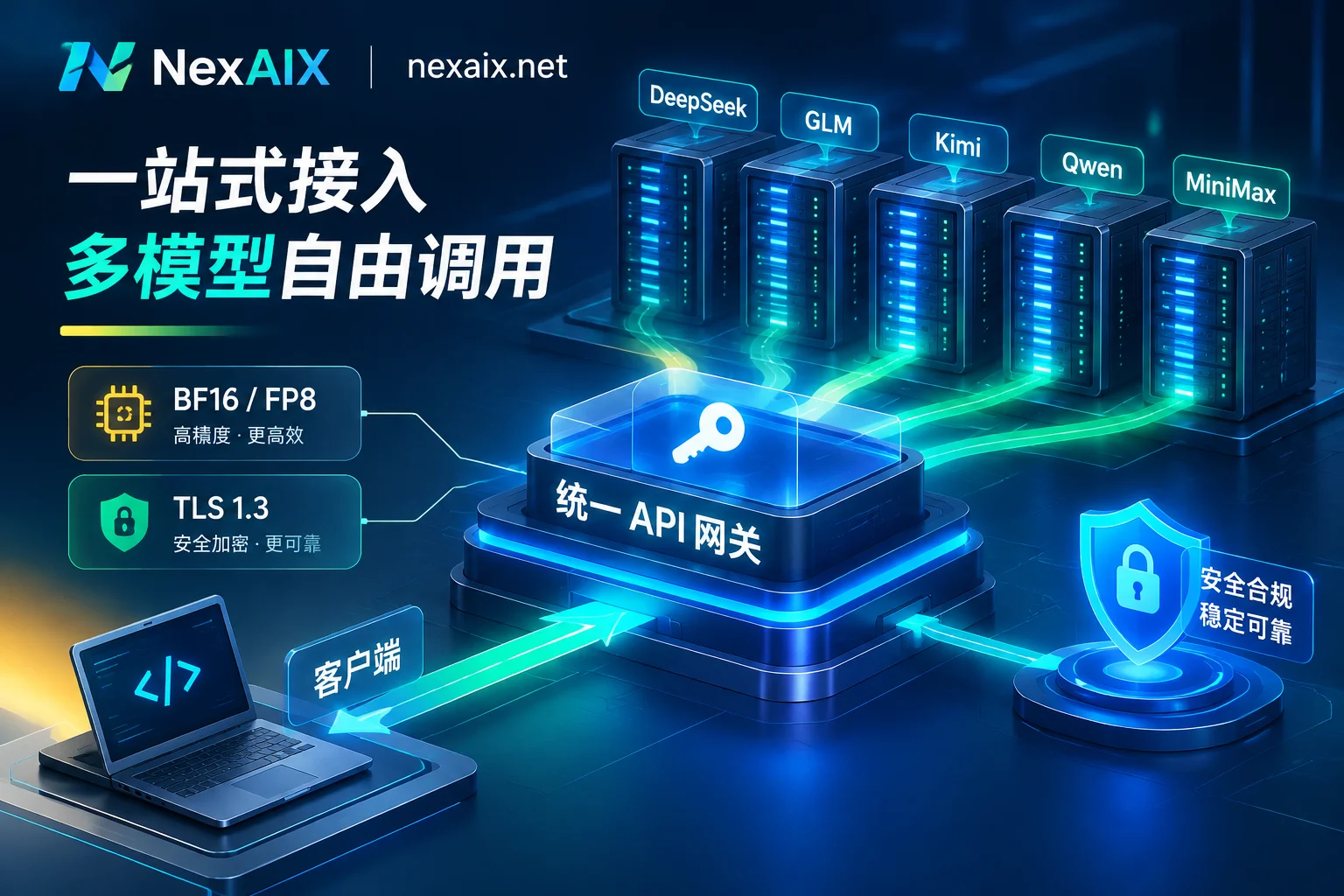
All open-source weight series listed in the NexAIX model marketplace—Kimi, GLM, DeepSeek, MiniMax, Qwen, gpt-oss, etc.—adopt the "proprietary compute deployment" model (see the Model List). We deploy officially released open-source weights directly on proprietary GPU clusters in self-built and self-rented data centers, with an internal infrastructure team fully responsible for inference engine tuning and cluster O&M. We never resell any third-party quotas.
If your business needs to call a specific open-source weight model not in the current list, simply email the target model and estimated usage to [email protected], and our compute team will evaluate cluster resources and reply directly with a launch schedule.
2. Full Transparency of Precision, Context, and Licensing
For open-source models, discussing performance without "inference precision" is hooliganism (for the underlying differences between precisions, refer to our article "What Is the Difference Between BF16 and FP8 Inference Precision: VRAM, Speed, Quality, and Selection").
On every individual model detail page of NexAIX, we mandatorily label the supply method, model ID, publisher, open-source license, context window, maximum output length, and the actual inference precision (e.g., BF16, FP8, MXFP4, etc., strictly marked according to the actual deployment).
At the same time, we adhere to a strict No Downgrade Policy:
- The
modelfield in the API response body is guaranteed to be the model that actually performs the inference; - We never secretly switch to smaller models, never privately reduce inference precision, and never truncate the nominal context or maximum output length;
- We never inject any hidden System Prompt and pass through your
temperature,top_p,max_tokens, and other hyperparameters to the underlying inference engine as-is. - Developers can self-check our interface at any time using four standard methods: fixed prompts with random seeds for retesting, verifying response body fields, and extreme-length stress testing.
3. In-Memory Forwarding and Zero Conversation Log Retention
Open-source models are favored by enterprises largely because the transparency of their code and weights brings a higher sense of security. To continue this security standard in API form, NexAIX implements a strict No Conversation Logging Policy:
- TLS 1.3 encryption is used throughout from client to inference node;
- Your
promptandcompletioncomplete streaming forwarding only in the service node's memory and are released immediately after the request ends, never written to disk or stored in a database; - The platform retains only metadata for billing and troubleshooting (request ID, model name, token count, timestamp, HTTP status code);
- Your business data is never used for any model training and is never handed over to any third party engaged in training. For proprietary compute calls of open-source models, the data链路 is completely closed within NexAIX, with no risk of retention by any external vendor.
III. Architecture in Practice: One Endpoint, One Key for Hybrid Orchestration of Open-Source and Closed-Source
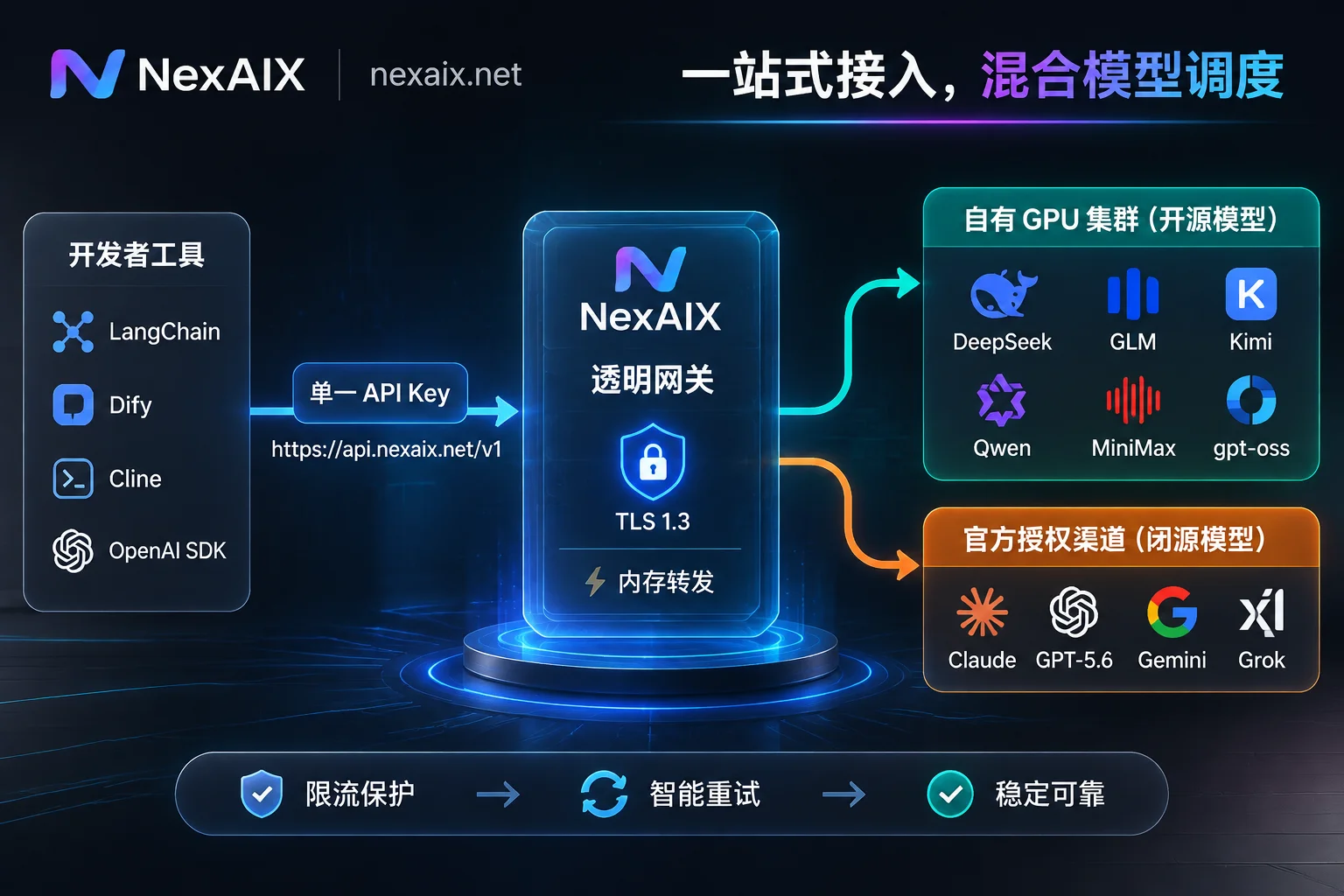
After solving the purity and security of underlying compute, how do you eliminate the engineering friction of multi-model access? NexAIX provides a Unified Compatible Endpoint that fully follows the OpenAI Chat Completions specification.
1. Smooth Migration with Zero Code Refactoring
Whether your project uses the native OpenAI SDK, a complex Agent built on LangChain, LlamaIndex, or Vercel AI SDK, or tools widely used internally such as Dify, Cherry Studio, NextChat, Cline, or OneAPI, in most cases you only need to change two lines of configuration:
- Replace
base_urlwithhttps://api.nexaix.net/v1 - Use the API Key obtained from the NexAIX Console
With this single key, you can freely call proprietary compute open-source models such as DeepSeek, GLM, Kimi, Qwen, MiniMax, and gpt-oss, and also seamlessly call closed-source flagship models such as Claude (e.g., Opus 5 with zero data retention support, Fable 5 with 30-day retention), GPT-5.6, Grok, and Gemini accessed through "official authorized channels" with the exact same interface format (to understand the compliance boundaries of the two supply methods, please refer to the Transparent Supply Statement).
2. Code Example: Switching Models Only Requires Changing the model Field
In business code, to hand heavy document preprocessing to a cost-effective open-source model and core decision-making to a closed-source or flagship reasoning model, you only need to change the model parameter in the request body. Streaming output, multi-turn dialogue, and function/tool calling logic are fully reused:
from openai import OpenAI

# 统一使用 NexAIX 端点与同一把 API Key
client = OpenAI(
    base_url="https://api.nexaix.net/v1",
    api_key="sk-your-nexaix-key"
)

def run_task(model_id: str, user_prompt: str):
    response = client.chat.completions.create(
        model=model_id,
        messages=[
            {"role": "system", "content": "你是一个严谨的生产级研发助手。"},
            {"role": "user", "content": user_prompt}
        ],
        temperature=0.2,
        stream=True
    )
    for chunk in response:
        if chunk.choices[0].delta.content:
            print(chunk.choices[0].delta.content, end="", flush=True)

# 场景 A:调用自有算力部署的开源模型 GLM-5.2 处理工程任务
run_task("glm-5.2", "请解析以下微服务日志并输出结构化 JSON 故障报告...")

# 场景 B:零代码改动,无缝切换至其他开源模型或官方授权闭源模型
# run_task("gpt-5.6", "基于上述故障报告,制定跨区域容灾演练方案...")
Engineering Pitfall Tip (Difference Between Slug and Model ID):
When consulting the NexAIX individual model documentation page, note that theslugin the URL replaces dots (.) in the model ID with hyphens (-). For example, to check the specifications and three-step integration code forglm-5.2, the correct documentation URL ishttps://nexaix.net/models/glm-5-2/(directly spelling/models/glm-5.2/will return 404); but when actually making an API code request, themodelfield in the request body still needs to strictly use the model ID itself (i.e.,glm-5.2).
In addition, if calling open-source or closed-source models that support multimodality (refer to the input modalities marked on each model page), images can be passed directly in OpenAI standard format toimage_urlorbase64, and videos can be passed as sequences of extracted frames.
IV. Deterministic Guarantees for Production: Rate Limiting Governance, Billing Isolation, and Enterprise Compliance
To truly run open-source LLM APIs in production, besides being callable, they must be manageable (for more details on production-grade high availability, you can read "Stable AI API Production Deployment Guide: Say Goodbye to Agent Call Chain Avalanches, Implicit Downgrading, and Hanging Failures"). NexAIX provides engineering teams with clear deterministic boundaries at the gateway and billing layers:
1. Rate Limiting Mechanism That Rejects Deadlock Hangs and Implicit Downgrading
When compute is saturated or during sudden peaks, the biggest fear is that the upstream gateway hangs connections indefinitely, exhausting microservice thread pools, or takes it upon itself to forward requests to cheaper small models, causing output quality to spiral out of control.
Under NexAIX's High Throughput and Rate Limiting System, the capacity of open-source models comes directly from our proprietary GPU clusters. Each key has explicit RPM (requests per minute), TPM (tokens per minute), and in-flight concurrency limits (if you need higher throughput, you can submit a request at any time, and we will evaluate an increase based on actual cluster capacity).
When rate limiting is triggered or the cluster is saturated, the system immediately returns a standard HTTP 429 Too Many Requests status code with a Retry-After response header, never hanging the connection indefinitely, and never overstepping to switch to another model for you, fully returning the decision of backoff retry, queuing, or switching flows to your application layer code. (Note: When processing million-level ultra-long context inputs, the first token latency (TTFT) and compute cost will naturally rise with input length. It is recommended to enable streaming output in all scenarios to optimize the end-to-end experience.)
2. Per-Key Isolated Permissions and Itemized Billing
To address the cost accounting pain points of multiple teams and projects, NexAIX provides a comprehensive per-key isolation mechanism:
- You can create separate API Keys for different microservices, development groups, or client tools;
- Each key has independent quotas, independent model call permissions, and independent usage bills; if a key is accidentally leaked, it can be individually revoked with one click without affecting global business;
- Console bills are strictly itemized by model, support one-click export of usage details, and financial aggregation is clear at a glance;
- Each API call returns a unique Request ID. If any online anomaly occurs, simply contact technical support with the Request ID to quickly locate the链路 status.
3. Complete Enterprise-Level Business and Private Deployment Support
For individual developers and agile teams, you only need an email to register at https://api.nexaix.net/, no cumbersome enterprise qualifications required, and test credits are given upon registration, so you can run the full set of mainstream open-source large models within minutes.
For enterprise customers in the scaling stage, NexAIX has a complete legal entity, supports formal business contracts, Service Level Agreements (SLA), and Data Processing Agreements (DPA), and provides compliant VAT invoices. If your finance, government, or core R&D scenarios have extremely high requirements for physical isolation, you can also contact us directly at [email protected] to discuss independent compute resource pools or private deployment solutions.
Conclusion
The flourishing of open-source large models gives developers unprecedented technical autonomy and cost space. Do not let heavy GPU O&M, fragmented multi-endpoint adaptation, or the risk of intelligence degradation from black-box resale devour this wave of technological dividends.
Visit the NexAIX Model Marketplace now to check the detailed specifications of proprietary compute open-source models such as Kimi, GLM, DeepSeek, MiniMax, Qwen, and gpt-oss, or go directly to Console Registration to claim test credits and start a pure, transparent, high-throughput production-grade AI calling experience with a single key.