NexAIX-官方博客
In 2026, large-model applications have moved fully from early Demo validation into production-grade deployment, but the AI API relay market underpinning these applications has undergone a dramatic industry shakeout.
On the one hand, multiple major model vendors overseas and in China have intensively upgraded their anti-fraud and risk-control mechanisms. Since the middle of this year, major vendors have carried out large-scale account bans and rate-limit purges targeting gray-market relay services that use sub2api technology to reverse-engineer personal subscription accounts (such as Plus/Max memberships and coding subscription plans) into API endpoints for low-price resale; many applications relying on "shared account pools" were abruptly interrupted during peak business hours. On the other hand, according to actual measurements of global relay endpoints in the CISPA 2026 independent research report (arXiv:2603.01919), as many as 45.83% of tested relay endpoints failed model identity verification—behaviors such as altering returned names, secretly substituting lightweight models, truncating context windows, or forcibly lowering quantization precision—so-called "swapping and dumbing down"—have become the biggest hidden trap for developers when selecting services.
As business requirements shift from "it just needs to connect" to "can we dare put it into production," how should developers, Agent R&D teams, and technical leads responsible for online stability evaluate and choose a reliable AI API relay?
1. Why can gray "account-pool relays" not support production environments?
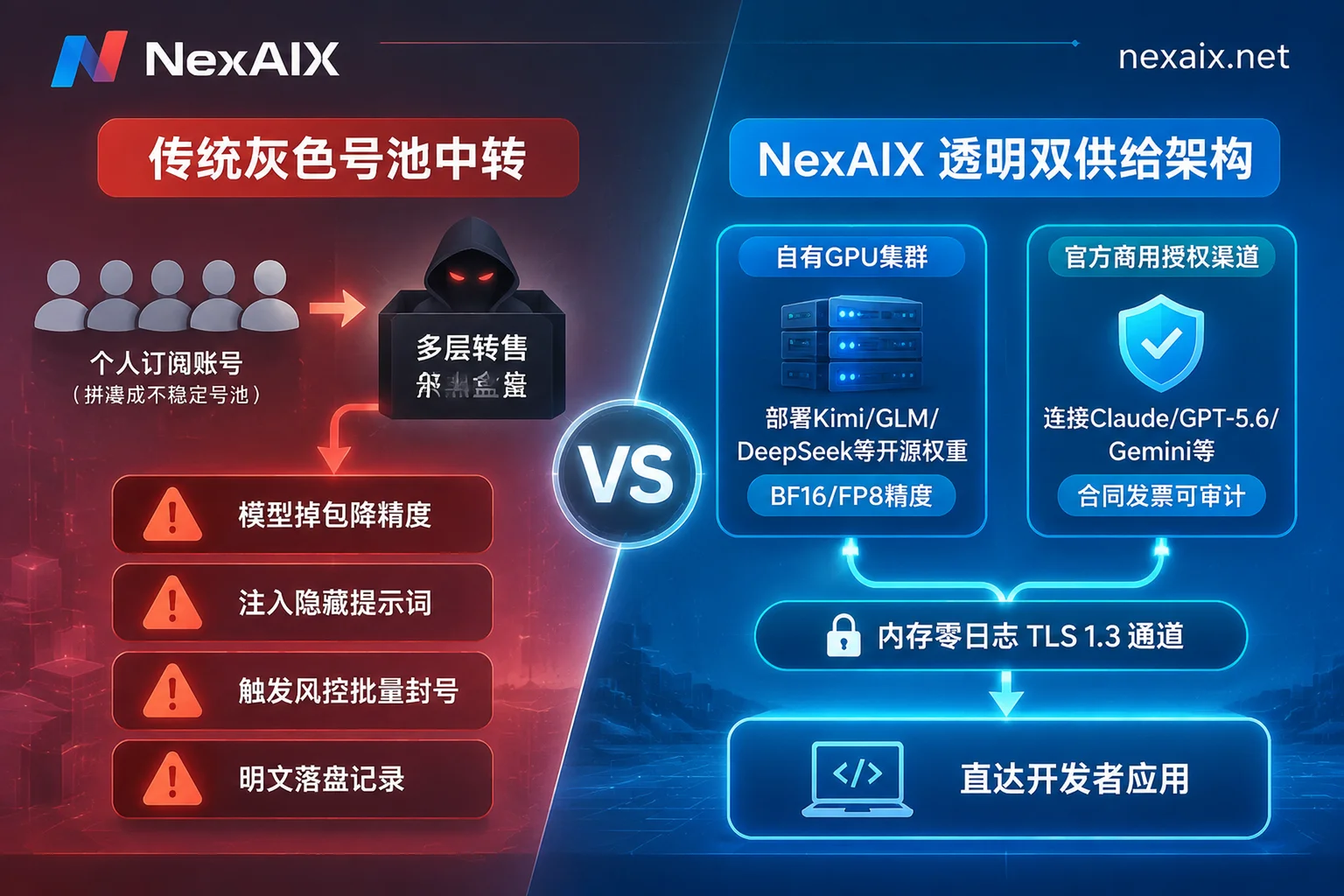
In the early personal development stage, many developers tried low-cost small relay services to solve cross-border network latency or the cumbersome registration process across multiple platforms. But in the technical and compliance environment of 2026, the traditional "account-pool carpooling" and "multi-layer resale" models expose three fatal flaws:
- Fragile links and collateral bans: For platforms that rely on reverse-engineered client protocols, stolen quotas, or pooled subscriptions, once upstream vendors' device fingerprinting and concurrency risk controls are triggered, the entire channel instantly returns a flood of errors, or even shuts down and absconds with funds.
- Hidden "dumbing down" causes Agent logic to collapse: In complex multi-turn tool use or long-document analysis scenarios, if a relay secretly injects a hidden System Prompt that shortens outputs in the background, or secretly swaps a high-end model for a small model and forcibly compresses context, the frontend business will encounter bizarre and hard-to-troubleshoot bugs such as JSON parsing failures and forgotten instructions.
- Exposed data and missing financial compliance: Multi-layer relay services often record users' Prompts in plaintext to disk, or even resell them for fine-tuning training; at the same time, lacking a legal entity and proper invoices, enterprise teams simply cannot complete financial reimbursement and security audit processes.
To thoroughly avoid these landmines, the first step in selection is to look past the API gateway facade and examine the provider's underlying compute and channel supply model.
2. Four hard selection criteria for production-grade AI API relays
Taking the architectural practice of NexAIX as an example, an AI API relay capable of directly carrying production traffic must provide transparent, verifiable commitments across four dimensions: channel source, model fidelity, flow-control mechanisms, and data compliance.
1. Transparent supply sources: only "proprietary compute" and "official authorization"
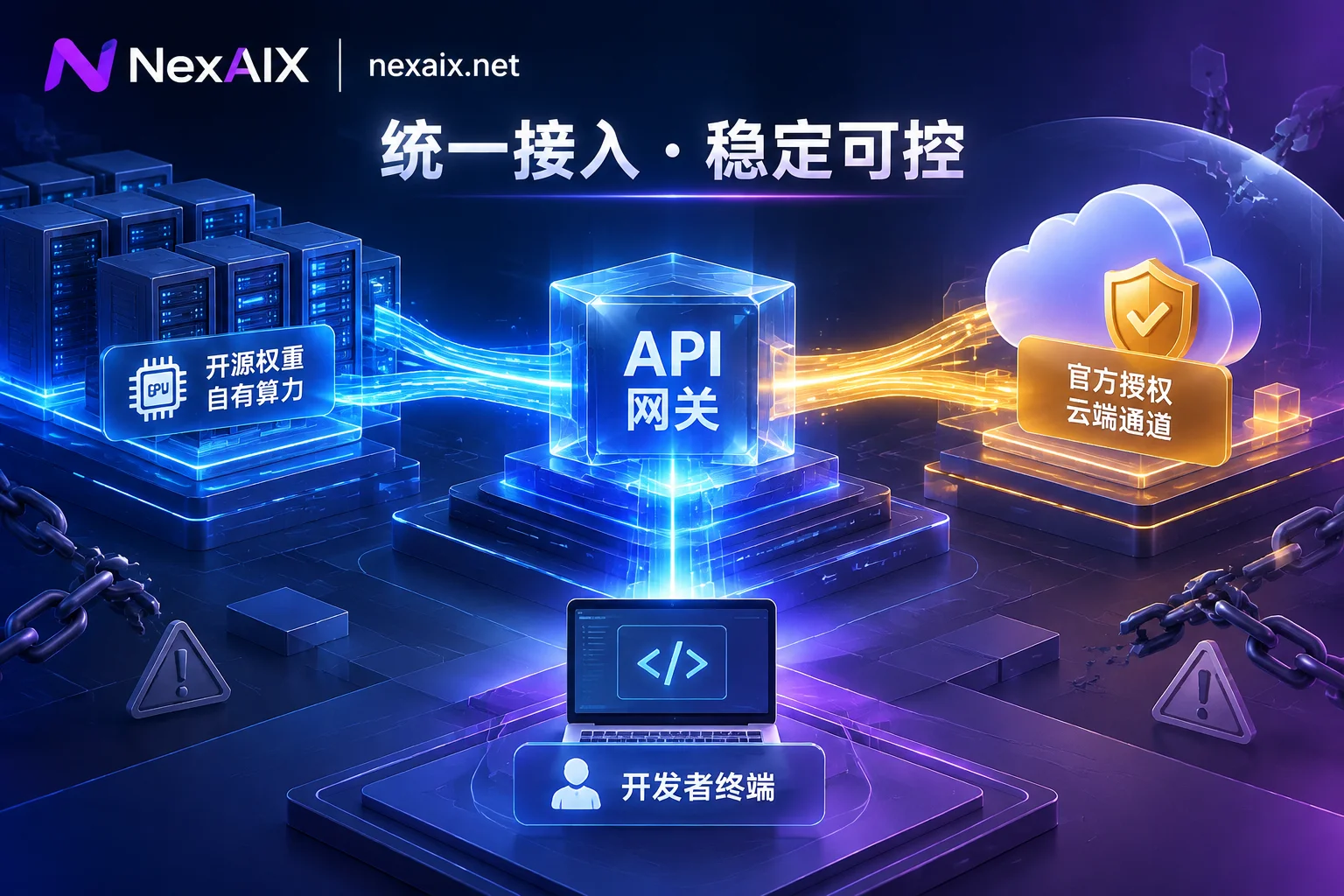
A truly stable API aggregation platform never touches personal subscription account pools and does not engage in multi-layer resale of second-hand quotas. In NexAIX's channel transparency statement, all models are strictly limited to the following two supply methods (publicly labeled at the top of each model detail page):
- Proprietary compute deployment (open-source weight models): Open-source weights released officially are deployed directly on proprietary GPU clusters in self-built and leased data centers, operated and maintained by the team itself, without reselling any third-party quotas. The official website currently covers mainstream open-source series such as Kimi, GLM, DeepSeek, MiniMax, Qwen, and gpt-oss. Each model page clearly states the context length, maximum output, license agreement, and actual inference precision (such as
BF16,FP8,MXFP4, etc., labeled truthfully by model; to understand the differences between precisions, see What is the difference between BF16 and FP8 model inference precision). If a team needs an open-source weight model not on the list, they can directly specify the model and estimated usage and email [email protected]; after evaluating compute capacity, a schedule will be provided directly in reply. - Officially authorized channels (closed-source commercial models): For closed-source series such as Claude, GPT-5.6, Grok, and Gemini, all use vendors' official commercial authorization channels, with formal contracts, invoices, and auditability, and never use account pools or reverse-engineered client protocols. Capacity for closed-source models is constrained by upstream quotas, greatly eliminating the risk of account bans and service interruptions caused by non-compliant calls.
2. Original models without downgrading: parameters passed through as-is, with a four-step self-check
In response to the industry-wide anxiety about "model swapping," NexAIX adheres to the principle of no downgrading for original models: the model field in the response body is the model actually executed; no swapping to smaller models, no lowering of inference precision, no truncation of context or maximum output, and no injection of hidden system prompts. Parameters such as temperature, top_p, and max_tokens in requests are passed through as-is.
More importantly, "no dilution" cannot rely on verbal promises alone; developers can fully verify it themselves using the following four engineering methods (see How to confirm whether an API returns the original model: four reviewable inspection methods):
- Fixed prompt and random seed retesting: Compare output distributions and logical reasoning depth under identical parameters.
- Check the
modelfield in the response body: Verify whether the model identifier in the returned message strictly matches the request and official specifications. - Length stress testing close to the upper limit: Directly construct inputs close to the model's nominal upper limit or request long outputs to verify whether hidden truncation exists.
- Message repetition test: Ask the model to fully repeat all received message content to check whether the gateway layer has secretly inserted a hidden System Prompt requiring "short answers."
3. Deterministic high concurrency and rate limiting: no "silent degradation"
In production environments, traffic peaks and burst concurrency are the norm. To conceal insufficient compute, some relay services silently route excess requests in the background to cheaper, weaker models, or leave requests hanging indefinitely, exhausting client connection pools.
In NexAIX's throughput and rate-limiting design, the system adopts clear and predictable engineering boundaries:
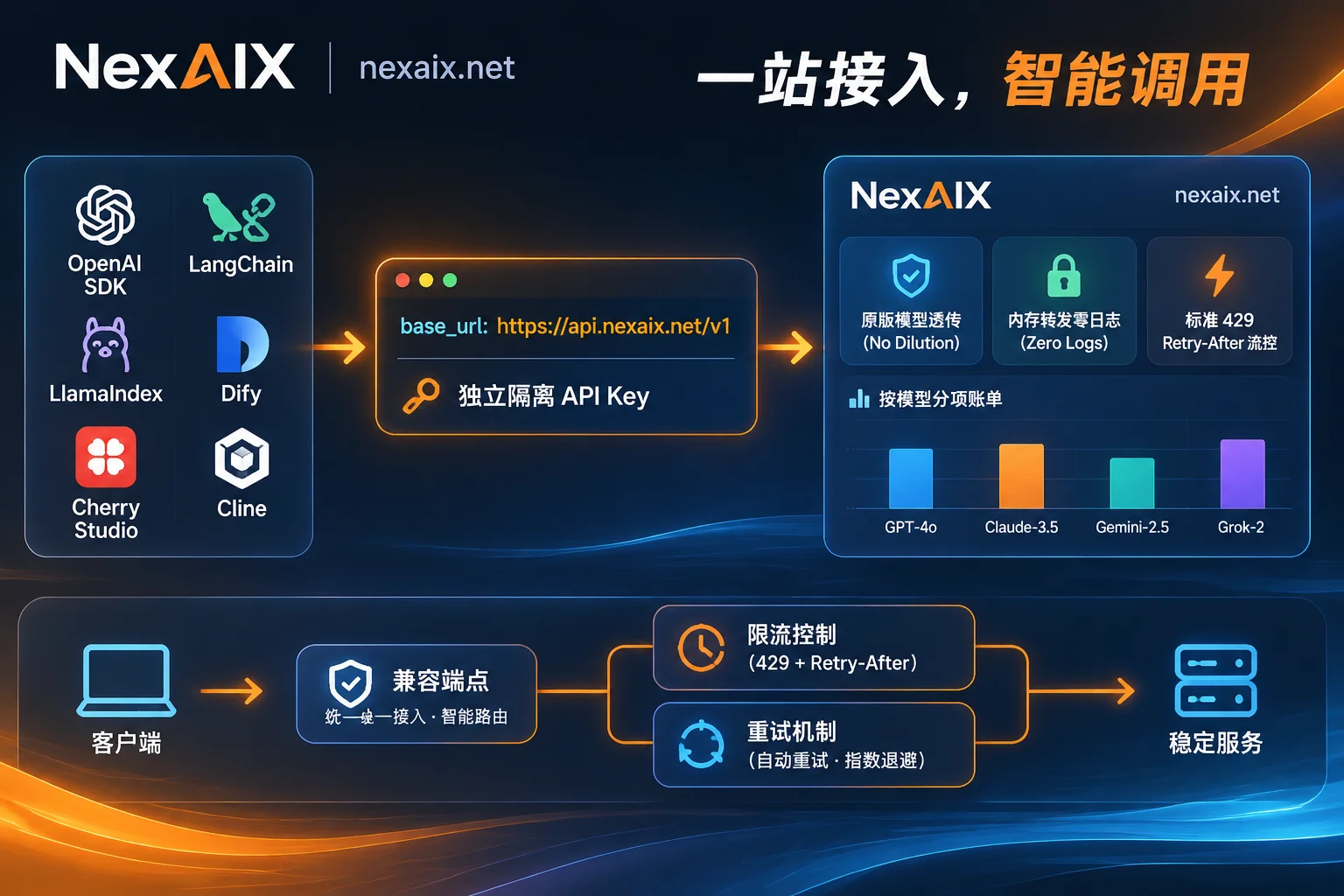
- Each API Key has independent RPM (requests per minute), TPM (tokens per minute), and concurrency limits; if business growth requires higher quotas, applications can be submitted at any time, and the platform responds truthfully based on actual compute and upstream capacity.
- When fully loaded, it returns the standard HTTP
429status code with aRetry-Afterresponse header, never hanging indefinitely and never privately substituting a cheaper model. - Because NexAIX insists on transparent calls with a single provider and a single endpoint, without black-box automatic routing or failover, after receiving
429, the business side decides in its own code layer whether to perform exponential backoff retries, queue requests, or switch to a backup model, giving architects 100% control over system behavior (for related high-availability design, see Large-model API production environment high-availability and security guide). - All models support streaming output, helping frontend applications effectively smooth first-token latency (TTFT) in ultra-long input scenarios.
4. Zero conversation logs, multi-Key isolation, and enterprise-grade compliance
For enterprise R&D and SaaS teams, data security and billing governance directly determine whether a project can pass security compliance review:
- The site does not record conversation content: Under the NexAIX zero-log architecture, users'
promptandcompletionare forwarded only in memory and released immediately after the request ends; they are not written to disk, not used for training, and not passed to third parties that perform training; the entire path from client to inference node uses TLS 1.3 encrypted transmission. The platform retains only metadata used for billing reconciliation and troubleshooting (request ID, model name, token count, timestamp, status code). - Objective and transparent upstream retention statement: For closed-source models, data retention after requests reach the vendor side follows each vendor's terms, and this site does not make false overreaching commitments on their behalf. Currently, the official website separately labels upstream retention policies only on two Claude model pages that have been clearly verified (Opus 5 supports zero data retention, while Fable 5 currently has 30-day retention); all others are subject to official terms (further reading: How to verify whether an AI API records conversation content).
- Per-Key isolation and clear billing: Supports creating multiple API Keys, each with independent quotas, permissions, and usage bills; bills are itemized by model, and the console supports exporting usage details at any time; if a Key leaks, it can be revoked separately without affecting other business lines. Each call returns a unique request ID, so troubleshooting can quickly locate issues with the request ID.
- Complete contracts and invoices: The platform has a formal corporate entity, supports signing service agreements and data processing agreements (DPA), and issues proper invoices; for teams with strict compliance requirements, they can also email [email protected] to discuss dedicated resource pools and private deployment evaluation.
3. Rapid migration in practice: access the full range of open-source and closed-source models with one line of code
After resolving stability and compliance concerns, what is the engineering cost of integration or migration?
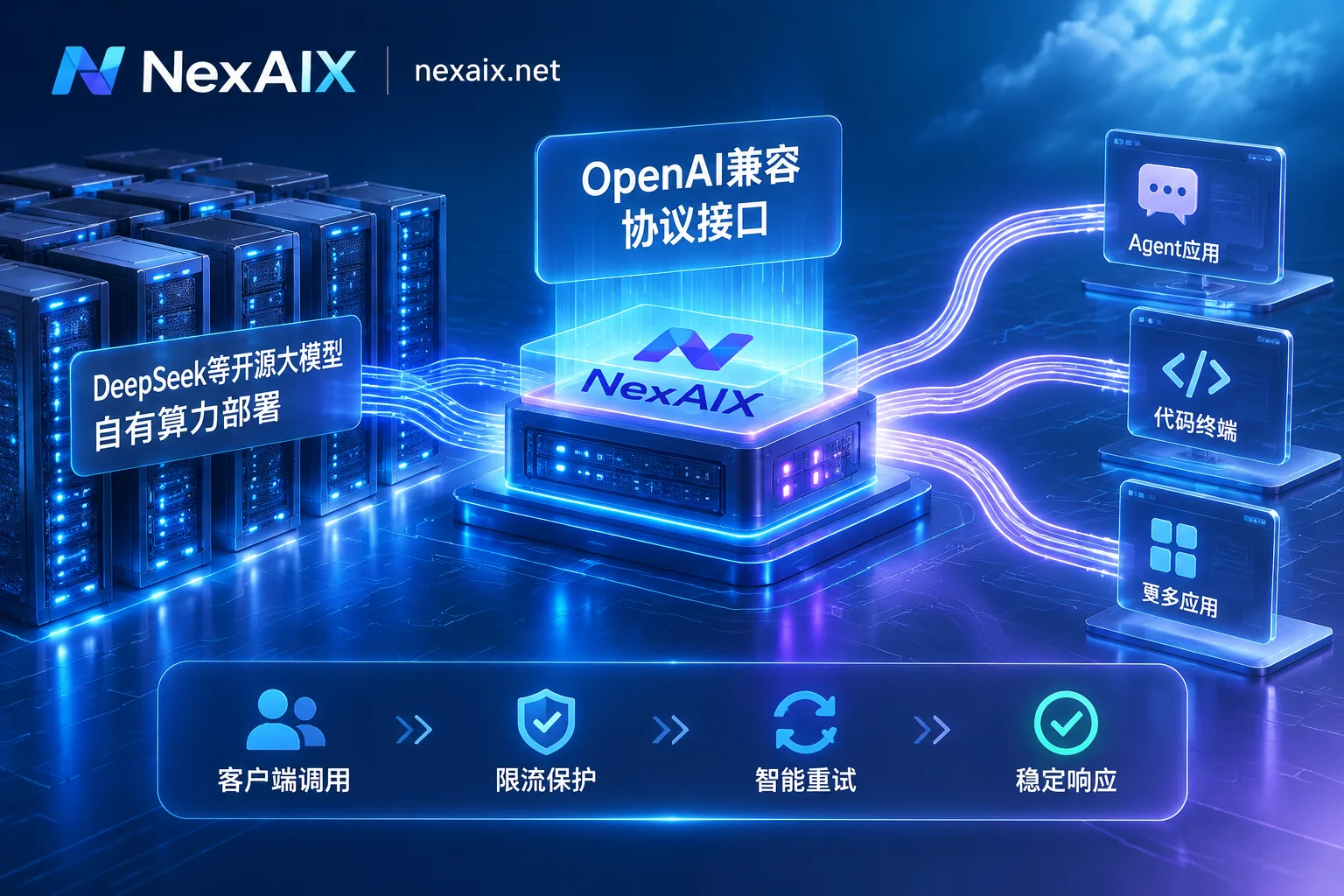
NexAIX implements seamless compatible access strictly according to the OpenAI Chat Completions specification. Whether it is streaming output, function/tool calling (Function Calling / Tool Use), or multi-turn dialogue, it remains consistent with the native specification; for models that support multimodality (see the "input modalities" label on each model page for details), images can be passed directly in OpenAI multimodal format via image_url or base64, while videos are passed as image sequences after frame extraction.
This means that codebases using OpenAI SDK, LangChain, LlamaIndex, Vercel AI SDK, or commonly used client tools such as Dify, Cherry Studio, NextChat, Cline, and OneAPI, in most cases require only two changes:
- Replace
base_urlwithhttps://api.nexaix.net/v1 - Replace it with the API Key obtained from the NexAIX console
Code example: seamlessly switch between closed-source and open-source models on the same endpoint
With a single Key, developers can call both officially authorized closed-source flagship models and open-source weight models deployed on proprietary compute within the same codebase; switching models only requires changing the model field (for a detailed migration checklist, see What code needs to be changed when switching large-model APIs):
from openai import OpenAI

# 仅需修改 base_url 和 api_key,无需引入五花八门的厂商专属 SDK
client = OpenAI(
    base_url="https://api.nexaix.net/v1",
    api_key=" NEXAIX_API_KEY "
)

def chat_with_model(model_name: str, user_prompt: str):
    response = client.chat.completions.create(
        model=model_name,
        messages=[
            {"role": "system", "content": "你是一个严谨的生产环境架构助手。"},
            {"role": "user", "content": user_prompt}
        ],
        temperature=0.2,
        stream=True
    )
    for chunk in response:
        if chunk.choices[0].delta.content:
            print(chunk.choices[0].delta.content, end="", flush=True)

# 场景 A:调用官方授权渠道的闭源模型处理复杂架构规划
# 具体可用模型 ID 请以 https://nexaix.net/models/ 列表为准
chat_with_model("gpt-5.6", "请设计一个基于 HTTP 429 Retry-After 的指数退避重试伪代码。")

# 场景 B:只改 model 字段,无缝切换至自有算力集群的开源权重模型处理高频任务
chat_with_model("glm-5.2", "将上述伪代码转化为带类型注解的 Python 函数。")
💡 Tips for viewing model documentation:
When visiting a single model detail page to view the three-step integration code and specification parameters, theslugin the URL requires replacing the dot (.) in the model ID with a hyphen (-). For example, to view the detail page forglm-5.2, visithttps://nexaix.net/models/glm-5-2/(concatenating directly with dots returns 404), while themodelfield in the API request code should still use the original model IDglm-5.2.
4. Conclusion: bringing infrastructure back to determinism
Competition in AI applications in 2026 is no longer about who can find cheaper "gray-market bargain channels," but about whose Agent responds more stably, whose context does not lose details, and whose data pipeline can withstand audits by customers and regulators.
If you are looking for a hassle-free unified entry point for your first large-model API integration, or are planning to migrate online business away from unstable relay channels, you can now register at the NexAIX console (api.nexaix.net) using only an email address—no enterprise qualifications required, and test credits are granted upon registration. Why not immediately take your most core business Prompt and stress-test scripts and personally run the original models to see their real performance?