 NexAIX-官方博客
In July 2026, OpenRouter and LangChain launched officially maintained dedicated packages langchain-openrouter (PyPI) and @langchain/openrouter (npm), while official LangChain documentation clarified that ChatOpenAI only aligns with the official OpenAI specification. This means that integrating unified AI APIs with LangChain has shifted from the single legacy pattern of overriding base_url to two official routes. This article is based on official documentation verifiable as of 2026-07-29, helping you decide: when to continue using ChatOpenAI override base_url, and when to adopt langchain-openrouter. Conclusion first: If your core use cases are basic chat, RAG, and regular tool calling, and you want to retain multi-provider switching capability, stick with the OpenAI-compatible base_url approach. Only when you explicitly need cross-provider routing policies, node-level failover, or parsing of proprietary reasoning fields should you introduce the dedicated package. Below, we break down capability boundaries, migration costs, and a compromise architecture.
The Change: LangChain Unified AI API Access Goes from base_url Override to Two Official Routes
Previously, LangChain developers integrating a unified AI API like OpenRouter had almost only one approach: override ChatOpenAI in base_url and pass the target model name. In July 2026, according to official OpenRouter and LangChain documentation (as of July 2026), both parties released officially maintained dedicated packages langchain-openrouter (PyPI) / @langchain/openrouter (npm), providing ChatOpenRouter classes with native support for cross-provider model identification, endpoint routing policies, and automatic failover. Meanwhile, the official LangChain ChatOpenRouter integration documentation (python.langchain.com, July 2026) states that ChatOpenAI only matches the official OpenAI specification and does not extract or retain non-standard fields extended by third-party providers (such as reasoning_content reasoning content output).
The essence of this change is that the official community no longer treats base_url override as the only "folk remedy" for unified AI API access; instead, it provides first-party support for scenarios needing provider-specific capabilities (routing, failover, proprietary field parsing). However, the official community does not dismiss the standard compatible approach—for scenarios needing only standard Chat Completions capabilities, ChatOpenAI remains fully usable. First, check whether your pipeline uses routing policies, failover, or proprietary reasoning fields; if none, no migration is necessary.
Capability Boundary Comparison: Which Parameters Are Only Expressible via the Dedicated Package
langchain-openrouter and ChatOpenAI+base_url are not a simple "new vs. old" replacement but two routes with different capability boundaries. The table below, based on information confirmed in official documentation, lists capability items you must check during selection:
| Capability Dimension | ChatOpenAI + base_url (OpenAI compatible) | langchain-openrouter / ChatOpenRouter |
|---|---|---|
| Initialization & credentials | Set via environment variables OPENAI_API_KEY, OPENAI_BASE_URL | Typically uses a separate API key; credential loading per official documentation |
| Model identifier format | Pass full model name per OpenAI spec | Supports cross-provider model routing identifiers (exact format per official docs) |
| Streaming | Supports standard SSE streaming | Supports streaming; specific implementation per official package docs |
| Tool calling | Supports OpenAI Chat Completions Tool Calling standard structure | Supports standard Tool Calling; per official package docs |
| Cross-provider endpoint routing policies | No built-in support; implement in code | Native support (per official docs) |
| Automatic failover | No built-in support; rely on external retry logic | Native support (per official docs) |
| Non-standard response field parsing (e.g., reasoning_content type) | Not extracted or retained (confirmed in official docs) | Official docs say to use provider-specific package when needing proprietary reasoning output; exact retention per official docs (inference: retained) |
Note: The "per official documentation" parts are not vague—the fact package does not provide specific parameter names, version numbers, or installation commands, and hardcoding them would mislead readers. Such information changes rapidly; check official repositories and docs directly. Items labeled "inference" are based on official statements and should be tested before production. Check off each item in the table; if any item falls in the dedicated package's exclusive column, proceed to the cost analysis in the next section.
Portability Cost Calculation: How Many Lines Would You Change to Switch to Another Unified AI API Provider?
When evaluating lock-in depth of a unified AI API provider, the most practical question is: If you switched to another unified AI API provider tomorrow, how much code would you need to change? Break down migration costs into four change surfaces:
- Model identifier string: In the
base_urlapproach, the model name is usually a string parameter; switching providers only requires changing configuration. The dedicated package may require a different model naming format, spreading changes to call sites. - Client initialization and credentials: In the
ChatOpenAIapproach, client construction is uniform; the dedicated package has its own construction logic, so all client-creation code must change. - Provider-specific parameters: If you use the dedicated package's routing preferences, failover strategies, etc., these parameters cannot be expressed in the OpenAI-compatible interface; migration means deleting or rewriting them.
- Response body non-standard field parsing: If your downstream code depends on proprietary fields like
reasoning_content, which are only available via the dedicated package, then migrating tobase_urlwill make these parsing logic fail.
A rough estimation metric: number of proprietary parameter occurrences × number of call sites. If your code has 0 occurrences of "provider-specific parameters" across 50 call sites, the migration cost using base_url is very low. Conversely, if you pass routing preference parameters in all 50 calls, lock-in with the dedicated package is already high. Recommend this formula to self-test lock-in depth on each project.
Where to Place Proprietary Capabilities: A Compromise Architecture with Compatibility Layer + Pluggable Adapters
Worried about lock-in but don't want to give up routing and failover? Use a "compatibility layer + pluggable adapter" compromise architecture:
- Core pipeline (LangGraph nodes, RAG retrieval, Agent main loop) uniformly uses OpenAI-compatible Chat Completions interface, only reading
base_url,api_key, model name via config. This code is provider-agnostic and highly portable. - Provider-specific capabilities (e.g., OpenRouter's routing preferences, failover strategies) are encapsulated in separate provider adapter interfaces, assembled via a factory function based on config. Adapters can internally use the dedicated package but expose a unified interface.
- LangGraph node logic depends only on the unified adapter interface, not directly referencing
ChatOpenRouteror other provider-specific classes, and no provider-specific parameter literals appear inside nodes (exact class/parameter names per official docs).
The diagram below illustrates the data flow and dependency directions:
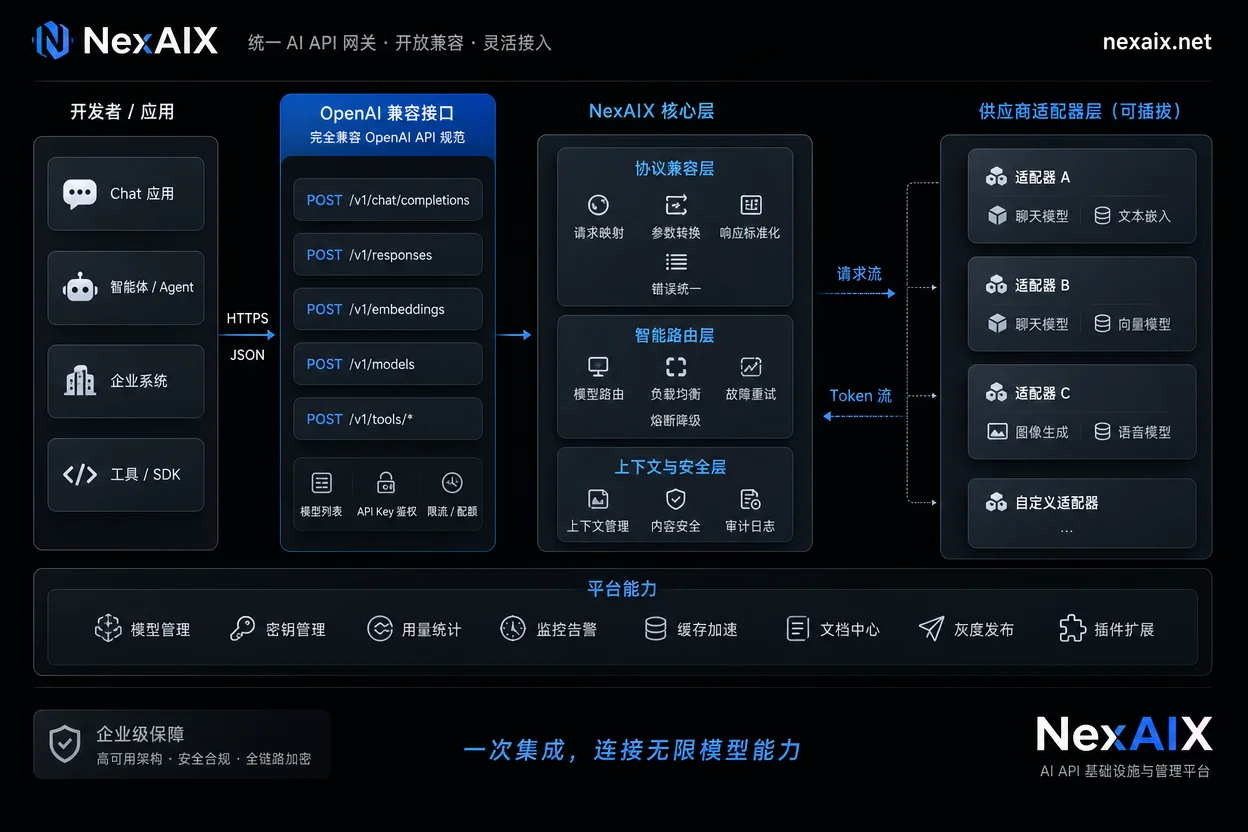
The benefit of this layering is that the core pipeline remains portable, while proprietary capabilities are isolated in replaceable adapters. When you need to switch providers or evaluate a new one, you only add a new adapter without modifying core nodes.
Don't Be Misled: Non-Standard Field Non-Parsing ≠ Degraded Streaming or Tool Calling
Some community claims say that using ChatOpenAI + base_url to connect to third-party aggregator gateways causes silent degradation of streaming. However, this claim has no corresponding statement in official LangChain docs; the official docs only confirm that non-standard extension fields are not automatically extracted/retained, while core Chat Completions streaming and Tool Calling remain supported via standard API. That is, if your scenario only relies on standard fields (e.g., choices, tool_calls), there is no difference between ChatOpenAI and the dedicated package.
If you're unsure, verify with a minimal experiment: same prompt, same parameters, compare first-token latency, chunk count, tool_calls structure, and finish_reason between the two approaches. Remember, trust your own measurements, not unsubstantiated rumors.
LangChain Multi-Model API Migration Checklist: 10 Regression Tests Before Switching
Regardless of switching direction, run the following regression checklist to ensure consistency:
- Streaming increments and end events: Test streaming, compare chunk content and order, confirm no unexpected truncation or duplication.
- Tool call parameter JSON validity and parallel calls: Confirm parameters in
tool_callsare JSON-parsable and multiple tool calls trigger correctly. - Multi-turn context and system messages: Verify context is maintained after multi-turn conversations and system message influence is consistent.
- Timeout and retry configuration: Check that timeout and retry counts are correctly passed in the new approach.
- 429 backoff and error code mapping: Trigger rate limiting, observe whether error code is standard 429 and backoff works.
- Token counting and cost delta: Compare token counts and estimated costs; differences should be within acceptable range.
- Non-standard field discard: If you need
reasoning_content, confirm the dedicated package can retain it; if using compatible approach, confirm downstream won't crash due to absence. - Model identifier and response model field consistency: Whether the requested model name and response
modelfield match, critical for logging and attribution. - Dependency version lock and breaking change monitoring: If introducing dedicated package, lock versions and monitor release cadence to avoid silent upgrades causing incompatibility.
- Rollback switch: Ensure new approach is configurable for one-click rollback if issues arise.
Use the Same OpenAI-Compatible Code Across Multiple Unified AI APIs for Comparative Eval
Under the above architecture, the biggest benefit of keeping the compatible approach is the ability to run comparative evals across multiple unified AI APIs with the same pipeline code. When doing cross-provider comparisons, fix these variables: prompt set, temperature and max tokens, concurrency and retry strategy, scoring script; only change base_url and model name. This way, result differences can be attributed to the model itself.
Take NexAIX as an example: it provides an OpenAI Chat Completions compatible interface (base_url is https://api.nexaix.net/v1), supporting streaming and function/tool calls, so you can directly use the ChatOpenAI standard approach in LangChain without introducing a provider-specific package. More importantly, it returns standard 429 status codes and retry suggestions when overloaded, does not silently switch to cheaper models, and the response field model corresponds to the actual executing model—enabling accurate attribution of eval results to specific models and more reliable cost accounting. For specific models and specs, refer to the NexAIX models page and documentation.
If your provider doesn't meet these two points, add validation in your eval: compare each response model field against the request, log 429s and retry counts to identify routing behavior impacts.
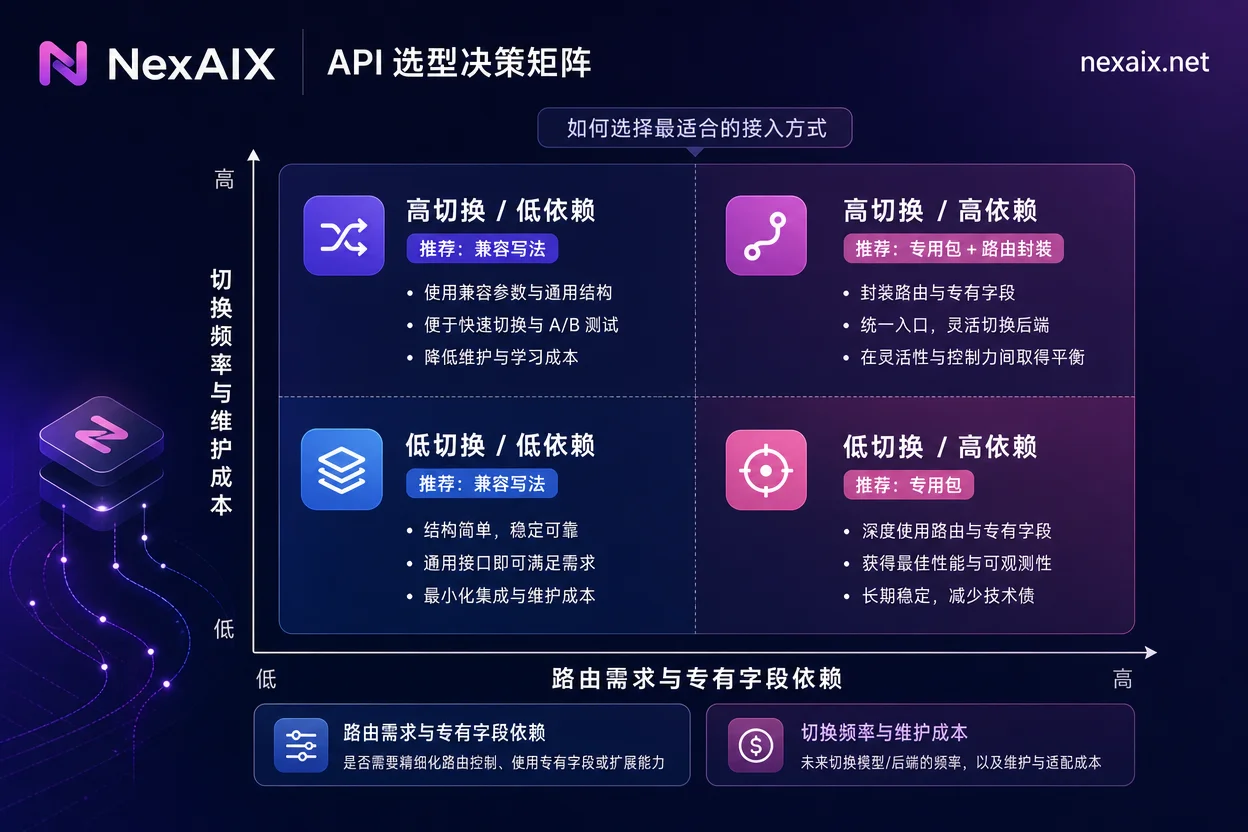
Below is a selection decision matrix based on routing needs, proprietary field dependency, switching frequency, and maintenance cost:
Conclusion: When to Adopt the Dedicated Package vs. Stick with Standard Compatible Approach
- Worth adopting dedicated package: You explicitly need cross-provider routing policies, node-level failover, or must retain proprietary reasoning output like
reasoning_content. - Stick with compatible approach: Mainly basic chat, RAG, regular tool calling, and want to retain multi-provider switching capability—then
ChatOpenAI+base_urlis a low-lock-in, portable choice. - Hybrid: Layer architecture as described, keeping the core pipeline compatible and isolating proprietary capabilities in adapters.
Final reminder: All parameter names, version numbers, and installation commands are per official documentation; this article's evaluation criteria are based on official docs as of July 29, 2026. Run the regression checklist on your existing pipeline for minimal comparative experiments before deciding. If you need to do same-code comparisons across multiple unified AI APIs, check NexAIX docs and model pages for current models and API specs, and validate with test credits.


Comments(0)