NexAIX-官方博客
In early generative AI applications, when developers talked about AI API privacy, they often only worried about "will the code I write in the chat box be used to train the next generation model?" But in the 2026 production environment, as AI Agents and automated programming tools fully take over core business flows, the boundary of privacy and security has undergone a qualitative change.
The recently released "2025-2026 Internet Security Report" shows that, influenced by external large model calls and the expansion of agent toolchains, AI-related sensitive information leakage incidents in office and R&D scenarios have increased by more than 300% year-over-year. Today's AI agents are no longer just a chat box that "inputs text and outputs text"—they actively read local files, scan code repositories, parse online crash logs, and even carry context credentials to initiate external tool calls. When these high-density business data are continuously sent to the cloud via API, any uncontrolled retention at any link will evolve into a serious data security incident.
If you are a technical lead migrating existing applications to a multi-model architecture, or a development team building complex Agents, how do you defend the AI API privacy defense line in production without sacrificing model inference capabilities? This article starts from real data flows and dissects a verifiable and actionable privacy architecture solution.
I. Why Is Your AI API Becoming a Disaster Area for Privacy Exposure?
Many people have a misconception: they believe that as long as API requests are encrypted with HTTPS, the data is secure. In fact, transport layer encryption can only prevent man-in-the-middle hijacking; the real leakage risks are almost entirely concentrated in forwarding nodes, upstream storage, and compliance auditing:
1. Gray Market "Account Pools" and Reverse Proxy Interception
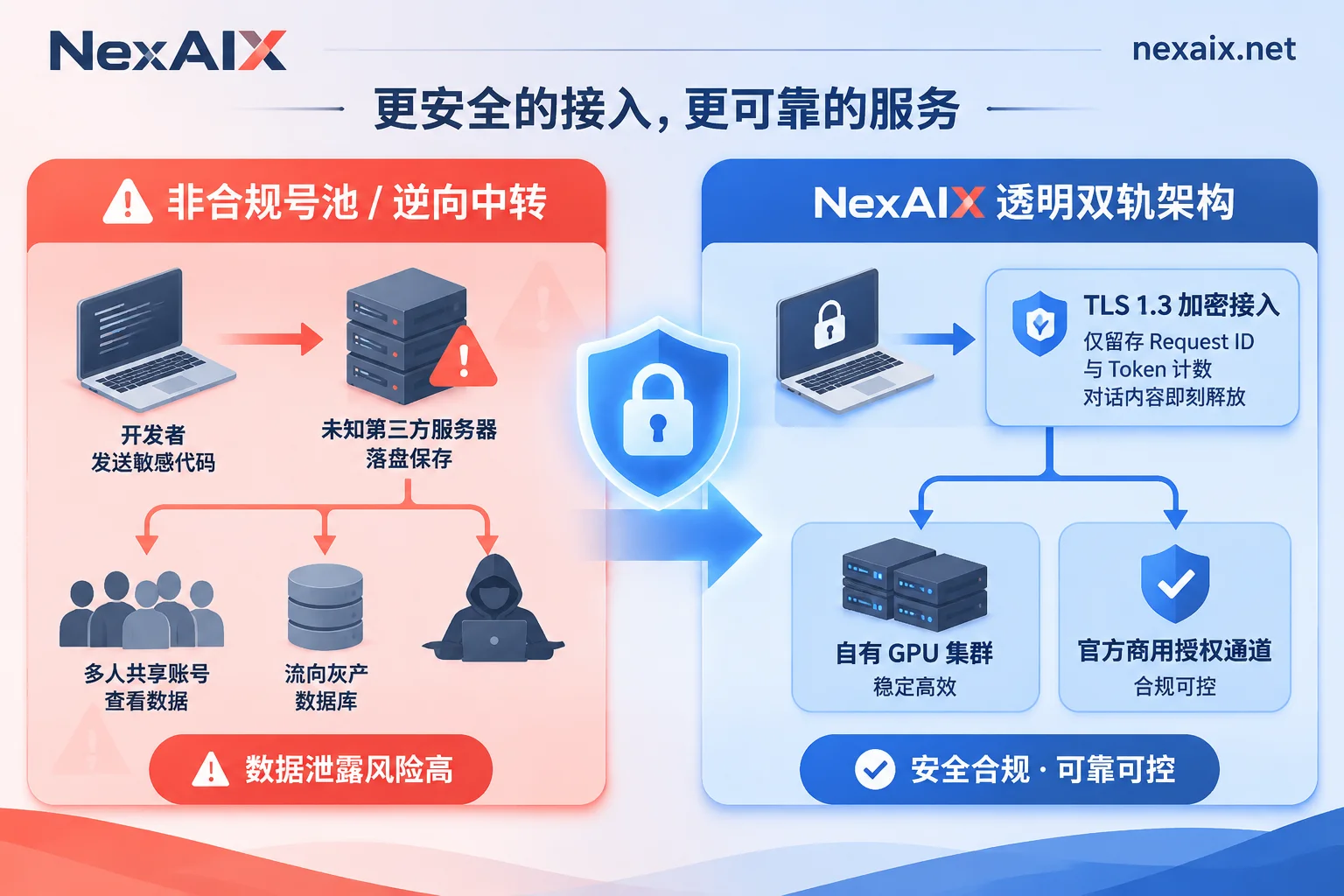
Recently, multiple media and regulatory authorities have intensively reported on the gray industry chain of "AI shared accounts" and illegal low-cost proxies. Such platforms typically split personal monthly subscription accounts into pay-per-use interfaces (commonly known as account pools or sub2api), or forward requests by reverse-engineering client protocols.
In this architecture, every prompt you send containing private source code, business contracts, or customer PII (Personally Identifiable Information) is not only stored in plaintext in the third-party proxy's backend database, but also directly lies in the history of some unknown overseas personal account, facing the risk of being collected, audited, or even packaged and resold at any time. (For how to identify and stay away from such gray channels, refer to our previous article "2026 AI API Proxy Selection and Pitfall Avoidance Guide: Saying Goodbye to sub2api Ban Waves and Model Swapping, Running Interfaces Stably in Production".)
2. "Gateway Zero Retention" Is Not Equal to "Upstream Model Zero Retention"
This is the most easily overlooked clause trap when enterprises purchase AI APIs in 2026. An API request, after being sent from the client, must pass through at least two entities: the access gateway and the underlying model executor.
Even if the intermediate aggregation gateway promises not to save logs, if a closed-source commercial model is called, the data will still reach the upstream vendor's servers. Major closed-source model vendors have different default data retention periods (such as 30-day caching for abuse monitoring) and whether they offer Zero Data Retention (ZDR). Blindly routing all sensitive payloads to a single closed-source interface can easily trigger data cross-border or industry compliance red lines.
3. The "Filter Paradox" and Data Leakage in Security Investigation Scenarios
In a recent industry security review, a highly representative case emerged: after a well-known AI community suffered an automated attack, the security team attempted to call the API of a mainstream closed-source frontier model to analyze attack logs and malicious payloads, but was directly blocked by the upstream interface's security filter—because the filter could not distinguish between "security personnel parsing a vulnerability" and "a hacker requesting assistance in an attack."
More importantly, the security team realized that during incident response, sending raw logs containing real attack paths and exposed credentials to an external third-party closed-source API itself violates the security principle of keeping core assets within the domain. Ultimately, they had to temporarily switch to open-source weight models GLM-5.2 to complete internal log analysis.
II. Dissecting AI API Data Flow: Building a Dual-Track Privacy Isolation Architecture
To thoroughly solve the above pain points, technical teams cannot rely solely on a vague "privacy statement"; they need to separate governance of the gateway forwarding layer and the underlying compute supply layer at the architecture level.
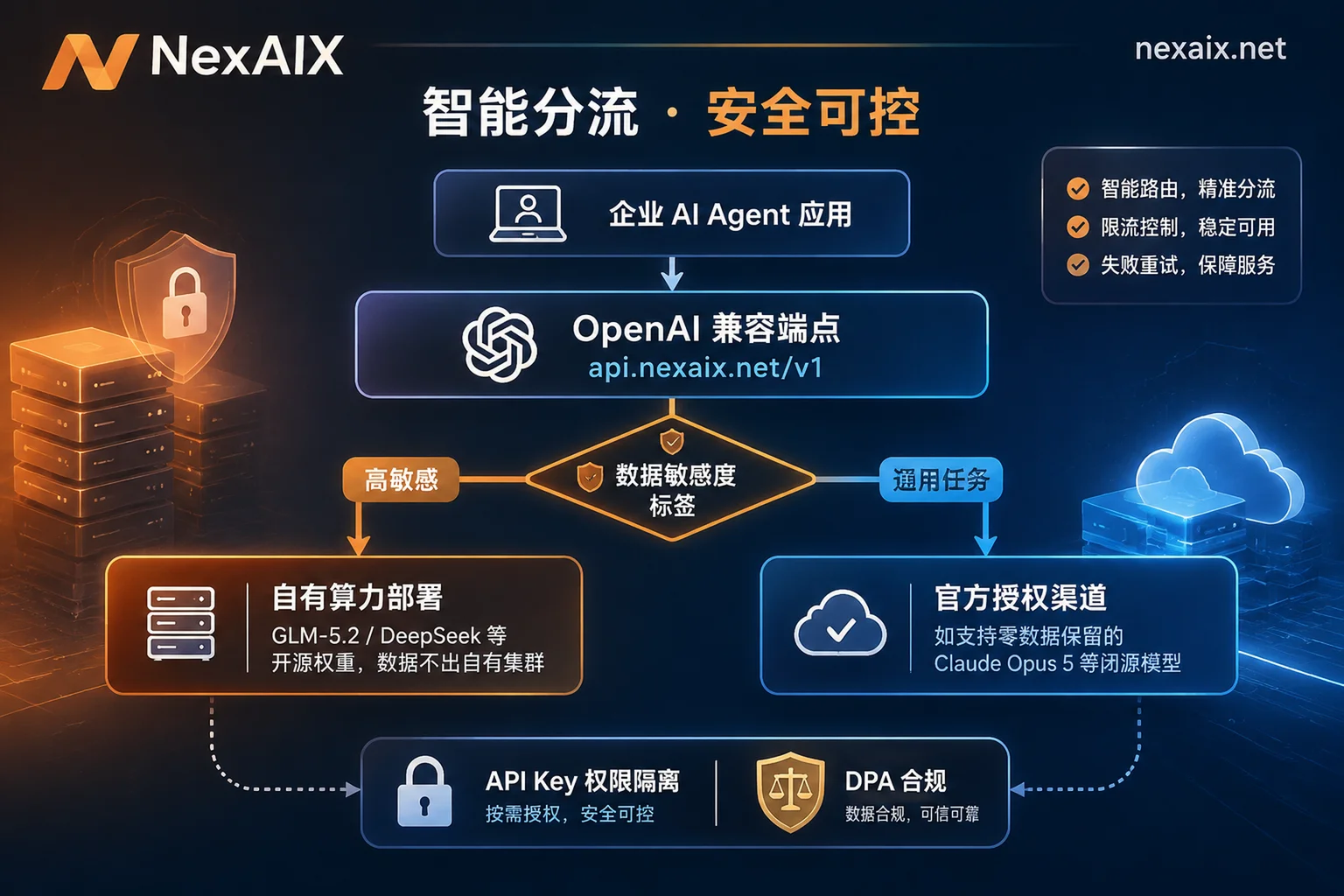
In NexAIX's production-grade supply system, all models are strictly limited to two transparent modes: "self-owned compute deployment" and "official authorized channels" (see Transparent Supply and Self-Check Instructions). Developers can implement "dual-track" routing based on data sensitivity through the same OpenAI-compatible endpoint:
Track A: The Absolute Bottom Line at the Gateway Layer—In-Memory Forwarding and Zero Conversation Logs
Regardless of which type of model you call, the security of data passing through the API gateway is the first threshold. On the NexAIX side, we enforce a strict Zero-Logs policy:
- Pure in-memory flow: Your
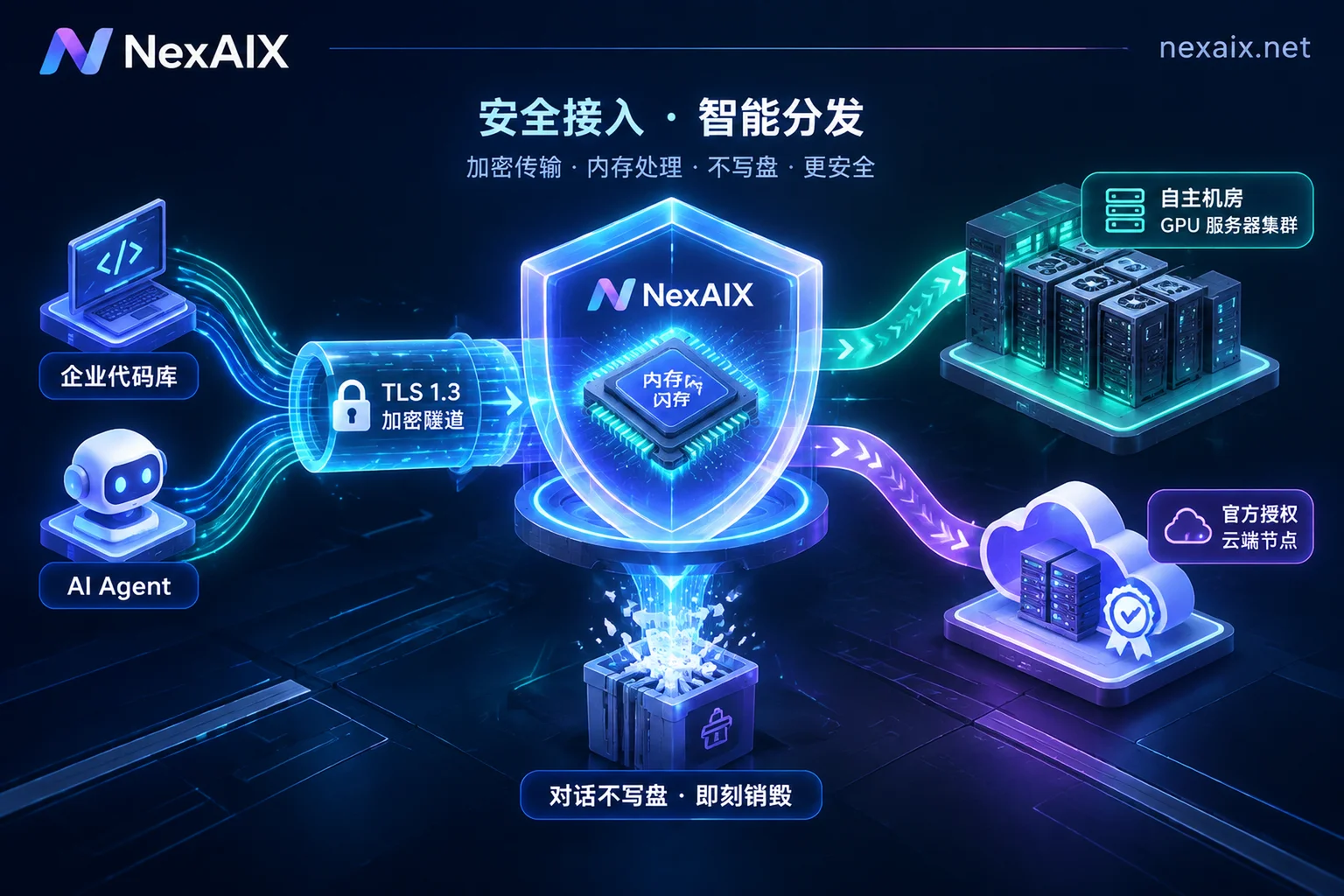
prompt(prompts) and model-generatedcompletion(completions) are forwarded only in server memory and released immediately after the request ends—never written to disk. - Minimal metadata retention: To meet basic billing and troubleshooting needs, the system retains only anonymized call metadata—Request ID, model name, token count, timestamp, and HTTP status code.
- No training and full-link encryption: We promise not to use any user data for model training and never transfer it to any third party engaged in model training; TLS 1.3 encrypted transmission is enforced from client to inference node.
Further Reading: If you want to know how to technically probe and verify whether a service provider secretly caches context, you can refer to "How to Verify Whether an AI API Records Conversation Content: What Can Be Checked, What Cannot, and How to Prevent".
Track B: Tiered Routing at the Model Layer—Self-Owned Compute for Open-Source Weights vs. Official Authorized Closed-Source
When data passes through the gateway and reaches the inference node, the privacy boundaries of different supply methods are completely different. We mandatorily label the supply method on each model's individual detail page and never mix them:
| Evaluation Dimension | Self-Owned Compute Deployment (Open-Source Weight Models) | Official Authorized Channels (Closed-Source Commercial Models) |
|---|---|---|
| Representative Model Series | DeepSeek, GLM, Kimi, Qwen, MiniMax, gpt-oss series | Claude, GPT-5.6, Gemini, Grok series |
| Compute and Channel Ownership | Official open-source weights deployed on NexAIX's self-built and leased own GPU clusters, self-operated and maintained, no reselling of third-party quotas | Through vendors' official commercial authorization channels, with contracts, invoices, and auditability; never use account pools or reverse-engineer client protocols |
| Data Flow Boundary | Data endpoint is NexAIX's own inference cluster, does not leave the platform's infrastructure | Requests are forwarded in-memory by the platform and then enter the upstream closed-source vendor's official interface |
| Data Retention Policy | Follows the site's in-memory forwarding without disk persistence policy throughout, completely destroyed after request ends | The site does not persist to disk; upstream data retention follows each vendor's official terms (the site cannot make commitments on their behalf) |
| Typical Use Cases | Core source code refactoring, security attack log analysis, internal finance/legal document cleansing, high-sensitivity Agent orchestration | Businesses with extreme requirements for frontier reasoning capabilities that have completed anonymization or comply with upstream retention compliance requirements |
Special Note on Upstream Retention for Closed-Source Models:
Because requests to closed-source models are ultimately processed by upstream vendors, data retention terms may differ between vendors, and even between different models from the same vendor. NexAIX insists on objective disclosure and does not make false guarantees to customers. For example, in the current model catalog, only two model pages in the Claude series separately and explicitly state upstream retention rules: Claude Opus 5 supports Zero Data Retention (ZDR), while Claude Fable 5 currently has 30-day retention (for specific integration strategies, refer to "New Approaches to Claude API Integration: How to Balance Production Compliance and Zero Data Residue Requirements?"). For other closed-source models, teams are advised to evaluate based on the vendor's latest official terms and each model's detail page before transmitting sensitive data.
III. Engineering Implementation: 3 Steps to Implement "Dynamic Routing by Sensitivity" at the Code Level
In actual development, you don't need to maintain two completely different SDKs to distinguish between open-source and closed-source models. NexAIX fully implements the OpenAI Chat Completions specification (supporting streaming output, function/tool calls, multi-turn conversations, and multimodal inputs). A single API key can access all activated models, and switching models only requires changing the model field in the request body.
Whether your team uses the native OpenAI SDK or tools like LangChain, LlamaIndex, Vercel AI SDK, Dify, Cherry Studio, Cline, etc., you can seamlessly integrate by pointing base_url to https://api.nexaix.net/v1 (see Compatibility Integration Guide).
Below is a Python practical example of dynamically routing models based on task privacy levels in a production environment:
import os
from openai import OpenAI

# 1. 统一使用 OpenAI 兼容客户端,一行配置切换至 NexAIX 端点
client = OpenAI(
    api_key=os.environ.get("NEXAIX_API_KEY"),
    base_url="https://api.nexaix.net/v1"
)

def secure_agent_dispatch(task_content: str, sensitivity_level: str):
    """
    根据数据敏感度动态选择底层模型:
    - HIGH_INTERNAL: 涉及内部源码或安全日志,路由至自有算力开源权重模型(如 glm-5.2)
    - FRONTIER_ZDR: 需前沿闭源能力且要求上游零留存,路由至支持零数据保留的闭源模型
    """
    if sensitivity_level == "HIGH_INTERNAL":
        # 选用自有 GPU 集群部署的开源模型,数据不离开自有算力闭环,且避开闭源通用安全过滤误拦
        # 注意:模型详情页 URL 为 https://nexaix.net/models/glm-5-2/ ,但代码里 model 字段仍传 glm-5.2
        target_model = "glm-5.2"
    elif sensitivity_level == "FRONTIER_ZDR":
        # 选用明确标注支持上游零数据保留的官方授权闭源模型(具体型号以官网模型页为准)
        target_model = "claude-opus-5"
    else:
        target_model = "gpt-5.6"

    response = client.chat.completions.create(
        model=target_model,
        messages=[
            {"role": "system", "content": "你是一个严谨的企业级安全与代码分析助手。"},
            {"role": "user", "content": task_content}
        ],
        temperature=0.1,
        max_tokens=2048
    )

    # 2. 核对返回的 model 字段,确保无隐式降配或模型掉包
    actual_model = response.model
    # 3. 记录请求 ID 以便合规审计与排障(不记录敏感文本本身)
    request_id = response._request_id

    print(f"[Audit] Executed Model: {actual_model} | Request ID: {request_id}")
    return response.choices[0].message.content
Integration Tip: When checking a single model's context limit, inference precision (e.g., BF16, FP8, MXFP4), and three-step integration code, please note the URL spelling rule—the detail page'sslugreplaces dots (.) in the model ID with hyphens (-). For example, the specification page forglm-5.2is at https://nexaix.net/models/glm-5-2/, but in API request code, themodelparameter still remains asglm-5.2.
IV. Defense in Depth for Production: Anti-Tampering, Anti-Leakage, and Compliance Endorsement
In addition to controlling the retention of conversation data, production-grade AI architectures need to guard against three other common security and engineering risks:
1. Eliminate "Hidden System Prompt" Injection and Implicit Downgrading
Some opaque API proxies, in order to save compute costs or forcibly intervene in output, secretly inject hidden system prompt, truncate context windows, or even silently route requests to cheaper smaller models during peak times. This not only causes Agent tool call format crashes but also the injected unknown instructions may induce the model to expose sensitive variables in the context.
NexAIX adheres to a strict No-Dilution Principle:
- The
modelfield in the response body is the actually executed model; never swap to a smaller model, reduce precision, or truncate context and max output. - No hidden system prompts are injected; parameters such as
temperature,top_p,max_tokensare passed through as-is. - When compute is fully loaded or quota limits are reached, the system returns a standard HTTP
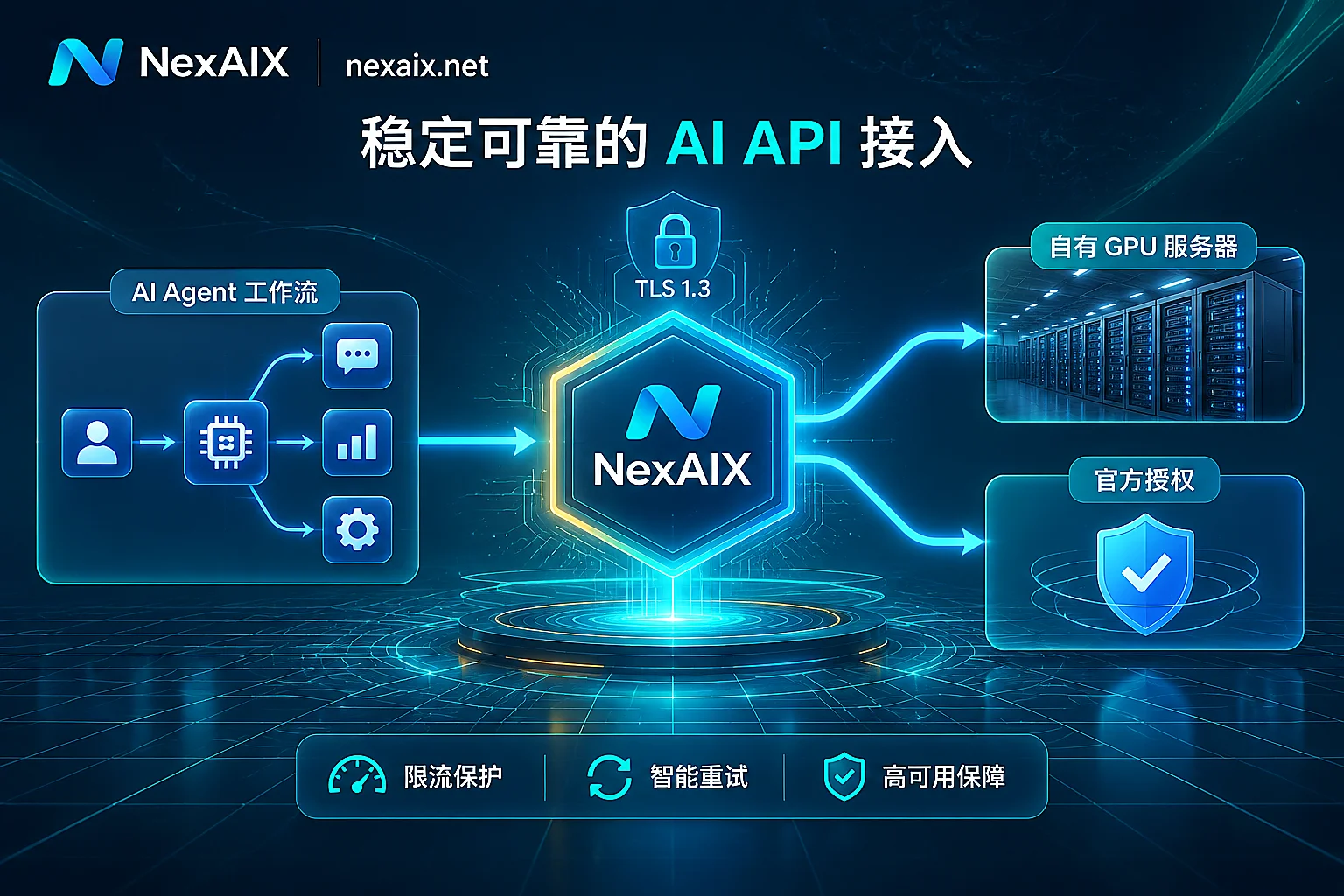
429status code with aRetry-Afterresponse header (see Rate Limiting and Throughput Description), allowing your business code to decide whether to back off and retry or switch to an alternative model. The platform will never arbitrarily redirect sensitive requests to other models in the background. (You can verify this in practice using "How to Confirm Whether an API Returns the Original Model: Four Verifiable Inspection Methods".)
2. Key-Based Isolation: Minimizing the Blast Radius of Credential Leakage
In several recently exposed security incidents, developers' API keys were leaked due to hardcoding in configuration files or theft by malicious plugins. If all microservices, test environments, and production Agents in the entire team share the same master key, once leaked, revoking the key will cause all business to halt.
In the NexAIX console, we support comprehensive Key-Based Isolation and Independent Billing Mechanism:
- Each API key has independent RPM/TPM quotas, independent permissions, and independent usage billing (billing is itemized by model).
- It is recommended to create multiple keys separated by "business module + environment (e.g.,
prod-agent-code-review,dev-chatbot)". Once a key is suspected of leakage, it can be revoked immediately without affecting the normal operation of other production pipelines. - Each call returns a unique Request ID. Since the platform does not retain conversation content, when troubleshooting, simply contact support with this Request ID to quickly locate the link status without exposing business privacy.
3. Enterprise-Level Compliance: Contracts, DPA Agreements, and Independent Resource Pools
For finance, healthcare, government, and going-global teams, technical "zero logs" also require the cooperation of legal documents and physical isolation.
- Legitimate business entity and agreement signing: NexAIX has a complete corporate entity, can sign formal contracts, issue compliant invoices, and supports signing service agreements and Data Processing Agreements (DPA), meeting enterprise internal audit and GDPR and other data protection compliance requirements.
- Custom open-source models and private deployment evaluation: If the open-source weight model you need is not in the current official model list, or if your scenario has extremely high data compliance requirements, you can directly email [email protected] to submit model requirements (with model and estimated usage) or discuss independent resource pools and private deployment solutions. Our architects will quickly reply with a schedule after evaluating compute.
Conclusion: Take Privacy Control into Your Own Hands
Competition in AI applications has entered deep waters. The stability of model calls and the certainty of data privacy determine whether your product can truly pass enterprise-level customer compliance and security audits. Rather than worrying about vague terms and unknown resale channels, it's better to rebuild your large model invocation layer today with transparent, self-checkable infrastructure.
Visit the NexAIX Console (api.nexaix.net) now, register with just an email—no cumbersome enterprise qualification review required, and you get free test credits upon registration. Get your dedicated API key and build a truly reliable privacy moat for your AI application with a single base_url switch.