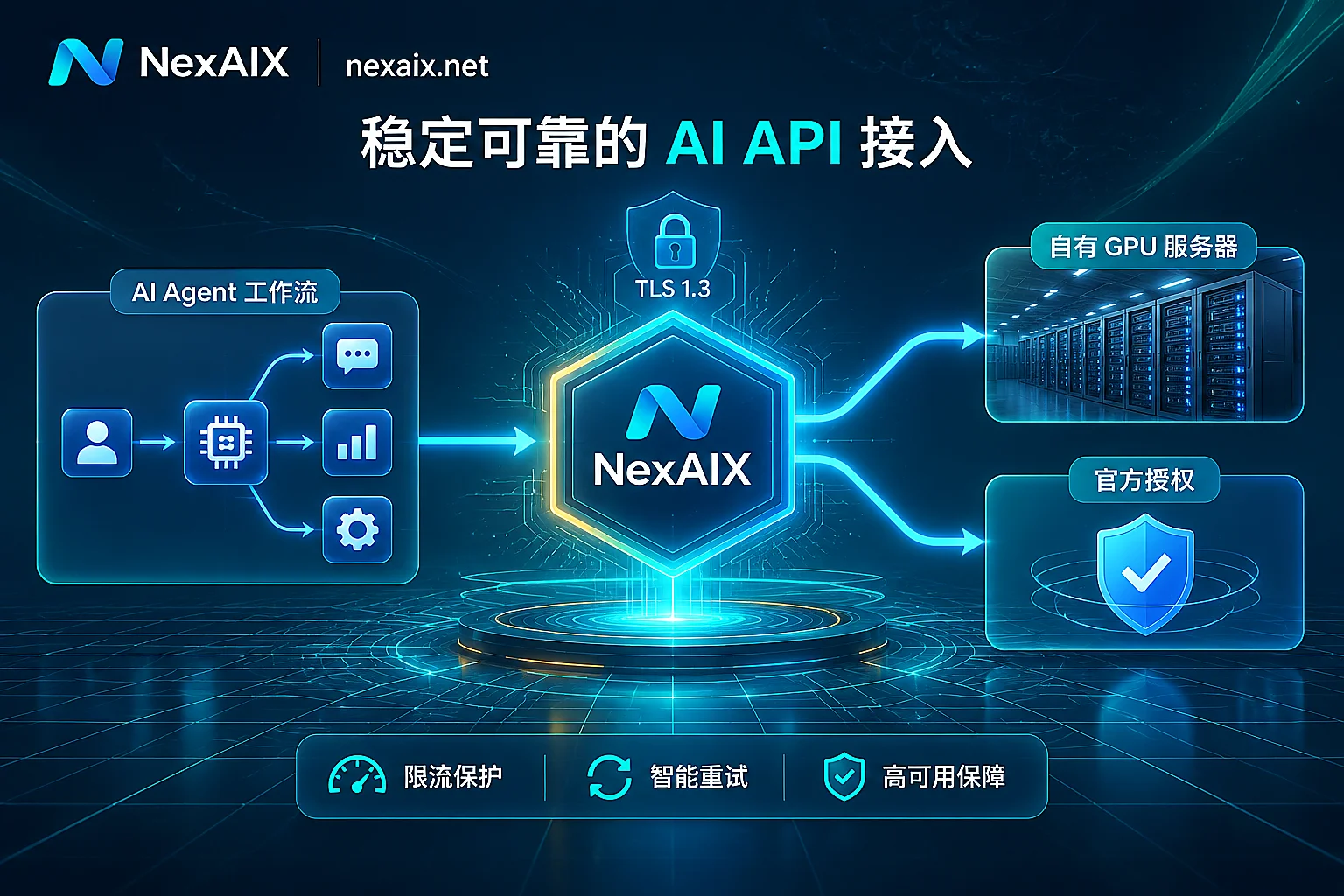
NexAIX-官方博客
A Production Guide to Stable AI APIs: Avoiding Agent Call-Chain Avalanches, Silent Degradation, and Hang Failures
In single-turn Q&A or simple text generation, an occasional hiccup in a large-model endpoint usually just means a user clicks "Regenerate" once. But in the 2026 production landscape, enterprise deployments have long since shifted to AI Agents built on multi-step reasoning and tool orchestration.
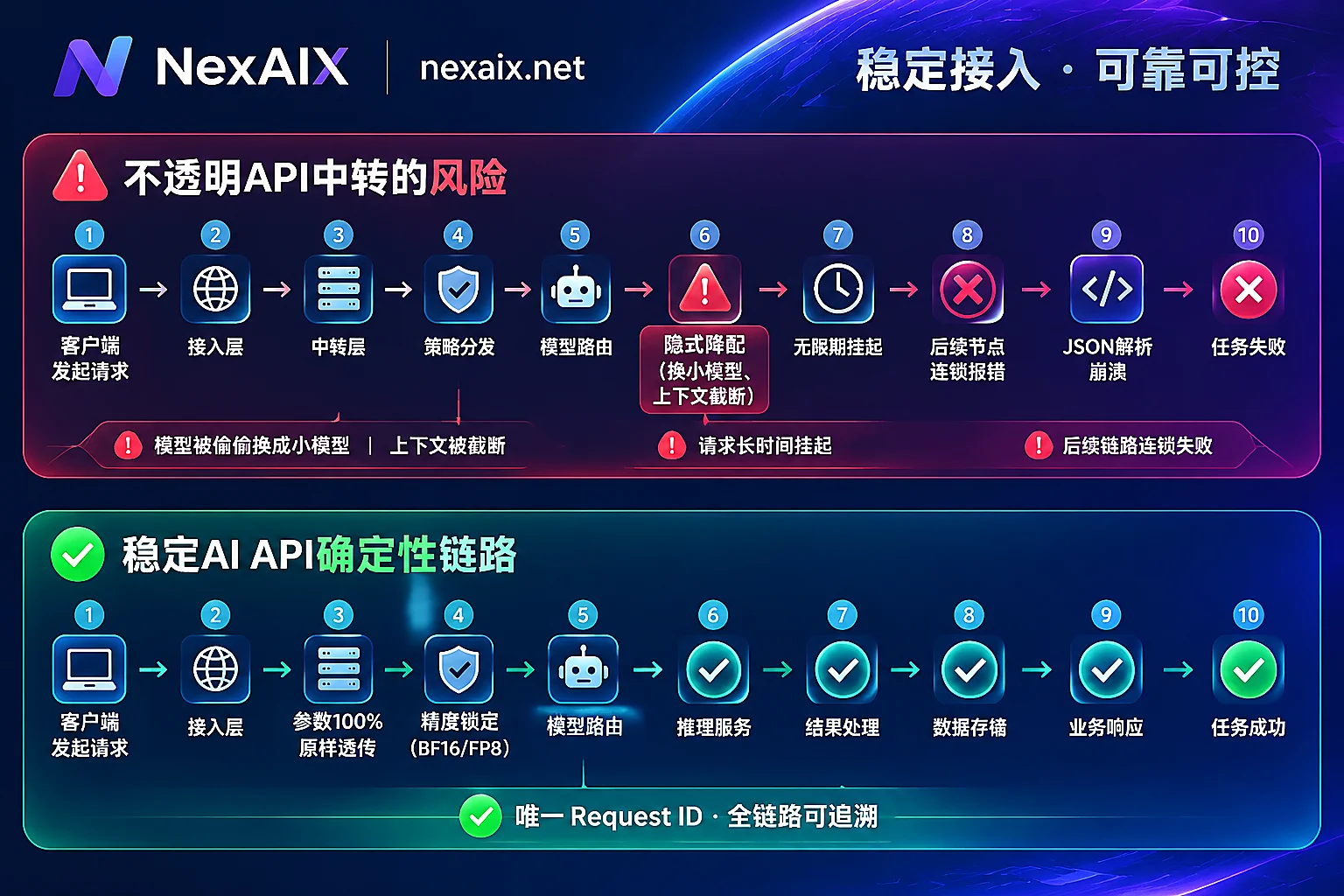
When a business request is split in the background into 10 to 20 consecutive model calls, function calls (Function Calling), and context backfills, tiny flaws in the underlying API are amplified exponentially. When investigating production incidents, engineering teams often find that what brings down an Agent system is usually not a clean, explicit error, but rather sudden outages caused by unclear upstream compute sources, "semantic collapse" triggered by gateways secretly swapping in smaller models during peak load, and connection pool exhaustion caused by indefinite hangs when requests are saturated.
To let complex applications converge smoothly in production, the criteria for evaluating a stable AI API must be upgraded from mere "connectivity rate" to the predictability of end-to-end behavior. This article starts from the engineering pain points of multi-step calls and breaks down the construction standards and practical solutions for a production-grade large-model API foundation.
1. Why Do Multi-Step Agents Place Such Extreme Demands on API Stability?
In traditional microservice architectures, API stability mainly concerns network latency and the HTTP 500 error rate. But in an Agent architecture driven by large models, inbound traffic and underlying LLM calls have a 1:N concurrency amplification relationship, and the system faces two highly destructive hidden failure modes:
1. Semantic-Level Failures Caused by Compute "Black Boxes"
If a single API call has a 2% anomaly rate, the probability that an Agent workflow with 15 steps completes successfully drops to $0.98^{15} \approx 73.8\%$. More critically, there is Silent Degradation: some opaque API resellers, in order to maintain seemingly "high availability" or cut costs during peak hours, dynamically truncate input context in the background, reduce model inference precision, or even secretly route requests destined for flagship models to cheap lightweight models.
For Agents that rely heavily on instruction following and structured JSON output, this kind of "bait-and-switch" does not trigger HTTP errors, yet it causes the model to suddenly omit required tool parameters at step 5, output malformed JSON, or lose critical state in long-context retrieval, ultimately triggering a logical avalanche across the entire business chain.
2. Indefinite Hangs and Client Retry Storms
Large-model inference is a long-running, resource-intensive operation. When upstream compute is saturated, if the server does not return throttling signals according to spec but instead leaves HTTP connections hanging for long periods (Hang), worker threads and connection pools on the business side are quickly exhausted. Once client timeouts trigger blind retries, a flood of multiplied backlogged requests pours in instantly, turning localized compute strain into global service paralysis.
2. Redefining the Four Engineering Cornerstones of a "Stable AI API"
Addressing the production pain points above, a truly stable AI API capable of supporting core business must provide deterministic engineering guarantees across four dimensions: compute source, parameter passthrough, flow control, and isolation with troubleshooting. This is also the baseline that NexAIX strictly follows when building API infrastructure:
1. Transparent Supply Sources: A Complete Break from Account Pools and Reverse-Engineered Protocols
Many online sudden disconnections stem from using gray-market relays based on personal account pool rotation (such as various sub2api solutions) or reverse-engineered client protocols (further reading: 2026 AI API Relay Selection and Pitfall Avoidance Guide). Such channels constantly face upstream account bans and policy risk controls.
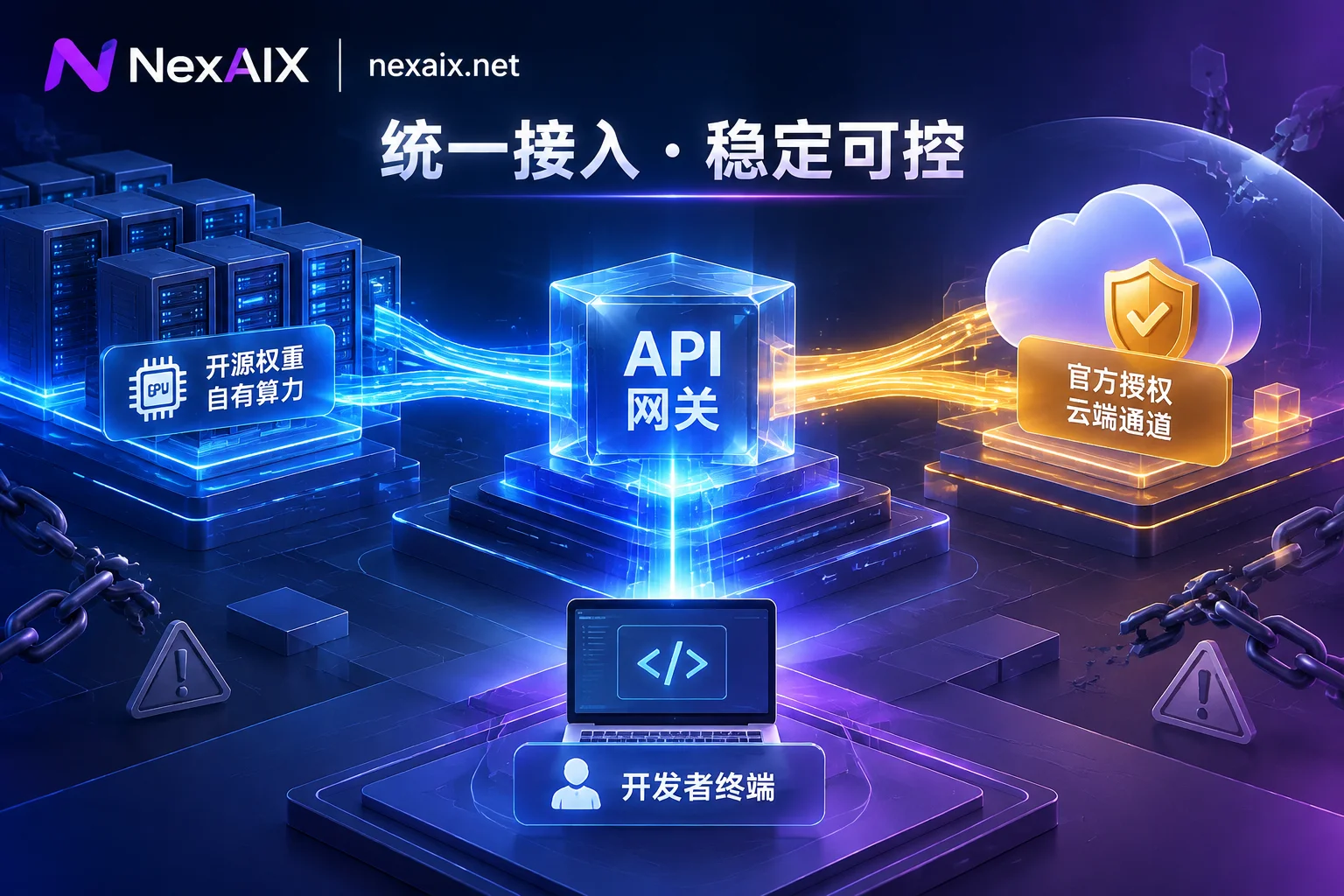
In NexAIX's supply system, all models use only two compliant, transparent supply methods (see Supply Transparency Statement):
- Self-operated compute deployment (open-source weights): For official open-source weight families such as Kimi, GLM, DeepSeek, MiniMax, Qwen, and gpt-oss, models are deployed directly on self-built and self-leased GPU clusters in our own data centers, operated and maintained by our team, and we never resell third-party quotas. Each model page clearly states the context window, maximum output, inference precision (such as BF16, FP8, MXFP4, etc.), and open-source license.
- Officially licensed channels (closed-source models): For closed-source commercial models such as Claude, GPT-5.6, Grok, and Gemini, all traffic goes through vendors' official commercial licensing channels, with formal contracts, invoices, and auditability. We never use account pools or reverse-engineered client protocols.
2. Faithful Execution Without Degradation: Ensuring Deterministic Inference Quality
To eliminate "semantic drift" in Agent chains, the API server must guarantee that every response comes from the exact original model specified by the developer. NexAIX strictly enforces the no-degradation standard:
- Model and precision fidelity: The
modelfield in the response body is the model that actually performed inference; we never secretly substitute smaller models or lower the advertised inference precision. - Zero tampering with parameters and context: We do not truncate the advertised context length or maximum output limits, and we do not inject any hidden System Prompts; core hyperparameters passed by the client such as
temperature,top_p, andmax_tokensare passed through verbatim to the inference nodes. - Verifiable at any time: Engineering teams can cross-validate at any time using four methods: retesting with fixed prompts and random seeds, checking the
modelfield in the response body, running length stress tests near the limits, or asking the model to repeat all messages it received (see How to Confirm Whether an API Returns the Original Model).
3. Predictable Backpressure Control: Standard 429 and Retry-After
Facing sudden traffic spikes, a stable API should not perform "black-box" automatic degradation, but should send clear backpressure signals to the client.
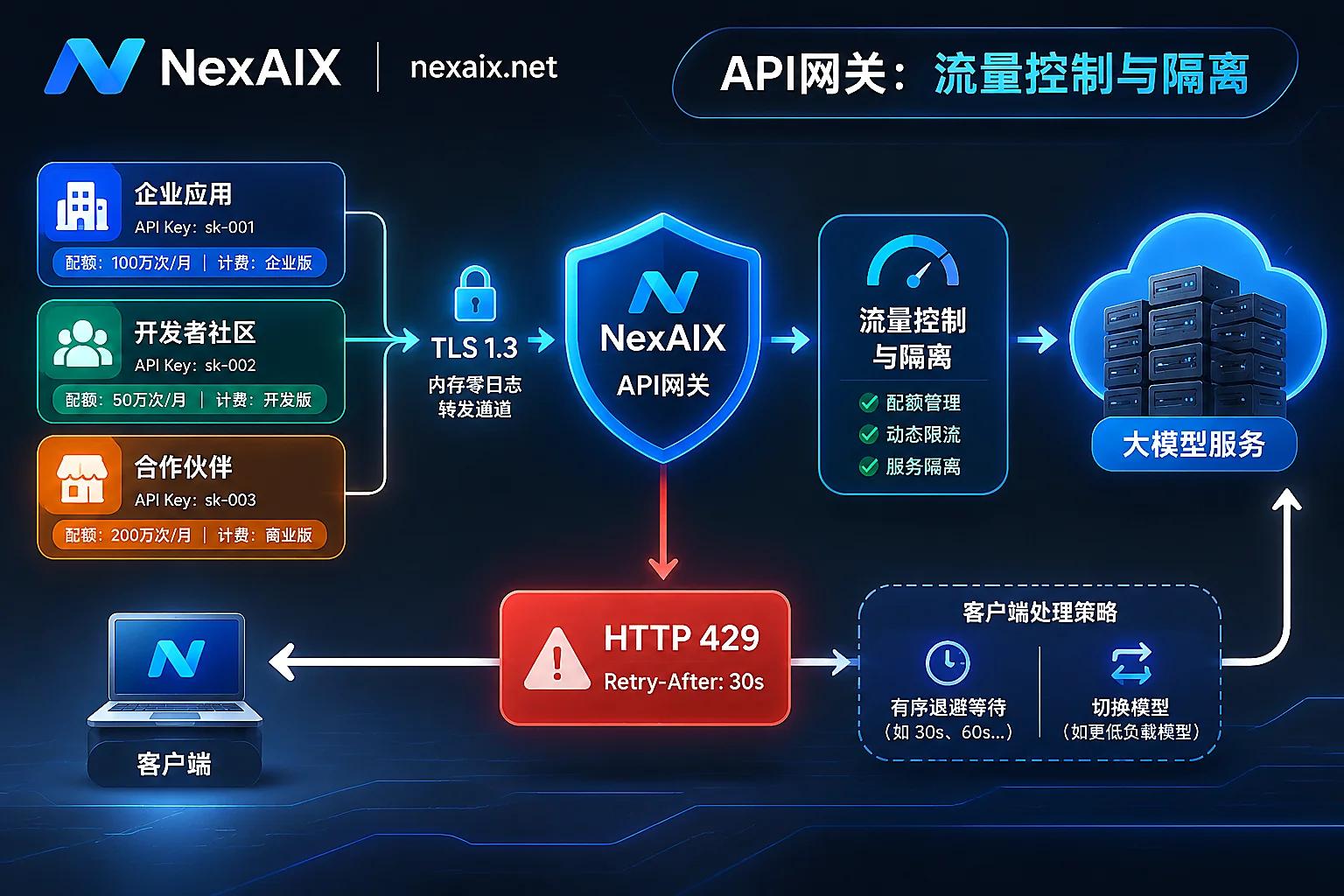
In NexAIX's throughput and rate-limiting mechanism, open-source model capacity is supported by self-operated GPU clusters, while closed-source models are constrained by upstream quotas. Each API Key has independent RPM (requests per minute), TPM (tokens per minute), and concurrency limits (contact us for capacity evaluation if you need higher quotas). When compute is saturated or a rate limit is triggered, the system immediately returns a standard HTTP 429 status code and includes an explicit Retry-After wait time in the response headers.
The server will never leave requests hanging indefinitely and occupying client connections, nor will it unilaterally and secretly forward requests to cheaper models. Control is returned to the business architecture: the developer's orchestration layer decides, based on business priority, whether to back off and wait according to Retry-After, place the request in an asynchronous queue, or explicitly switch to a fallback model.
4. In-Memory Zero-Log Forwarding and Multi-Key Isolation Governance
Production stability also encompasses security compliance and fault isolation:
- Conversation content never touches disk: On the NexAIX side, the
promptandcompletionof requests are forwarded only in memory and released immediately when the request ends; they are never written to disk, never used for model training, and never handed to any third party that does training; the entire path from client to inference node uses TLS 1.3 encryption (see Zero Logging and Privacy Protection). For closed-source models, data retention after requests reach the upstream vendor is governed by each vendor's terms (currently only two Claude model pages separately state upstream retention policies: Opus 5 supports zero data retention, while Fable 5 currently has 30-day retention). - Per-Key isolation and precise troubleshooting: You can create multiple API Keys, each with independent quotas, independent permissions, and independent per-model usage billing. If a Key for one business module is leaked or used abnormally, it can be revoked separately without affecting other core services (reference: High Availability and Security Guide for LLM APIs in Production). Meanwhile, the system retains only basic metadata such as request ID, model name, token counts, timestamps, and status codes; every call returns a unique request ID, so online troubleshooting only requires carrying that ID to quickly locate the link status.
3. Production Integration in Practice: Robust Calling Code That Honors Retry-After
NexAIX is implemented strictly according to the OpenAI Chat Completions specification, fully supporting streaming output (Streaming), function/tool calling, multi-turn conversations, and multimodal input (images are passed in standard format via image_url or base64; videos are passed as sequences of extracted frames).
For teams already using the OpenAI SDK, LangChain, LlamaIndex, Vercel AI SDK, or tools such as Dify, Cherry Studio, NextChat, Cline, and OneAPI, simply change base_url to https://api.nexaix.net/v1 and swap in a NexAIX Key, and you can use one Key to call all enabled open-source and closed-source models on the platform (see Quick Start Guide).
Below is a production-oriented Python example. It shows how to seamlessly switch models through a single endpoint, strictly read the Retry-After response header to back off and retry when hitting a 429 rate limit, and log the request ID for production troubleshooting:
import time
import random
from openai import OpenAI, RateLimitError, APIStatusError

# 仅需修改 base_url 和 api_key 即可无缝迁移现有项目
client = OpenAI(
    base_url="https://api.nexaix.net/v1",
    api_key="sk-your-nexaix-key",
    timeout=60.0,       # 显式设置客户端超时,防止异常网络挂起
    max_retries=0       # 关闭 SDK 默认盲目重试,由业务层精准控制 Retry-After
)

def call_llm_reliably(model_id: str, messages: list, max_attempts: int = 4):
    """
    生产级调用封装:遵循 Retry-After 背压信号,记录请求 ID,支持显式切换模型
    """
    for attempt in range(1, max_attempts + 1):
        try:
            response = client.chat.completions.create(
                model=model_id,
                messages=messages,
                temperature=0.2,
                max_tokens=2048,
                stream=False  # 生产环境长文本建议开启 stream=True 降低首字等待焦虑
            )
            # 核对返回体中的实际执行模型,确保未发生隐式降配
            actual_model = response.model
            request_id = response.id
            print(f"[Success] Model: {actual_model} | Request ID: {request_id}")
            return response.choices[0].message.content

        except RateLimitError as e:
            # 捕获标准 429 响应,优先读取服务端返回的 Retry-After 头部
            retry_after_str = e.response.headers.get("Retry-After") if e.response else None
            if retry_after_str and retry_after_str.isdigit():
                wait_seconds = int(retry_after_str) + random.uniform(0.1, 1.0)
            else:
                # 兜底:指数退避 + 随机抖动 (Jitter)
                wait_seconds = min((2 ** attempt) + random.uniform(0, 1), 30)

            req_id = e.request_id or "unknown"
            print(f"[429 RateLimit] Attempt {attempt}/{max_attempts} | Request ID: {req_id}. "
                  f"Waiting {wait_seconds:.2f}s before retry...")

            if attempt == max_attempts:
                raise RuntimeError(f"Max retries reached for {model_id}. Last Request ID: {req_id}") from e
            time.sleep(wait_seconds)

        except APIStatusError as e:
            # 捕获其他 HTTP 状态码异常,保留请求 ID 供快速排障
            print(f"[API Error] Status: {e.status_code} | Request ID: {e.request_id} | Message: {e.message}")
            raise

# 示例:同一套代码,仅修改 model 字段即可在开源集群与闭源授权模型间切换
if __name__ == "__main__":
    prompt_messages = [{"role": "user", "content": "请输出一段用于解析订单状态的 JSON Schema。"}]

    # 调用自有算力部署的开源权重模型(注意:请求中 model 字段保留原始点号,如 glm-5.2)
    result = call_llm_reliably(model_id="glm-5.2", messages=prompt_messages)
    print(result)
Engineering tip: When browsing the model list and individual model detail pages, note that the URL slug replaces dots in the model ID with hyphens (for example, visithttps://nexaix.net/models/glm-5-2/to view context, inference precision, and three-step integration code; directly appending/models/glm-5.2/returns a 404). However, in API request code, themodelfield must still be filled with the standardglm-5.2. In addition, in very long input scenarios, first-token latency and cost naturally rise with input length, so we recommend enabling streaming output (stream=True) throughout production code.
4. Architect's Pre-Launch API Stability Checklist
Before pushing an AI application or Agent workflow to production, technical leads are advised to complete foundation acceptance against the following checklist:
| Check dimension | Common pitfalls of low-quality/gray-market relays | Production-grade stable API standard (NexAIX) | Recommended business-side architecture support |
|---|---|---|---|
| Compute and channel compliance | Personal account pool rotation and reverse-engineered web protocols, facing large-scale bans and outages at any time | Self-operated compute deployment (open-source weights on self-built/self-leased GPU clusters) + officially licensed channels (closed-source commercial contracts, invoicing, auditability) | Combine open-source and closed-source models by task complexity, and verify supply tags and licenses in the model catalog |
| Inference quality consistency | Secretly switching to lower-spec models during peak hours, truncating context, tampering with system prompts | 100% verbatim passthrough without degradation; the model in the response body is the actual executing model, with precision such as BF16/FP8/MXFP4 stated | Run fixed-seed retests and extreme-length stress tests before launch to ensure long-chain Agent logic does not drift |
| Overload and rate-limiting behavior | Connections hang for long periods without returning, or requests are secretly routed to cheap models to make do | Immediately return standard HTTP 429 with Retry-After when saturated; never hang or silently switch models | Disable blind retries on the client, read Retry-After to back off, or have the business layer explicitly decide to switch to a fallback model |
| Security isolation and observability | A single Key shared across all services, plaintext conversation logs, no traceability credentials on errors | In-memory forwarding without disk writes (TLS 1.3 encryption); per-Key independent quotas and itemized billing; every call returns a unique request ID | Split independent Keys by environment (Dev/Prod) or microservice, and mandatorily log the request ID of each call in structured logs |
5. Conclusion: Leave Determinism to the Foundation, Creativity to the Business
Large models evolve extremely fast, but production requirements for stability, compliance, and transparency never change. Rather than having your engineering team spend energy responding to upstream account bans and hunting down bizarre bugs caused by silent degradation, choose an API infrastructure with clear boundaries and predictable behavior from the start.
You can now visit the NexAIX Console and register for free with your email—no cumbersome enterprise qualification review required, free trial credits upon registration, and you can obtain an API Key within minutes to complete real-machine validation and export usage details.
If your team or enterprise needs to sign a formal commercial contract, issue VAT invoices, sign a Service Level Agreement (SLA) and Data Processing Agreement (DPA), or has scheduling requirements for open-source weight models not on the list, independent resource pools, or private deployment needs, feel free to email [email protected] (please include estimated usage or a description of your compliance scenario), and our engineering team will provide one-on-one evaluation and support based on actual compute capacity.