 NexAIX-官方博客
Bottom Line First: Async Multimodal Interfaces Differ from Sync Text Interfaces in Only Four Ways
Integrating multimodal APIs for video generation, the core is accepting one fact: you cannot wait for a single request like text interfaces. The differences between async video interfaces and sync text interfaces can be compressed into four points: the response semantics change from "complete result" to "task ID", status requires client-side polling, terminal state classification is more complex (queued, running, completed, failed, expired), and the output is a temporary URL that must be persisted promptly. This pattern is becoming the industry default—on August 25, 2026, OpenRouter launched a unified Video Generation API that consolidates submission, query, and download logic for different video models into a single async specification.
Why Video Generation Can't Use the Request-and-Wait Model
Single video generation typically takes tens of seconds to minutes. If you use the synchronous Chat Completions model where the request hangs until return, long connections are prone to hitting gateway timeouts (like Vercel/Lambda's 30-60 second limits) and network interruptions. Therefore, mainstream platforms (OpenRouter, SiliconFlow, Fal.ai) have chosen decoupled chains: submission immediately returns 200/202, and clients retrieve results via polling or webhooks. What's the difference between async task APIs and sync interfaces? In short, sync interfaces put the waiting cost on the caller's connection, while async interfaces transfer that cost to the server-side queue and client-side polling logic, resulting in higher reliability and scalability.
Step 1: Submit Task—Parameters, Business Serial Number, and When to Persist the Task ID
Two key engineering decisions in the submission phase: whether to persist first then submit, or submit then persist. Recommended approach: first create a placeholder in your local task table using a business serial number (e.g., UUID) with status CREATED, then call the submission endpoint. Once you get the task ID, immediately update the local record. This way, even if the network fails after submission, you can identify tasks that may have been submitted but didn't get an ID, facilitating gap analysis. The task ID (sometimes called requestId) and polling endpoint must be persisted in corresponding fields of the task table.
Note that there is currently no unified standard idempotency header across platforms (e.g., mandatory Idempotency-Key). Although OpenRouter and others standardize the interface, each vendor's deduplication implementation varies. So deduplication must be guaranteed by your application-layer task state machine, not relying on platform filtering of duplicate submissions. Authentication for synchronous chains can be reused, but deduplication for async tasks needs separate handling.
Step 2: Polling—State Machine Design, Intervals, and Exponential Backoff
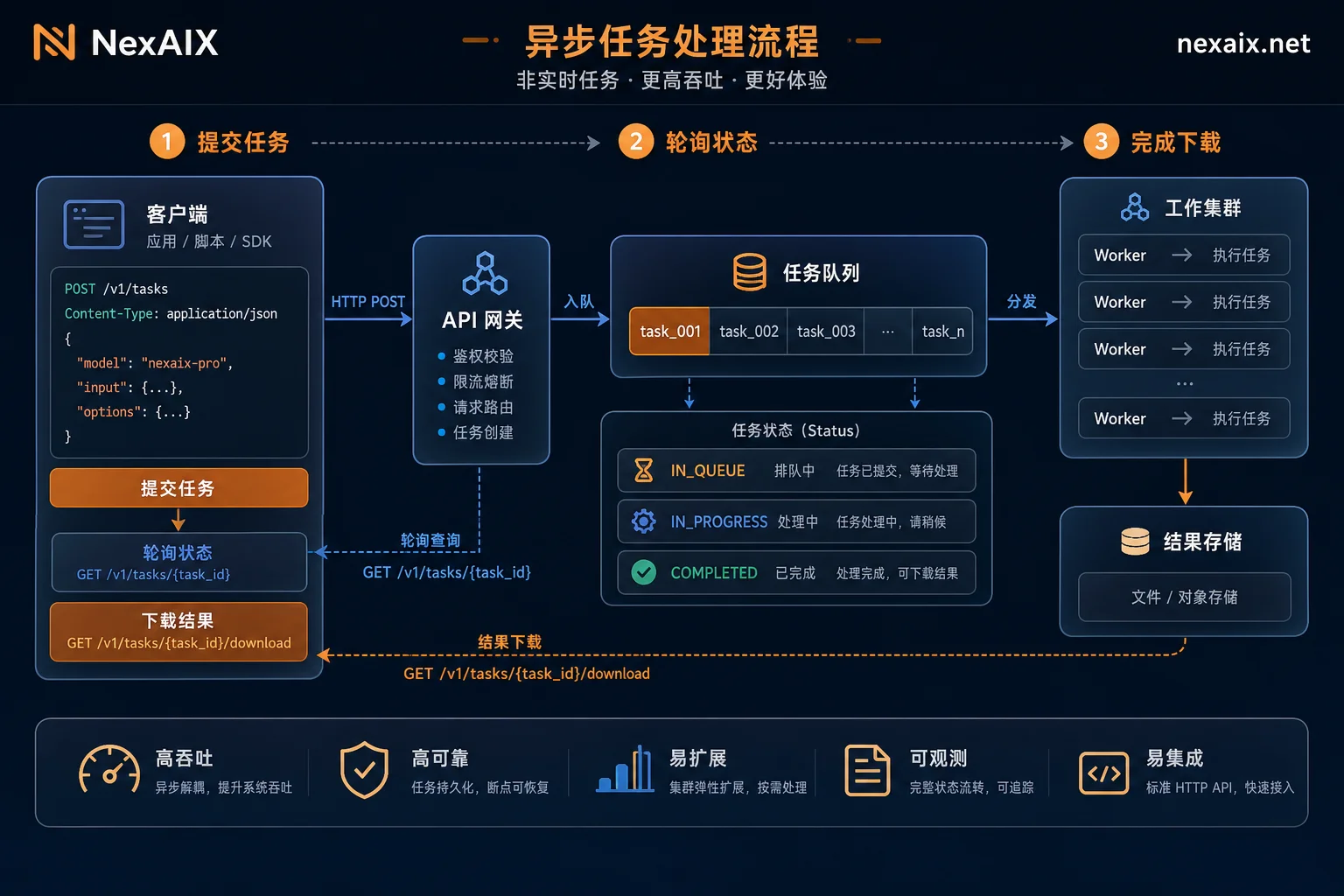
The core of polling is the state machine. Async task states typically include: queued (IN_QUEUE / queued), in progress (IN_PROGRESS / in_progress), completed (COMPLETED / completed), and abnormal terminal states (FAILED / failed / expired / cancelled). After getting the task ID, the client periodically queries the status endpoint.
How many seconds to set your polling interval depends on the task duration distribution—exponential backoff better balances first-screen response and rate limiting risk than fixed intervals. There is no official baseline; you must measure based on your own task expected duration. General principle: interval increases with expected task duration, e.g., start at 1 second, max 30 seconds, doubling after each poll until reaching the cap. This effectively avoids triggering gateway 429 Too Many Requests rate limits. Below is a minimal polling skeleton (Python-style pseudocode):
import time

def poll_task(task_id, max_wait=600, initial_interval=1, max_interval=30):
    interval = initial_interval
    waited = 0
    while waited < max_wait:
        status = query_status(task_id)
        if status in ('COMPLETED', 'FAILED', 'EXPIRED', 'CANCELLED'):
            return status
        time.sleep(interval)
        waited += interval
        interval = min(interval * 2, max_interval)
    return 'TIMEOUT'
If the platform supports webhooks, prefer webhooks to reduce useless polling, but keep polling as a fallback.
Step 3: Terminal State Handling—Immediate Output Transfer, Classify Failures Before Retrying
When the status becomes COMPLETED, you receive a temporary output URL. A common pitfall: some platforms' temporary output links have a lifespan of only minutes (e.g., SiliconFlow has been observed at ~10 minutes); refer to current platform docs for specifics, and test before integration. Business systems must never assume third-party URLs are permanently readable. The correct approach: immediately stream-download in the terminal state callback, transfer to your own private object storage, and update the task record with the output address.
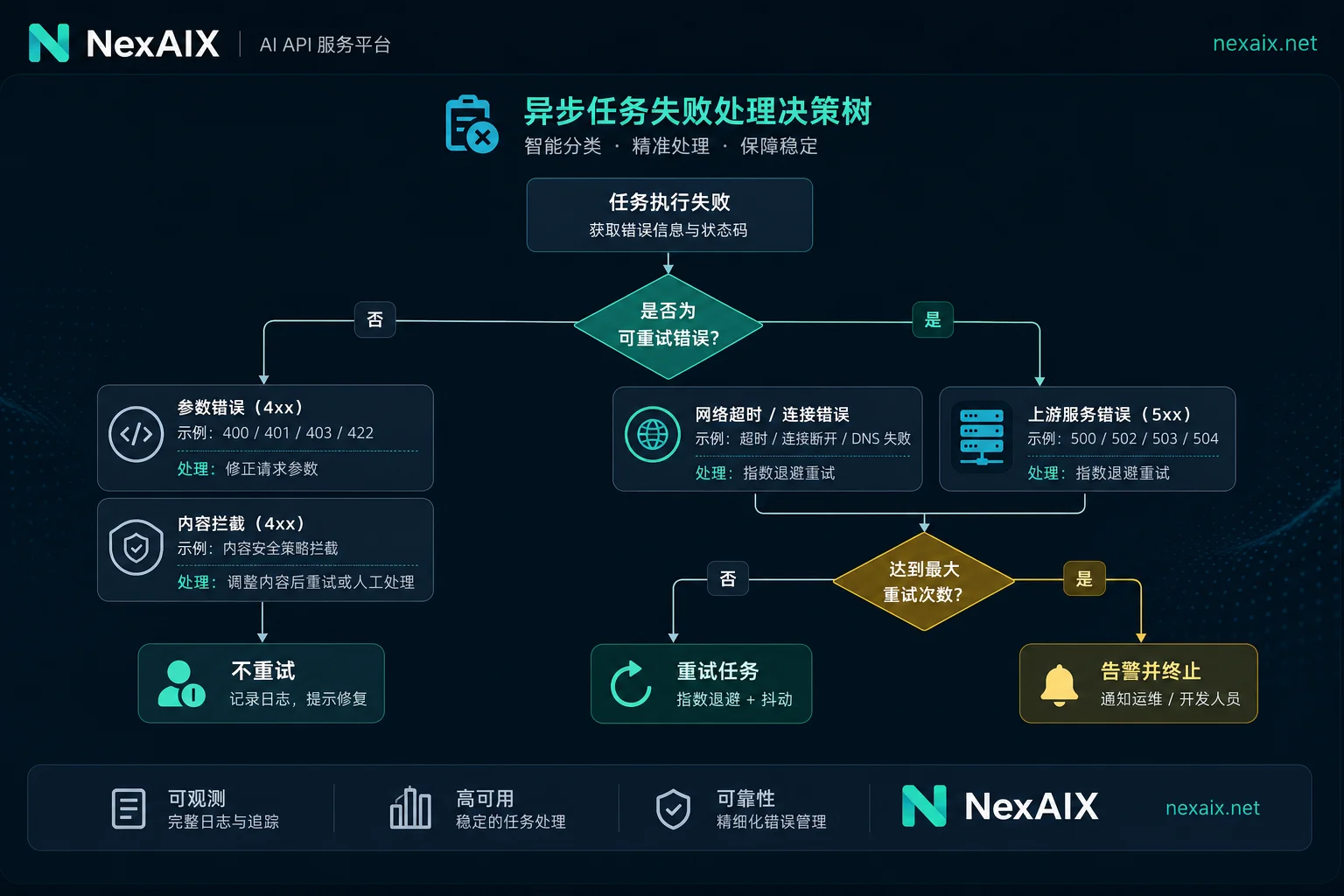
If the status is FAILED or another abnormal terminal state, don't rush to retry. First classify: parameter errors (4xx), content blocking, upstream timeouts, queue anomalies. Only retry non-deterministic failures (e.g., upstream 5xx, network jitter), and must create a new task record with a new business serial number to avoid duplicate billing. For content blocking, retrying won't help; adjust the prompt. For parameter errors, refer to Claude API 400 troubleshooting to locate the issue.
On whether to auto-retry multimodal API failures, the rule of thumb is: only retry tasks that might fail due to bad luck, not those with request issues. Clients must distinguish between these two categories.
Step 4: Timeout and Quota—Task-Level Maximum Timeout, Concurrent Task Count, and Queue Backlog Fallback
You must set defensive limits on the client, not rely on platform. First, task-level maximum wait time: e.g., 10 minutes; if exceeded, mark as TIMEOUT and enter dead-letter handling (manual intervention or later compensation). Second, concurrent in-flight tasks: the number of tasks being polled simultaneously must not grow indefinitely, lest you overwhelm your own service. Third, backlog degradation: when queue backlog exceeds a threshold, reject new tasks or go async batch processing.
There's a factual boundary: platform-side global fallback thresholds under extreme queueing have no unified public benchmark, and currently no publicly available official baseline. OpenRouter's guide also doesn't give specific seconds. So these limits must be coded into your own code as engineering defenses. If you've already accumulated 429 backoff handling experience from synchronous chains, you can fully reuse that.
After Unified Protocol Convergence, What Variables Remain for Selection?
When multi-vendor models are abstracted into the same submit-poll-download loop, the integration code cost drops significantly, and the selection variables shift to these metrics:
| Metric | Description | Need Self-Test? |
|---|---|---|
| Queue Wait Time | Time from submission to execution start | Yes |
| Output Link Lifespan | Time from completion to link expiration | Yes |
| Failure Explainability | Whether error codes are clear and localizable | Yes |
| Quota and Status Transparency | Whether queue/execution status is clearly displayed | Yes |
These four items are not marketing promises; they are metrics you must re-test in a gray environment before integration.
How One Codebase Covers Multiple Modalities and Multiple Models
Authentication, timeout, 429 backoff, and request ID troubleshooting strategies from synchronous chains can be naturally reused in async task submission and polling wrappers. NexAIX offers an OpenAI Chat Completions compatible interface (base_url https://api.nexaix.net/v1),支持流式输出与函数/工具调用;满载时返回标准 429 and retry recommendations, without silently switching models; the returned body's model field indicates the actual model executed, facilitating attribution of in-flight tasks to specific models. Supported models and modality capabilities are subject to NexAIX's current model page and changelog.
Parts Still Without Standard Answers: Queue Timeout and Retry Idempotency Require Self-Testing
Across vendors, async task deduplication implementations vary; there is no mandatory unified idempotency header or deduplication window. Global queue abandonment thresholds under extreme backlog also lack public benchmarks. So before integration, do minimal self-tests:
- Submit twice with the same business serial number and observe whether the platform deduplicates;
- After reconnecting from a network outage, resume polling and see if the task status is still queryable;
- Long-queue stress test: submit tasks exceeding your usual concurrency to observe queue performance and timeout behavior.
These can only be validated in your own environment.
Pre-Integration Must-Run Multimodal API Regression Checklist
| Check Item | Expected Behavior | Notes |
|---|---|---|
| Submission Idempotency | Duplicate submission produces no duplicate task | Implement at application layer |
| Task ID Persistence | Status queryable after restart | Must persist to DB |
| Complete State Mapping | All status codes have corresponding handling | Including expired/cancelled |
| Backoff Effective | Polling interval increases, no 429 | Observe logs |
| 429 vs 5xx Differentiation | 429 triggers backoff, 5xx may retry | Consistent with sync chain strategy |
| Output Transfer Success Rate | URL downloadable promptly after completion | Monitor download failure rate |
| Task Timeout and Dead Letter | Timeout tasks enter quarantine | Manual intervention |
| Concurrency Limit | In-flight task count controlled | Prevent overwhelming own service |
| Observability Fields | requestId, model, statusCode | Facilitate troubleshooting |
After running the checklist, remember to check NexAIX's model page and docs for current available models and rate limits.
FAQ
Why is my video generation task stuck pending?
Pending usually means the task is in queue, but if it stays unchanged for a long time, it might be stuck. First check if it's actually in queue status (IN_QUEUE) and ensure your polling logic isn't missing checks due to overly large backoff intervals. If it hasn't changed beyond your maximum wait time, submit a ticket or consider cancellation and retry.
What polling interval should I set?
These are engineering values, not official platform benchmarks. General advice: start at 1 second, back off exponentially to 30 seconds, but adjust based on your task's average duration. If the average is 60 seconds, low-frequency polling for the first 30 seconds, then speed up. Final parameters depend on your own task duration distribution and rate limit logs.
Should multimodal API call failures be retried automatically?
It depends: parameter errors (4xx) or content blocking should not be retried; modify the request. Non-deterministic failures like network timeouts or 5xx can be retried, but limit attempts (e.g., 3 times) and each retry must create a new task record with a new serial number to avoid duplicate billing.
Do video generation API returned links expire?
Yes. Some platforms' temporary output links have a lifespan of only minutes (e.g., SiliconFlow observed ~10 minutes); refer to current docs and test before integration. Regardless of platform promises, you should immediately stream-download after task completion and transfer to your own object storage; don't store third-party URLs long-term.
Can I directly reuse sync chain authentication and retry strategies for async tasks?
Authentication can be reused, but retry strategies must change: sync chain retry means re-requesting, async chain means creating a new task; idempotency is completely different. Polling and backoff logic need separate implementation; you can't directly reuse. Refer to tool call API writing to understand sync calling style, then grasp the differences.


Comments(0)